 Whalesbook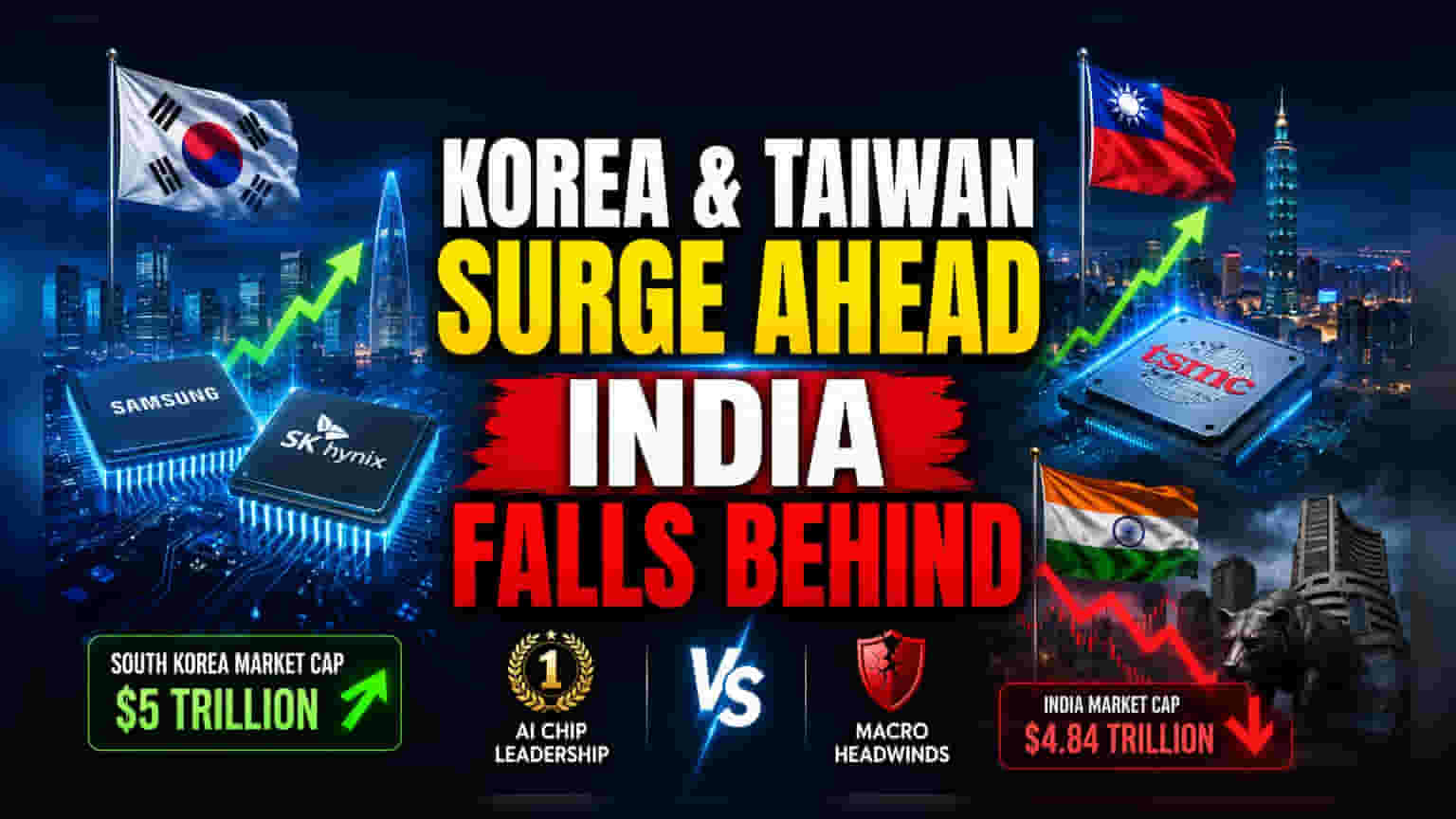


The Semiconductor Squeeze
The hierarchy of global equity markets has undergone a structural realignment as capital decisively rotates toward the architects of the artificial intelligence infrastructure. South Korea and Taiwan have solidified their positions as the primary beneficiaries of this transformation, with both nations surpassing India in total market capitalization. This shift is not merely a transient data point but reflects a profound divergence between markets embedded in the semiconductor supply chain and those relying on traditional consumption and financial sectors.
The Concentration Risk
South Korea’s ascent to a $5 trillion market valuation has been an exercise in extreme index concentration. The rally is fundamentally powered by Samsung Electronics and SK Hynix, both of which have joined the exclusive trillion-dollar club on the back of explosive demand for high-bandwidth memory chips. In a similar vein, Taiwan’s valuation of approximately $5.15 trillion remains tethered to the massive footprint of Taiwan Semiconductor Manufacturing Company (TSMC), which accounts for nearly half of its exchange weight. While this concentration has catalyzed massive year-to-date gains, it creates a narrow dependency; the performance of these entire nations is now intrinsically linked to the continuous growth of AI data center capital expenditures.
The Indian Macro Headwinds
India, now the seventh-largest equity market at roughly $4.84 trillion, finds itself caught in an antithetical environment. The domestic market has struggled with a confluence of negative pressures, including consistent foreign institutional investor outflows, the drag of a weaker rupee, and the burden of elevated crude oil prices. Unlike its East Asian peers, which leverage their dominance in hardware manufacturing to capture the "AI impulse," India’s benchmark indices—the Nifty and Sensex—have faced double-digit declines in 2026. The absence of a large-scale, domestically listed semiconductor manufacturing ecosystem has rendered the Indian market an effective spectator in the most significant investment cycle of the decade.
Structural Vulnerabilities
Investors must weigh the sustainability of this current market order against underlying risks. While the surge in Korea and Taiwan showcases the rewards of long-term industrial policy, the concentration of these markets invites significant downside vulnerability should AI investment cycles peak or should memory chip pricing face cyclical volatility. Furthermore, the reliance of these tech-heavy hubs on external demand makes them sensitive to geopolitical tensions, particularly regarding semiconductor trade. Conversely, India’s challenge is structural; its struggle to integrate into the global hardware supply chain leaves it lacking a defensive tech-sector moat, necessitating a shift toward broader manufacturing integration if it intends to reclaim its previous status as a top-five global equity market.