

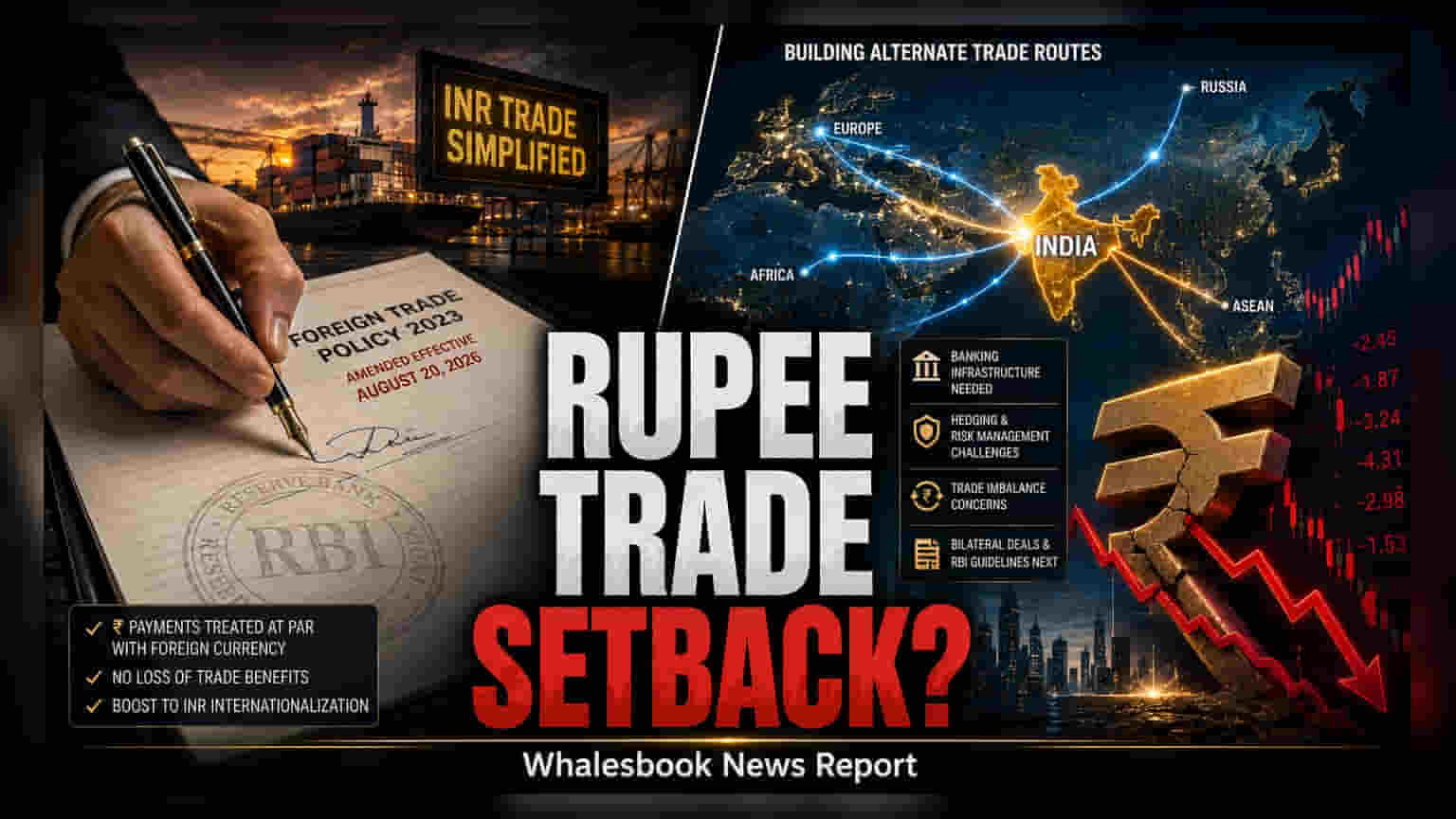
The DGFT has aligned rupee-based export receipts with foreign currency earnings, allowing exporters to claim trade incentives for INR payments. While this removes a major regulatory hurdle, experts warn that mass adoption depends on building better banking support, easier access to rupees for foreign buyers, and affordable hedging tools to manage currency risk.
The Directorate General of Foreign Trade (DGFT) has amended the Foreign Trade Policy (FTP) 2023 to simplify international trade using the Indian Rupee (INR). Effective August 20, 2026, export payments received in Indian Rupees are now treated at par with foreign-currency earnings. This change is designed to encourage exporters to invoice in rupees by ensuring they do not lose out on government trade benefits or export obligation fulfillment.
Removing the Regulatory Roadblock
Previously, Indian exporters faced uncertainty regarding whether rupee-denominated receipts would qualify for various Foreign Trade Policy incentives. By explicitly aligning these receipts with foreign-currency earnings, the government has removed a key barrier that discouraged traders from moving away from the U.S. dollar. This step is a strategic effort to promote the internationalization of the rupee and reduce dependence on major global currencies for trade.
Why Infrastructure Matters More Than Rules
While the industry has welcomed the move, experts from the Global Trade Research Initiative (GTRI) caution that regulatory permission is only the first step. For rupee trade to scale up, the ecosystem around the currency must evolve. The primary challenge is that foreign buyers, such as importers in Europe or Africa, may find it difficult to procure large volumes of Indian rupees to pay for their imports.
Similarly, overseas banks and financial institutions need clear, practical options to manage these rupee balances. If a foreign bank accumulates excess rupees from trade, it needs an efficient way to use, invest, convert, or repatriate those funds back to its home country. Without these mechanisms, the rupee may struggle to compete with the ease and liquidity provided by the U.S. dollar or the Euro.
Managing Commercial Risks
Beyond banking infrastructure, exporters also face commercial risks when trading in local currency. International trade is built on the ability to hedge—or protect—against the risk of currency values changing over time. Exporters are currently concerned about the lack of affordable, mature hedging tools for rupee trade that are as reliable as those available for dollar-denominated contracts.
Additionally, there is the risk of trade imbalance. If India imports less from a specific country than it exports, that partner country may end up with a surplus of unused rupees. These countries need the freedom to use these funds in other ways to ensure they are not stuck holding a currency they cannot easily convert.
What Investors Should Track
For investors monitoring the impact of this policy, the next stage of development will be the creation of bilateral trade agreements. The focus will likely shift to the Reserve Bank of India (RBI) and the Ministry of Commerce introducing standardized banking procedures, including clear guidelines for documentation, Know Your Customer (KYC) norms, and simplified settlement timelines. The success of this initiative will depend on how quickly these support systems are established to make rupee invoicing a standard, rather than a niche, practice.