

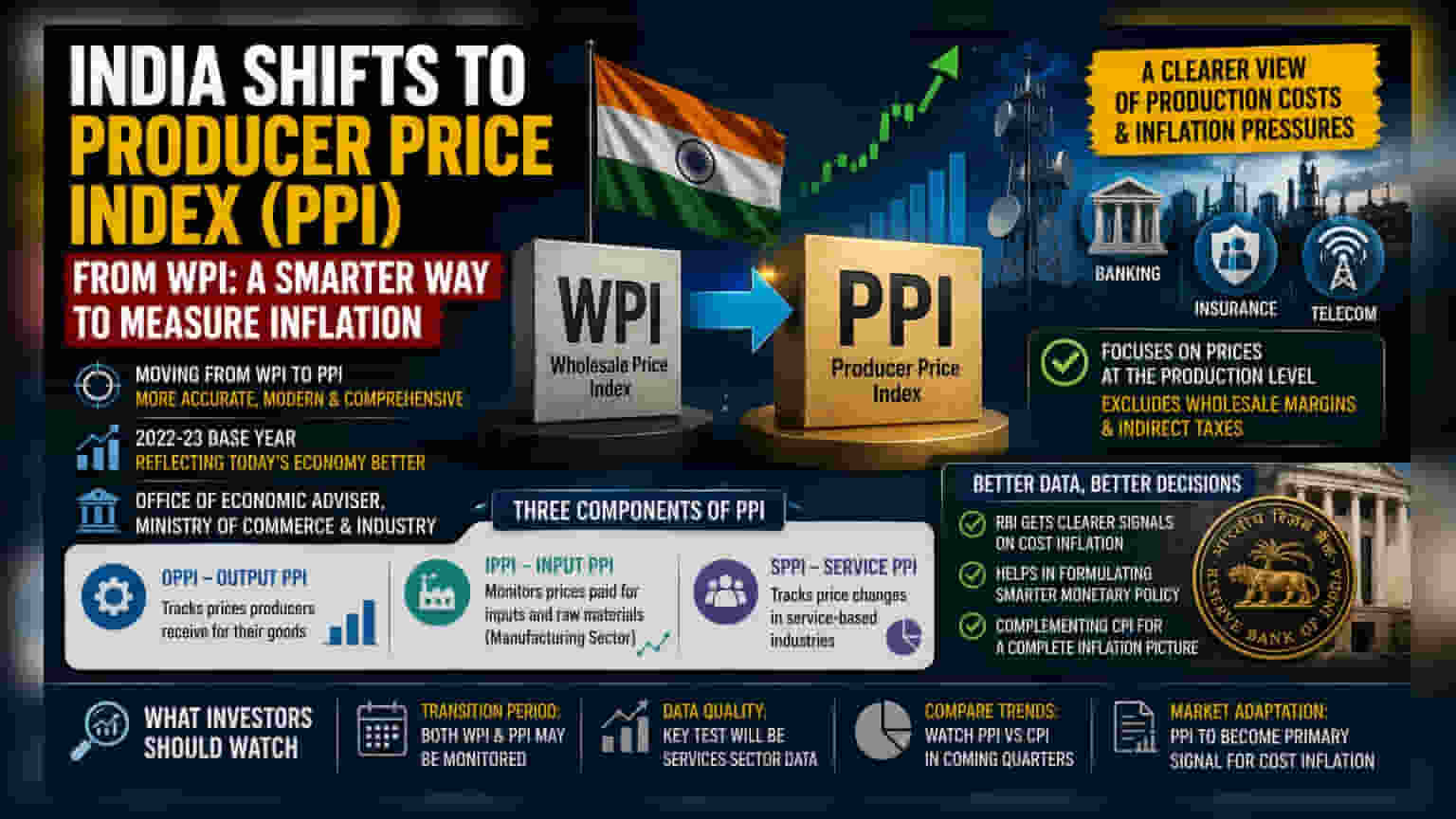
India is transitioning from the Wholesale Price Index (WPI) to the Producer Price Index (PPI) to gain more accurate inflation data. This new framework tracks prices at the factory gate and includes the services sector, providing businesses and policymakers with a clearer view of actual production costs. This shift aims to improve how the economy assesses inflation and aligns the country with global statistical standards.
What Happened
The Indian government has announced a significant shift in how it measures inflation by moving from the Wholesale Price Index (WPI) to the Producer Price Index (PPI). This change, managed by the Office of the Economic Adviser under the Ministry of Commerce and Industry, will use 2022-23 as the base year for the new series. The transition is designed to provide a more precise and modern way to track price movements across the economy, moving away from a system that focused primarily on wholesale goods.
Why This Matters For Investors
For investors and corporate analysts, this shift provides a cleaner view of business costs. The current WPI includes wholesale margins and indirect taxes, which can blur the lines of true production-related cost inflation. The PPI, by design, focuses on prices directly related to the production process, excluding these extra costs. This allows analysts to better understand whether rising costs are due to actual supply-side pressures or just changes in tax structures and distribution markups. Furthermore, the inclusion of services like banking, insurance, and telecom is crucial, as these sectors make up a large part of the Indian economy but were largely left out of the traditional WPI.
How The New Index Works
To ensure a comprehensive view, the PPI is built on three specific measures. The Output Producer Price Index (OPPI) tracks the prices producers receive for their goods. The Input Producer Price Index (IPPI) monitors the prices companies pay for their raw materials and inputs, initially focusing on the manufacturing sector. Finally, the Service Producer Price Index (SPPI) tracks price changes in service-based industries. This structure uses Input-Output tables to create a more detailed picture of how price changes at the supplier level eventually flow through to the rest of the economy.
Policy And Economic Impact
This transition holds implications for the Reserve Bank of India’s (RBI) Monetary Policy Committee. Because the PPI provides a more granular look at where inflation is originating—whether from raw materials, intermediate goods, or service costs—it allows policymakers to make more informed decisions about interest rates. While the WPI will likely remain in use for existing legal and contractual obligations during a transition period, the PPI is intended to become the more reliable tool for tracking cost dynamics alongside the Consumer Price Index (CPI).
What Investors Should Watch
While this is a structural change in data reporting, investors should watch for a few practical details. First, the transitional period where both WPI and PPI might be monitored could lead to some confusion in data interpretation. Markets will need to adjust to the new index as the primary signal for production-side inflation. Second, the quality of data collection for the newly included services sector will be the key test of the index's reliability. The next few quarters of data releases will be important to see how the PPI trends compare with the existing CPI and if it offers a more stable indicator for the economy.