

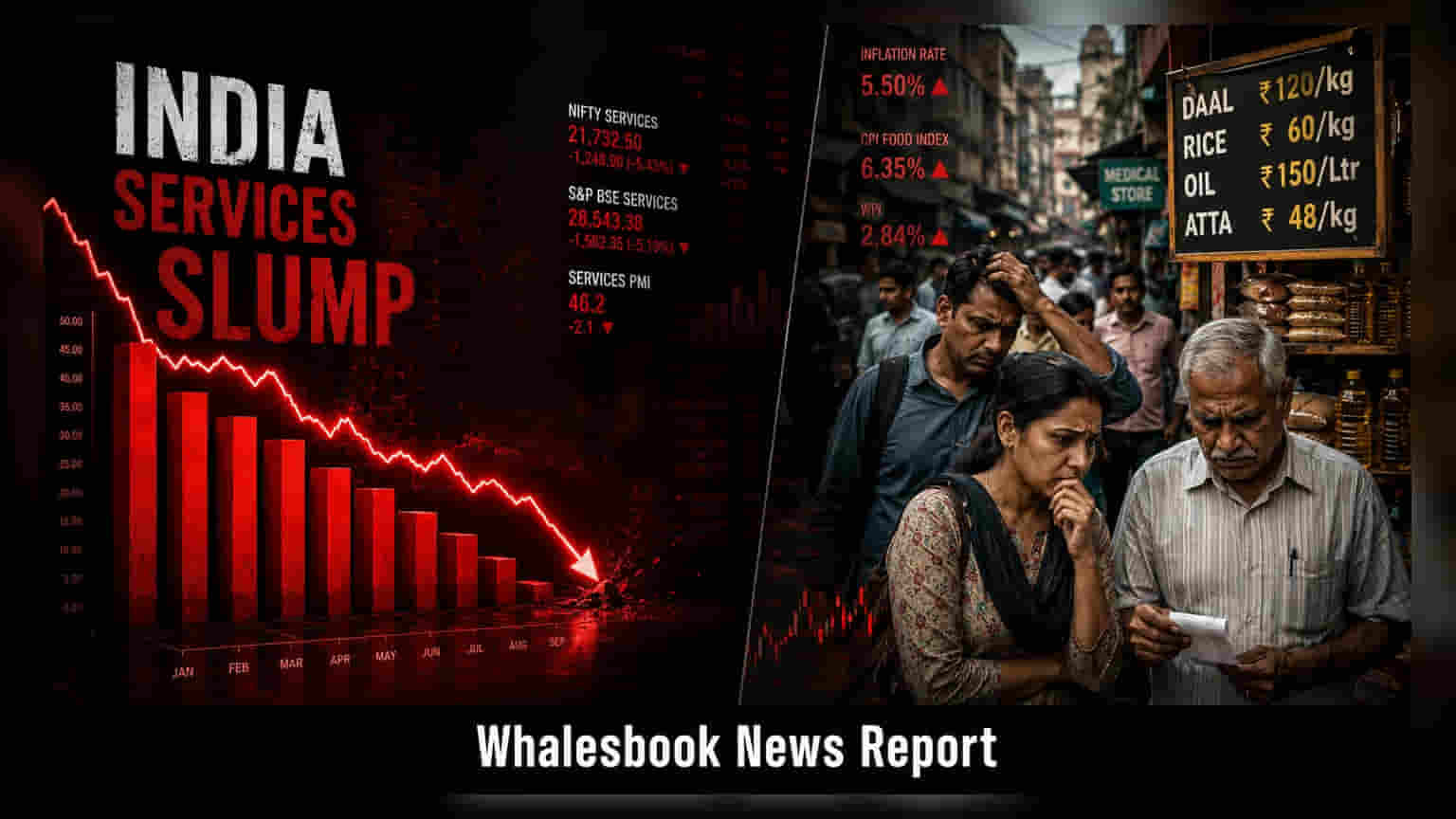
India's services sector growth slowed to a four-year low in July, with the Flash PMI falling to 53.1 from 57.4 in June. While business activity remains in expansion mode, rising operating costs are putting pressure on profit margins and dampening corporate sentiment. Investors should track whether resilient consumer spending can offset these inflationary pressures in the coming months.
Detailed Coverage
The pace of expansion in India’s services sector saw a sharp decline in July, with the HSBC Flash India Services Business Activity Index retreating to 53.1 from 57.4 in June. This reading represents the slowest growth rate observed since February 2022. The Composite PMI, which tracks both manufacturing and services, also hit a four-year low of 54.3, signaling a cooling trend across the broader private economy.
Inflationary Pressures Impacting Sentiment
Businesses have reported a combination of challenging market conditions, reduced client inquiries, and some instances of order cancellations. A primary factor behind this cooling sentiment is the rise in operating costs. Companies are facing higher expenses related to fuel, labor, and transportation, leading to the fastest increase in output prices in three months. For investors, this suggests that while businesses are still expanding, the cost of sustaining that growth is rising. Companies that lack pricing power may find their profit margins squeezed as they struggle to pass these higher costs on to end consumers.
Domestic Consumption vs. Rising Costs
There is a notable divergence between the sentiment-based PMI data and hard economic indicators. While the PMI suggests a slowdown, high-frequency data points to continued resilience in consumer spending. For instance, gross GST collections in June recorded a 13.9% year-on-year increase, with domestic transactions growing by 6.5%. Furthermore, digital payments via UPI and credit card spending volumes remain robust. This indicates that the current cooling in PMI may be driven more by cost-push inflation rather than a collapse in actual demand. Retail inflation, which stood at 4.38% in June, continues to be a factor that influences both consumer purchasing power and corporate input costs.
Export Performance and Sectoral Divergence
Despite the domestic slowdown, the export segment of the services economy provides a buffer. Overseas orders across the private sector showed improvement in the July flash survey, and official data for the April-June period showed a 6.16% year-on-year increase in services exports. This suggests that export-oriented sectors, particularly IT and business-process management, may be better insulated from the domestic inflationary squeeze than sectors reliant on local discretionary spending, such as hospitality or retail finance. Investors may look for these patterns in upcoming quarterly results, as the ability to maintain margins in an inflationary environment will be a key differentiator between companies. The Reserve Bank of India will likely monitor these trends closely to balance its monetary policy, as a cost-driven slowdown presents different challenges compared to a demand-driven contraction.