

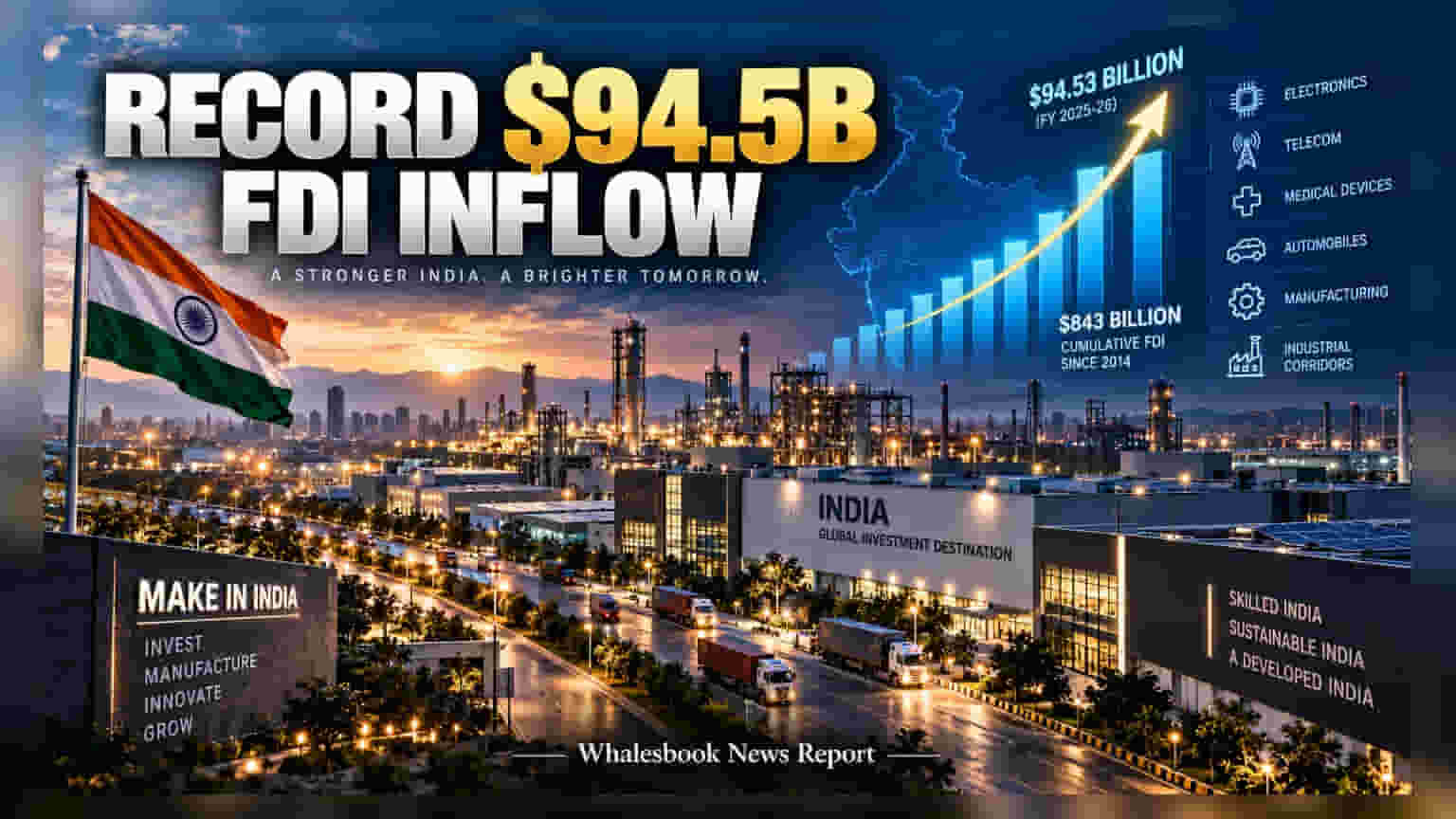
India attracted a record $94.53 billion in Foreign Direct Investment during the 2025-26 financial year, driven by the 'Make in India' initiative. This cumulative influx is reshaping the economy from consumption-based to manufacturing-led. Investors should monitor how this record capital deployment translates into long-term profit margins and project execution across the industrial sector.
India has reached a significant milestone in its industrial trajectory, recording its highest-ever annual Foreign Direct Investment (FDI) inflow of $94.53 billion for the 2025-26 financial year. This brings the total cumulative investment since 2014 to $843 billion, reflecting sustained global interest in the Indian market. The record influx is largely credited to the government's 'Make in India' push and specific incentive programs aimed at boosting domestic production capabilities.
The Production Linked Incentive (PLI) schemes have been a major catalyst in this shift. These programs have successfully triggered ₹2.40 lakh crore in actual capital spending, leading to ₹23.8 lakh crore in production and sales. For investors, this data is meaningful because it shows a transition from plans to tangible industrial output. However, it is important to note that many manufacturing companies are currently benefiting from these subsidies. Investors should watch whether these companies can maintain profit margins and competitiveness if or when these incentives are eventually phased out.
Sectorally, the capital flow has been concentrated in electronics, telecommunications, medical devices, and the automobile industry. These sectors are becoming central to the Indian manufacturing story, with companies expanding capacity to meet both domestic demand and export targets. The government’s focus has also shifted toward structural support, particularly through the National Industrial Corridor Development Programme. The construction of greenfield industrial smart cities is designed to lower logistics costs, which has historically been a challenge for Indian manufacturers compared to global peers. If these infrastructure projects are completed on schedule, it could provide a long-term cost advantage for domestic firms.
Beyond traditional manufacturing, the integration of digital infrastructure is also scaling, as seen in the growth of the Open Network for Digital Commerce (ONDC), which has handled over 470 crore orders. While the macroeconomic data looks robust, investors must remain aware of potential risks. The success of this massive capital influx depends heavily on efficient project execution. Delays in infrastructure development or a global slowdown in demand could impact the projected returns for these new manufacturing units. Furthermore, export-oriented companies remain vulnerable to changes in global trade policies and demand cycles.
Moving forward, the primary focus for market participants will be to track the commissioning of these new manufacturing facilities and the actual revenue growth reported by companies in the PLI-eligible sectors. Investors should also watch for updates on logistics costs and the ability of the industrial smart cities to attract tenants, as these factors will determine the real long-term impact of this FDI surge on corporate balance sheets.