

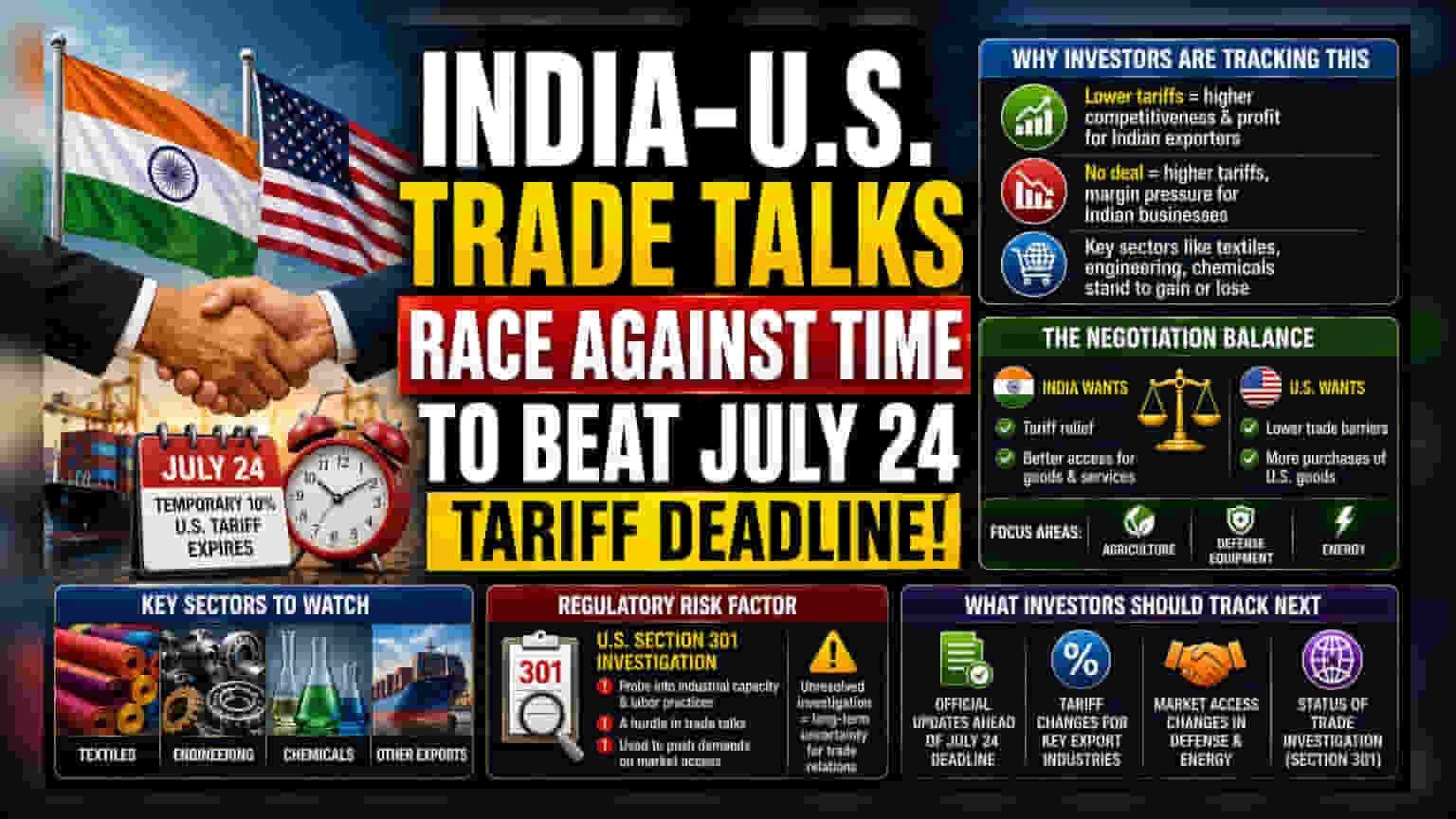
India is negotiating with the US to secure lower tariffs than rivals like Vietnam, aiming to finalize a deal before a key July 24 deadline. For investors, the outcome will influence export margins in sectors like textiles and engineering, while US demands for defense and energy market access remain a central point of negotiation.
What Happened
India and the United States have entered critical trade discussions, with U.S. Trade Representative Jamieson Greer visiting New Delhi this week. The primary objective is to finalize a trade agreement that gives Indian exporters a competitive edge over rivals in countries like Vietnam. The negotiations carry significant urgency, as the two nations are aiming to reach a resolution before July 24, the date when a temporary 10% U.S. tariff on trading partners is set to expire.
Why Investors Are Tracking This
For Indian businesses, especially those in export-heavy sectors like textiles, engineering, and chemicals, tariff rates are a major factor in pricing and profitability. If India secures a favorable deal with lower tariffs than its regional competitors, Indian exporters may gain a significant advantage in U.S. markets. Conversely, any delay or failure to reach an agreement could leave Indian goods subject to standard or higher tariffs, putting pressure on profit margins. Investors are watching for any clarity on these tariff structures as it directly impacts the competitiveness of Indian products abroad.
The Balancing Act In Negotiations
While India is pushing for tariff relief, the U.S. is seeking a "fair and reciprocal" framework. This means the U.S. wants India to lower its own trade barriers and increase purchases of American goods. Reports indicate that U.S. negotiators are focusing on market access in areas such as agriculture, defense equipment, and energy. If India agrees to open these sectors further, it could benefit U.S. companies operating in India, but it may also create new competitive pressure or regulatory shifts for domestic Indian companies in those spaces.
The Regulatory Risk Factor
A key monitorable for investors is the U.S. "Section 301 investigation." This is an ongoing U.S. government probe into allegations regarding excess industrial capacity and labor practices. While the details of such investigations can be complex, they essentially act as a hurdle in trade talks. The U.S. is using this investigation to push for its specific demands on market access. If this remains unresolved, it could create long-term uncertainty for trade relations, which is generally viewed as a risk for companies dependent on steady U.S.-India trade flows.
What Investors Should Track Next
Investors should monitor official updates leading up to the July 24 deadline. The most important details to look for include any specific changes to tariff structures for key export industries and any government policy changes regarding market access for foreign defense and energy players. Additionally, any statements regarding the status of the ongoing trade investigation will be crucial, as this will clarify whether the regulatory environment for Indian exporters is becoming more stable or if additional trade hurdles remain.