 Whalesbook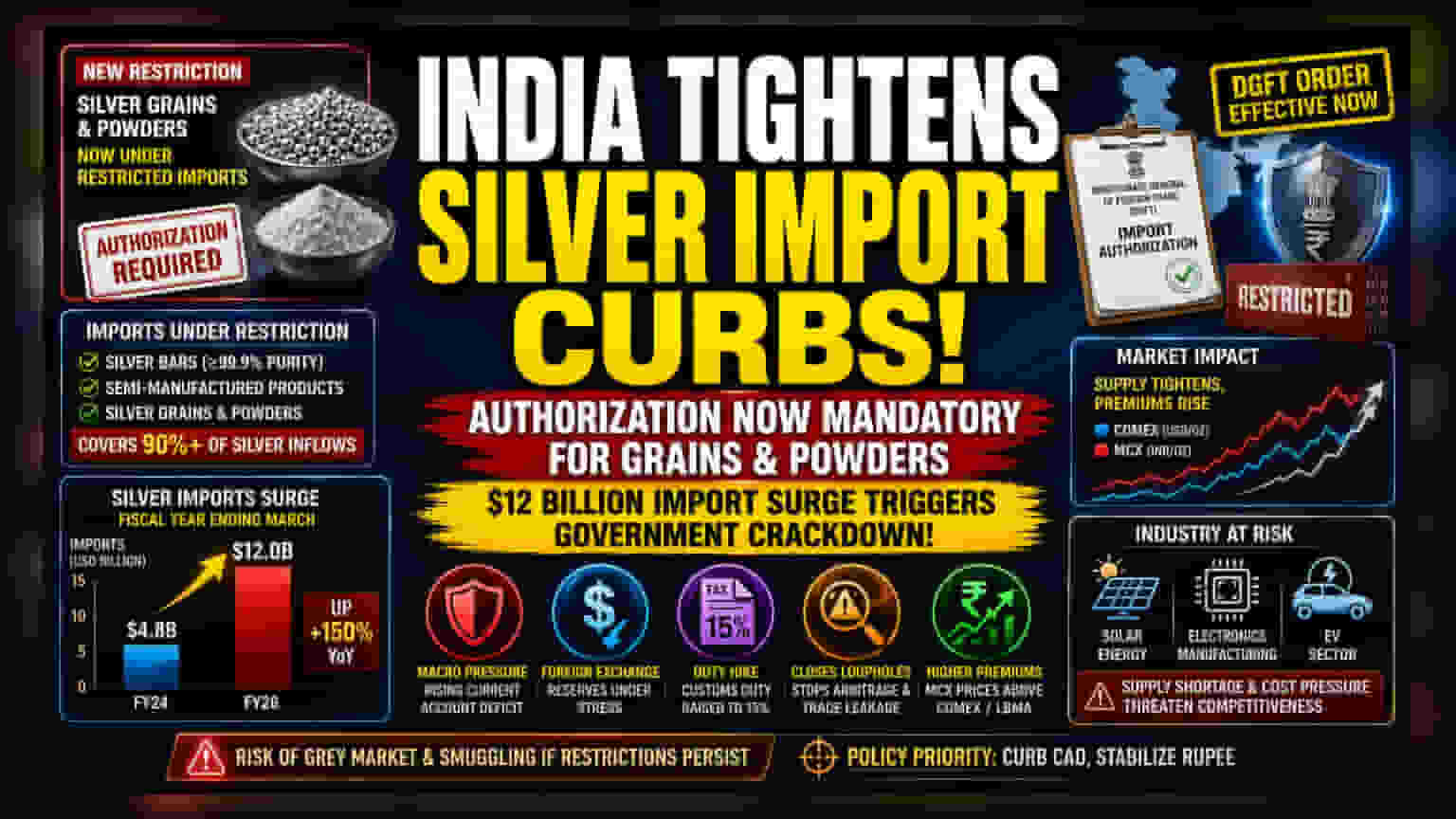


The Regulatory Squeeze on Silver
The Indian government has escalated its intervention in the precious metals market, adding silver grains and powders to the growing list of restricted imports. This policy, enforced by the Directorate General of Foreign Trade (DGFT), demands that importers secure explicit authorization before bringing these materials into the country. This expansion follows a mid-May directive that placed high-purity silver bars and semi-manufactured products under the same restricted category, effectively moving to gate-keep over 90% of the nation’s silver inflows.
The Macroeconomic Catalyst
This aggressive regulatory stance is a direct response to the ballooning current account pressure. During the fiscal year ending March 2026, India recorded an unprecedented $12 billion in silver imports, a stark contrast to the $4.8 billion seen in the previous year. Policymakers are acutely aware that every dollar spent on non-essential bullion imports exacerbates the strain on foreign exchange reserves, which have been pressured by elevated global crude oil prices and a persistently strong dollar. By shifting the import regime from “free” to “restricted,” the administration is attempting to filter speculative investment-driven demand while maintaining a semblance of oversight on industrial supply chains.
The Analytical Deep Dive: Arbitrage and Premiums
Market observers note that the core objective of these restrictions is to close trade loopholes that emerged after a sharp hike in customs duties from 6% to 15% earlier in May. Following that tax increase, a significant duty gap appeared, particularly regarding imports routed through trade partners with preferential agreements. Traders had begun exploiting these discrepancies to bypass the higher tariff burden, forcing the government to tighten import licensing to prevent mass leakage. In the domestic market, this has triggered a divergence between international COMEX prices and local MCX rates. As the physical supply becomes harder to secure, Indian importers are increasingly paying higher premiums to access the metal, creating a localized inflationary effect on silver-reliant sectors.
The Forensic Bear Case: Structural Weaknesses
While the government aims to defend the currency, these policies carry significant risks for downstream industries. India’s solar energy, electronics, and electric vehicle (EV) sectors are highly dependent on imported silver for high-conductivity components. Unlike gold, which is largely consumed for investment and jewelry, silver is a fundamental industrial input. If the licensing process remains opaque or bureaucratic, domestic manufacturers could face supply shortages or surging input costs, which would ultimately weaken their competitive standing compared to global rivals. Furthermore, historical experience with similar gold-market interventions—such as the 2013-era 80:20 scheme—suggests that overly stringent regulations often push trade toward the parallel economy, fostering smuggling and grey-market activity rather than truly destroying demand.
The Future Outlook
Industry analysts expect the domestic silver market to remain volatile as stakeholders navigate the new licensing requirements. Market participants are advised to monitor the MCX-LBMA price spread closely, as this gap serves as the most accurate barometer for the severity of supply-side friction. Given the government's current priority of maintaining macroeconomic stability over industrial convenience, there is little expectation of a policy reversal in the near term. The focus remains on managing the current account deficit until global energy price pressures subside.