

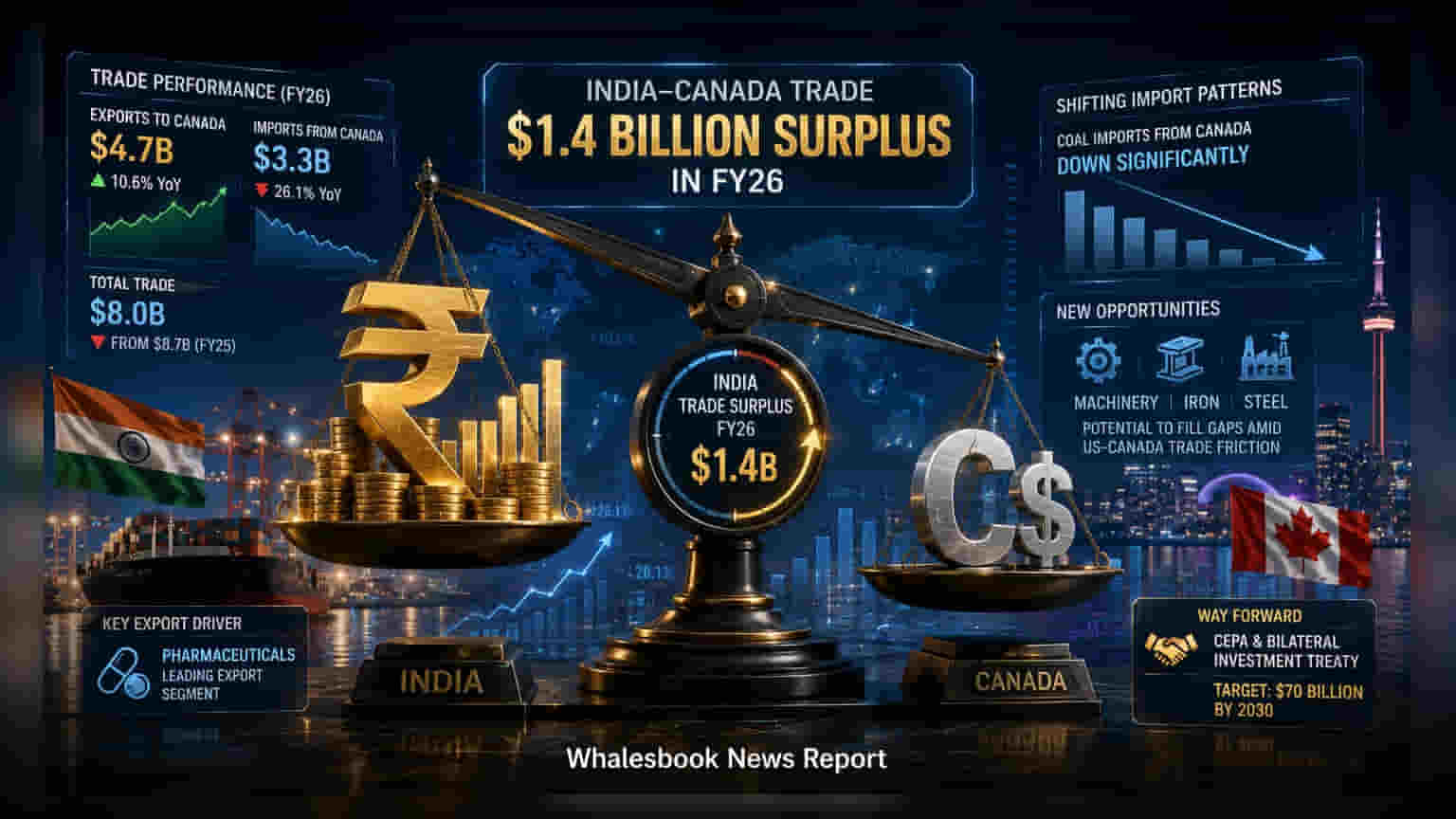
India has turned its trade balance with Canada into a $1.4 billion surplus for FY2026, shifting from a deficit the previous year. This improvement was driven by a 10.6% rise in exports and a 26.1% reduction in imports. Market observers are now tracking how this shift impacts ongoing trade agreement negotiations and potential new opportunities for Indian exporters.
India successfully transitioned its trade relationship with Canada into a $1.4 billion surplus in the fiscal year 2026. This is a notable shift from the $200 million trade deficit recorded in the previous year, reflecting changing patterns in bilateral goods movement.
The improvement in the trade balance was driven by two opposing trends. Indian exports to Canada rose by 10.6% to reach $4.7 billion. At the same time, Indian imports from Canada contracted sharply, falling 26.1% to $3.3 billion. While the overall trade balance improved, the total volume of goods exchanged between the two nations dipped to $8 billion from $8.7 billion in the previous year, suggesting that the surplus was achieved more through lower import reliance than through a massive surge in overall trade volume.
The composition of this trade is also evolving. Indian exports are increasingly supported by the pharmaceutical sector, which now makes up a significant share of shipments. On the import side, India has adjusted its sourcing, particularly with a reduction in coal imports from Canada compared to previous years. This change indicates a broader shift in how India secures energy and raw materials for its industrial needs.
Trade experts are now monitoring whether Indian manufacturers can take advantage of new market gaps. Ongoing trade friction between the United States and Canada, which has included the imposition of tariffs, may create opportunities for third-party suppliers. Indian companies in sectors like machinery, iron, and steel currently export products that could potentially fill some of the demand vacated by US-Canadian trade disputes. However, the ability of Indian firms to capitalize on this will depend on their ability to meet strict Canadian regulatory standards and maintain competitive pricing in a changing global trade environment.
These economic figures provide the context for the ongoing high-level discussions between the two governments. As officials work toward finalizing a Comprehensive Economic Partnership Agreement (CEPA) by the end of 2026, the current trade surplus may offer New Delhi more room to maneuver in negotiations. The stated goal for both nations is to reach a bilateral trade target of $70 billion by 2030, a figure that remains a key benchmark for policymakers.
For investors and market participants, the next important updates will involve the progress of the CEPA and the Bilateral Investment Treaty. Additionally, analysts will monitor whether Indian companies can effectively navigate Canadian regulatory requirements to increase their export footprint, especially in sectors affected by current North American trade tensions.