

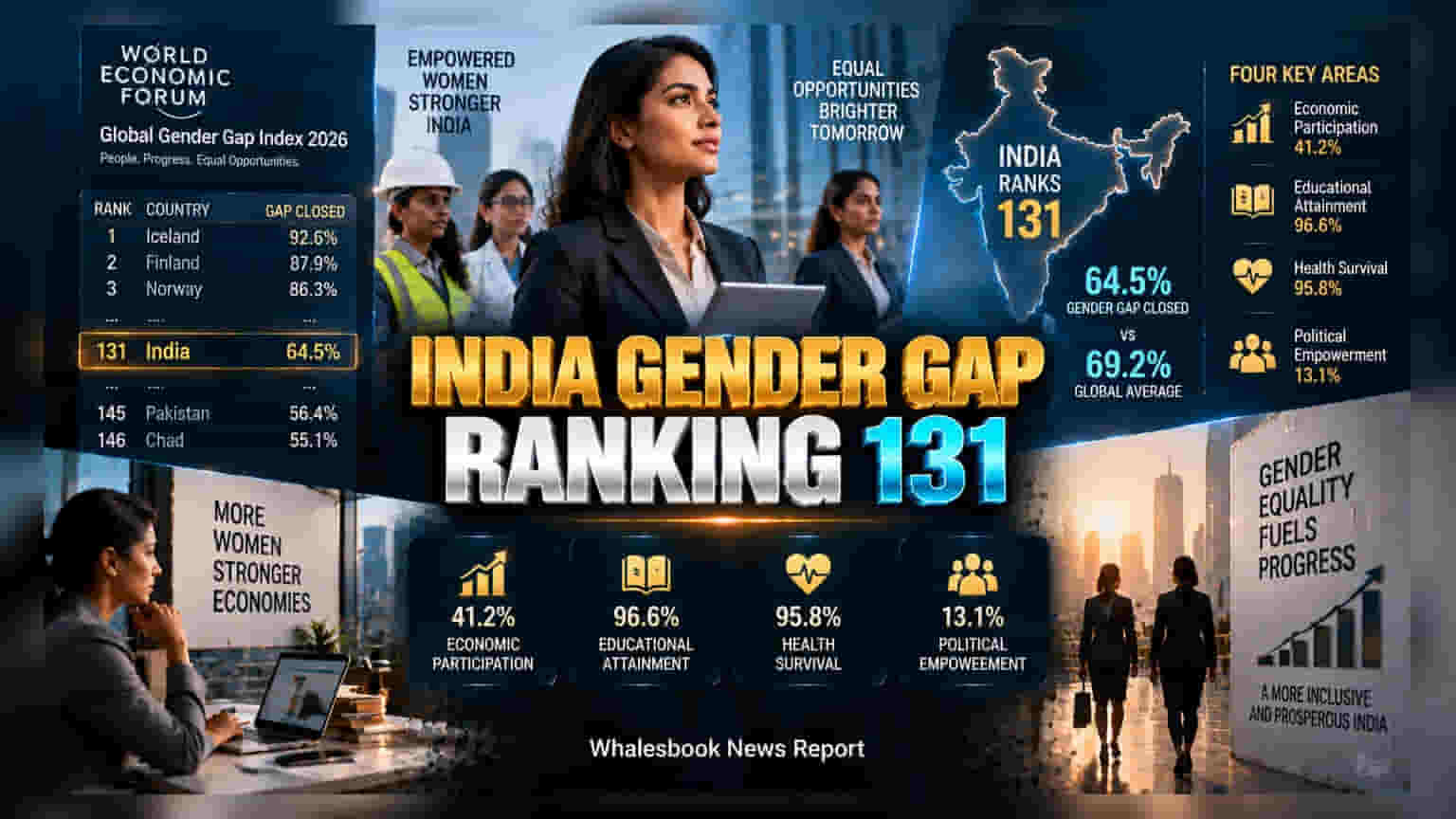
India retains the 131st position out of 145 countries in the World Economic Forum’s latest gender gap report. While education outcomes remain strong, low female workforce participation and limited representation in leadership roles persist as key challenges for economic growth.
India has maintained its 131st position in the 2026 Global Gender Gap Index, published by the World Economic Forum. The latest data reveals that the country has closed 64.5% of its overall gender gap, placing it below the global average of 69.2%. This index, now in its 20th edition, evaluates countries based on four primary metrics: economic participation, educational attainment, health survival, and political empowerment.
The report highlights a consistent theme in India’s progress: success in schooling has not yet translated into equal economic outcomes. Educational attainment is a clear strength, with India achieving a 96.6% parity score in this area. However, this success is contrasted by significant hurdles in economic opportunity, where the parity score stands at just 41.2%.
From a macroeconomic perspective, this gap is important because the full utilization of a country's workforce is a primary driver of long-term productivity. While India has seen improvements in technical and professional roles, the representation of women among senior officials, legislators, and managers remains low at 13.1%. Additionally, labor-force participation parity remains at 44.1%, suggesting that a large portion of the potential workforce is not contributing to the formal economy.
Globally, the gap remains wide, with full parity estimated to be over a century away at current rates. Iceland continues to lead the index, followed by Finland and Norway. Regionally, Southern Asia continues to struggle, particularly in economic metrics. India currently ranks ahead of 14 economies, including Pakistan and Chad, though the country's own trajectory depends heavily on whether these social gains in education can be effectively converted into economic participation.
The future trend for India will depend on the ability of both public and private sectors to improve employment rates and leadership representation for women. Investors and policymakers monitoring the nation’s long-term growth potential often track these human capital metrics, as they directly impact labor supply and, consequently, future economic output. The primary monitorable will be whether labor market policies and corporate diversity initiatives can move the needle on economic participation, which has shown only limited improvement in recent years.