

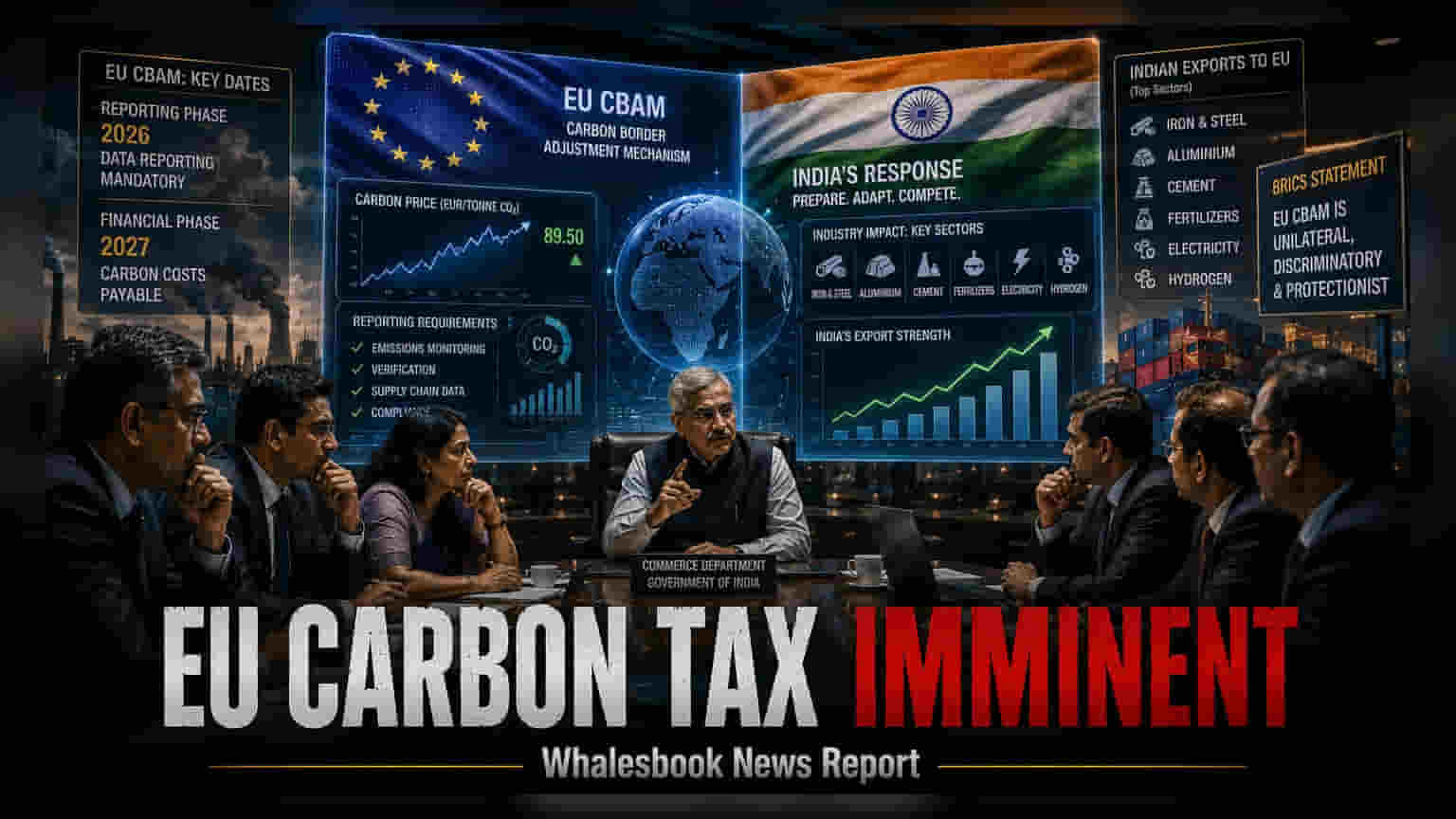
The Indian government is accelerating training for exporters to navigate the EU’s Carbon Border Adjustment Mechanism (CBAM) before financial payments begin in 2027. With sectors like steel and aluminum under the scanner, producers are racing to improve emissions tracking. Investors are watching closely to see how compliance costs and potential trade barriers may impact the profit margins of major industrial exporters in the coming years.
The Indian Commerce Department has intensified efforts to help domestic exporters prepare for the European Union’s Carbon Border Adjustment Mechanism (CBAM). During an awareness session held on August 18, 2026, government officials and industry experts worked with businesses to clarify the reporting and verification requirements needed to avoid trade penalties.
The EU’s CBAM is essentially a tax on the carbon pollution generated during the production of imported goods. While the reporting phase began in 2026, the critical financial phase—where companies must actually pay for their carbon footprint—is set to start in 2027. For Indian companies that export to Europe, this means that every unit of carbon emitted during production must be tracked, verified, and eventually compensated for.
Impact on Key Industrial Sectors
The immediate focus is on six carbon-intensive sectors that are most exposed to this new levy: iron and steel, aluminum, cement, fertilizers, electricity, and hydrogen. These industries are significant contributors to India’s export revenue. Companies in these sectors now face the urgent task of collecting precise data on their emissions. This is not just about measuring what happens at the factory gate, but also understanding the emissions profile of the entire supply chain, including suppliers of raw materials.
The challenge for investors is determining how these new compliance requirements will affect the bottom line. Large corporations may have the capital to invest in the software and systems required for accurate carbon accounting. However, smaller companies and those with less sophisticated technology could face higher operational costs, which might squeeze profit margins. If a company cannot provide verified, reliable data, the EU may apply default values that could result in higher tax liabilities than necessary.
Geopolitical and Economic Friction
The introduction of this tax has met with resistance at the diplomatic level. On August 18, 2026, environment ministers from the BRICS nations issued a joint statement labeling the EU's measure as a unilateral and discriminatory trade barrier. While this diplomatic pushback highlights the severity of the trade friction, it does not currently change the reality that Indian exporters must comply to keep their access to the European market open.
What Investors Should Monitor
Beyond just compliance, the market is looking toward how the Indian government might provide relief. One key development to track is the progress of India’s domestic Carbon Credit Trading Scheme (CCTS). If India can successfully link its domestic system with global standards, it might allow companies to offset some of the costs imposed by the EU.
For shareholders, the primary monitorable is how quickly companies can adapt their production processes to lower carbon intensity. Companies that lead in green energy adoption or more efficient production methods are likely to be better shielded from these rising regulatory costs. Meanwhile, those dependent on older, high-pollution technology may face increased pressure on both their competitive positioning and their financial stability in the export market.