 Whalesbook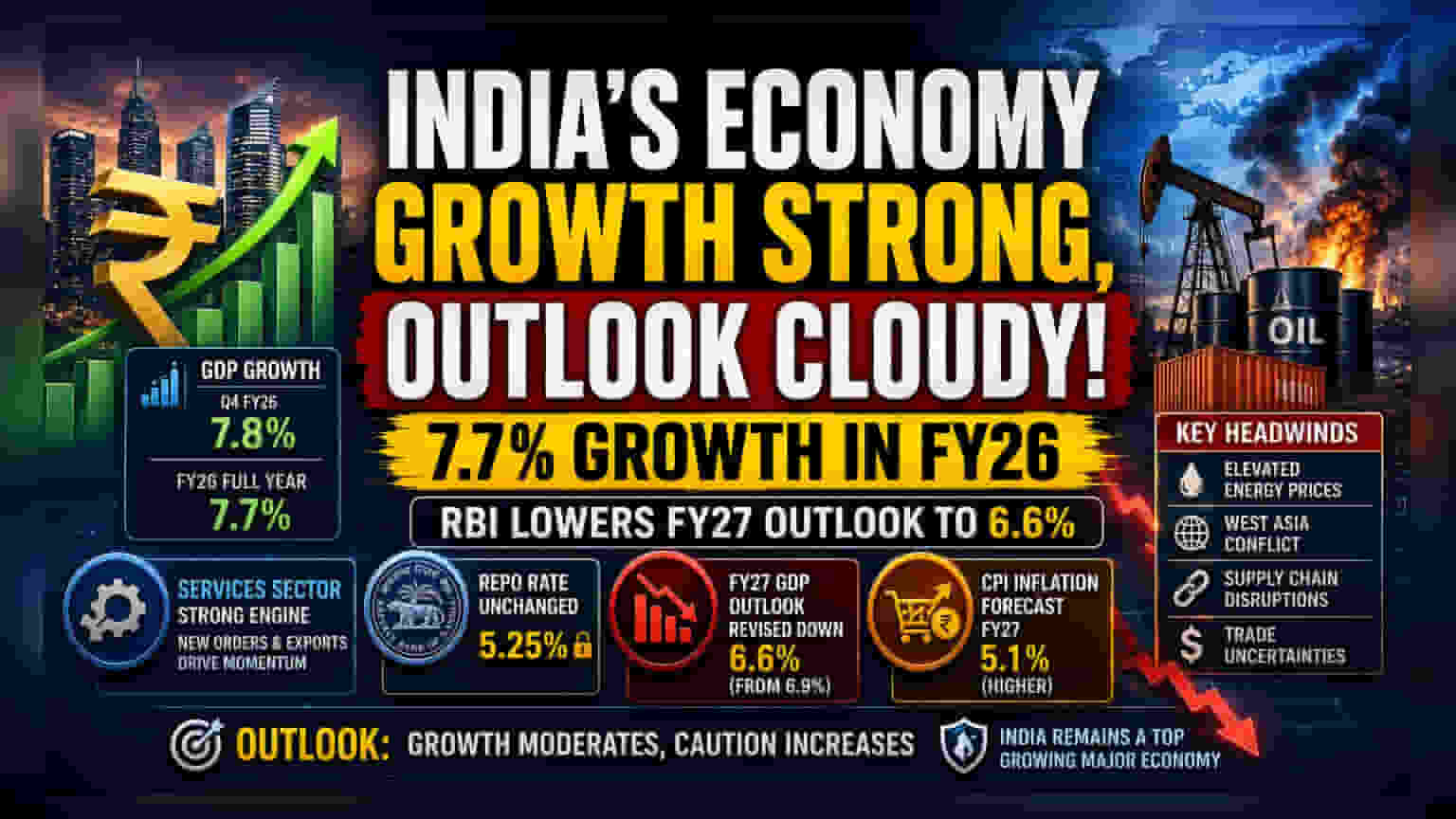


The Valuation of Resilience
India’s fiscal year 2026 concluded with a 7.8% GDP expansion in the final quarter, bringing the annual growth rate to 7.7%. This performance suggests that domestic demand remains structurally sound even as external pressures mount. The services sector, bolstered by strong new business inflows and robust export orders, served as the primary engine for this late-fiscal-year momentum. Yet, this rearview mirror success faces an immediate cooling effect as global economic headwinds begin to penetrate the local market.
The Shift in Monetary Calculus
While the Q4 growth print appears strong, the Reserve Bank of India (RBI) has pivoted toward a more defensive posture. In a concurrent announcement, the Monetary Policy Committee maintained the repo rate at 5.25% while simultaneously lowering the GDP growth forecast for fiscal year 2027 from 6.9% to 6.6%. The central bank’s revision is largely attributed to elevated global energy prices, which have significantly outpaced earlier assumptions, alongside the ongoing fallout from the West Asia conflict. By raising the CPI inflation projection for FY27 to 5.1%, the RBI is signaling that the era of easy, high-growth, low-inflation dynamics is currently under threat from supply-side volatility.
The Bear Case: Structural Vulnerabilities
Despite the headline growth figures, the outlook for the next fiscal year is tempered by several structural risks. The primary concern remains the pass-through effect of global energy prices. With the Indian basket of crude oil averaging significantly higher than anticipated, the domestic economy is facing a margin squeeze across industrial and manufacturing segments. Unlike previous years where domestic consumption could absorb supply-side shocks, current projections indicate that higher input costs are likely to suppress investment activity. Furthermore, economists have noted that trade uncertainties and supply chain disruptions continue to cloud the broader economic landscape, potentially eroding the momentum seen in the manufacturing and services sectors over the past twelve months. The decision to keep the repo rate at 5.25%—rather than opting for a rate cut—reflects the central bank’s prioritization of currency stability and inflation containment over aggressive growth stimulus.
Forward Outlook
Market participants are now recalibrating their expectations for the coming quarters. While the government’s focus on infrastructure and capital expenditure continues to support the underlying economic floor, the moderation in growth projections suggests that the pace of expansion is likely to decelerate as the year progresses. The upcoming quarters will depend heavily on whether the impact of global energy prices wanes or if further geopolitical shocks force a deeper economic contraction. For now, the consensus among observers is that India will remain one of the fastest-growing major economies, though it will do so against a backdrop of increased caution and reduced fiscal optimism.