

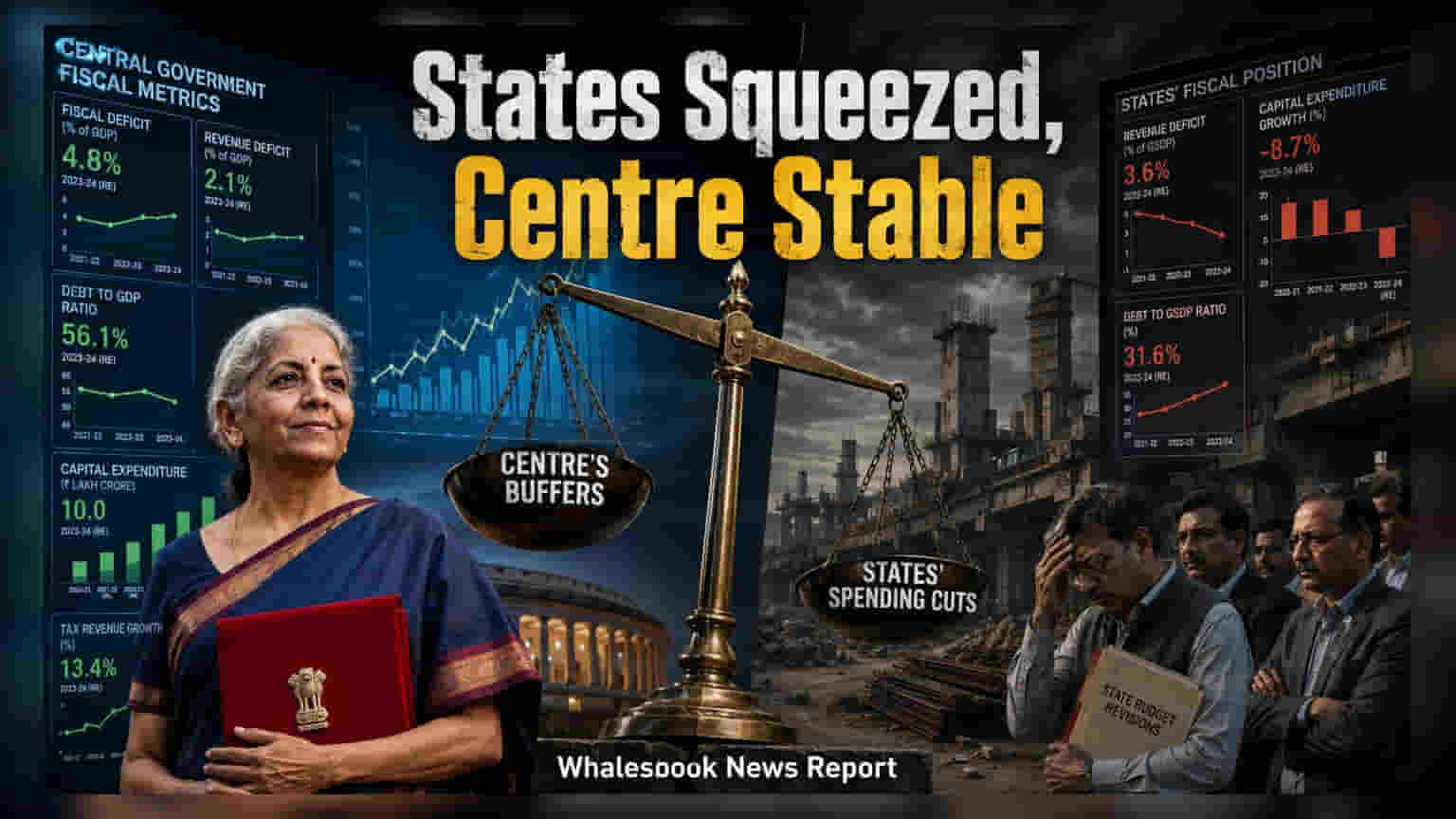
India’s fiscal deficit for the first quarter of FY27 reached 18.2% of the annual target. While the central government has ramped up capital expenditure, data shows state governments are curtailing spending to balance their books. This divergence is a monitorable risk for investors as states drive crucial infrastructure and social investments.
Data for the first quarter of the 2027 fiscal year indicates a growing gap between the spending patterns of the Union government and individual states. The central government reported its fiscal deficit at 18.2% of the full-year target, totaling approximately Rs 3.1 trillion. While the Centre has maintained momentum by increasing its own capital expenditure—money spent on building assets like roads and railways—by nearly 24% year-on-year, the broader economic picture is complicated by a slowdown at the state level.
Financial data suggests that state governments are operating under tightening constraints. Unlike the Centre, which has benefitted from specific revenue buffers and dividends from the Reserve Bank of India, states are finding it difficult to maintain their spending targets. Consequently, many are responding by cutting back on both revenue and capital expenditure. For investors, this shift is important because state governments are responsible for essential services including health, education, and local infrastructure projects that often serve as key demand drivers for various industries.
The current structure of fiscal federalism, which governs how money is shared between the Centre and the states, continues to evolve. While the 16th Finance Commission has maintained the vertical share of tax devolution to states at 41%, states are struggling with lower-than-anticipated revenue growth. This has forced some to rely more heavily on excise duties, particularly on alcohol, to shore up finances rather than seeing growth driven by broad-based economic expansion.
The risk for the broader economy lies in the potential impact on public welfare and project execution. If states continue to prioritize short-term fiscal targets over long-term capital investment, there could be a cascading effect on infrastructure project timelines and rural consumption. Reduced spending at the subnational level often leads to delays in awarding local contracts and can dampen demand for raw materials like steel and cement, which are crucial for construction and development.
Looking ahead, market participants should track state-level spending patterns and infrastructure project updates. While the Centre’s fiscal consolidation is a positive signal for macroeconomic stability, the sustainability of India's growth will depend on whether states can regain the financial flexibility needed to support their share of the country’s development agenda. Increased pressure from fertilizer subsidies and other structural obligations may further limit the space states have to maneuver in the coming quarters.