

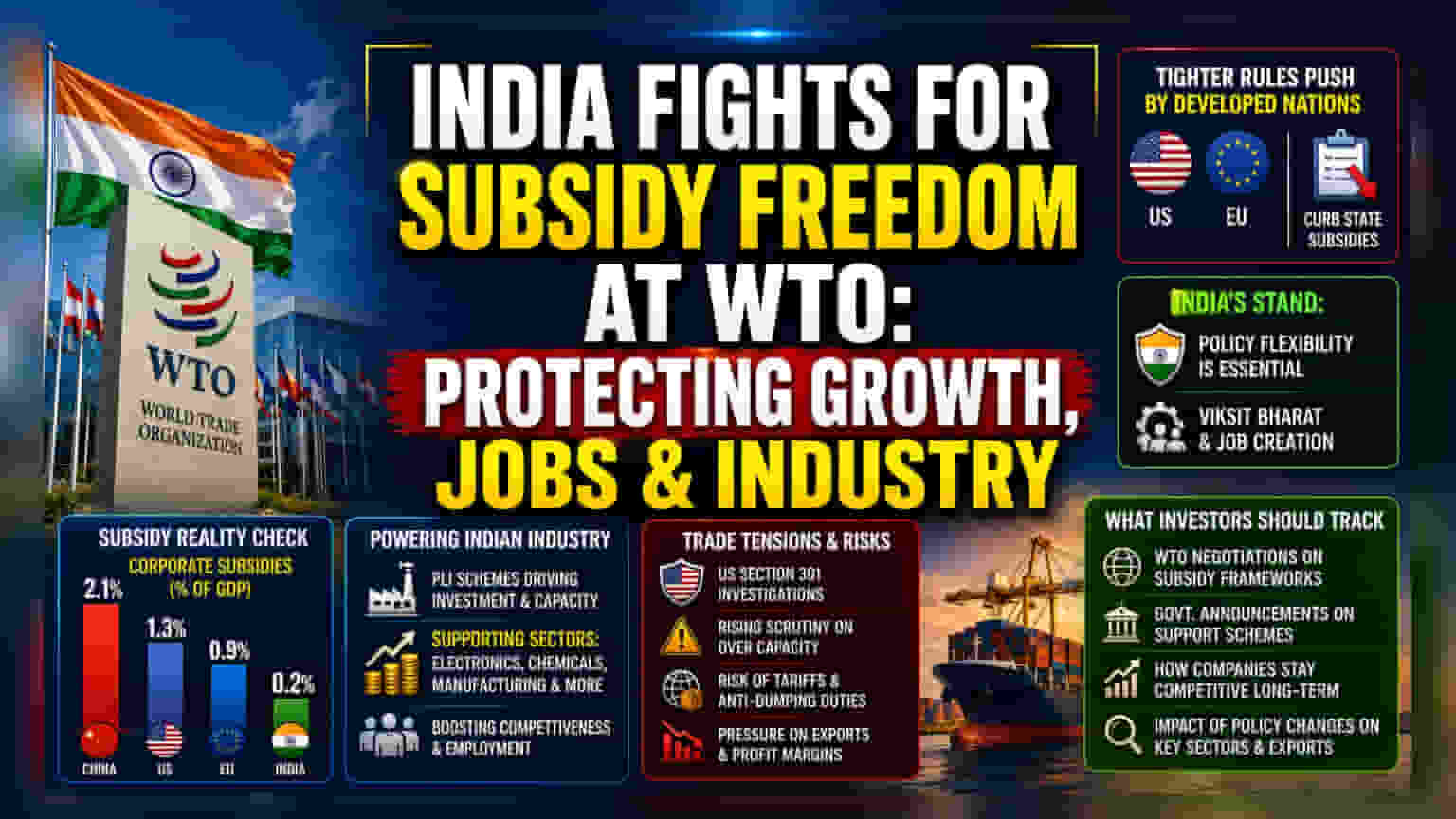
India is defending its right to use industrial incentives at the WTO, countering calls for stricter subsidy controls from developed nations. This stance is critical for domestic manufacturing and the 'Viksit Bharat' growth vision. Investors should watch how potential trade rule changes could affect future government support schemes for Indian industries.
What Happened
India is actively negotiating at the World Trade Organization (WTO) to maintain flexibility in its industrial policies. As global trade tensions rise, developed nations—particularly the US and the EU—are calling for tighter rules on state subsidies. They argue that these government interventions distort global trade and create unfair competition. India, however, maintains that its industrial policy is essential for achieving its 'Viksit Bharat' economic vision and generating employment. The country is resisting a one-size-fits-all approach to subsidy regulation, arguing that developing nations need specific policy tools to grow their manufacturing base.
The Subsidy Reality Check
For investors, it is important to distinguish between India’s actual subsidy levels and the global perception of state intervention. Research, including data from the OECD’s MAGIC Database, shows that India’s corporate subsidies are a small fraction compared to those provided by large economies like China, the US, and the EU. This data supports India's argument that its policies are developmental rather than predatory. The country's stance is that limiting its policy space would unfairly hamper its ability to industrialize and improve living standards compared to nations that have already used similar subsidies to build their economies.
Impact On Indian Industry And Policy
Many Indian manufacturing sectors currently rely on government support programs, such as Production Linked Incentive (PLI) schemes, to attract investment and build capacity. If global trade rules are tightened to restrict such incentives, it could create uncertainty for companies that depend on state support for growth. Investors should understand that if India is forced to scale back its industrial policies, it may affect the pace of capital expenditure in sectors like electronics, chemicals, and manufacturing. The ability of domestic firms to compete globally often hinges on the support they receive during their initial growth phases.
Trade Tensions And Risks
The current global climate involves rising scrutiny of manufacturing overcapacity, with the US frequently using 'Section 301' investigations to address trade concerns. While these investigations often target China, they create a broader risk environment for emerging markets. There is a potential risk that Indian exports could face increased trade barriers or anti-dumping duties if international regulators conclude that domestic incentives provide an unfair price advantage. If these barriers rise, companies heavily dependent on exports may face pressure on their margins and market access.
What Investors Should Track
Investors should monitor developments in WTO negotiations regarding subsidy frameworks. Any shift in how "dominant" and "non-dominant" economies are classified could directly impact India's regulatory freedom. Additionally, keep an eye on government announcements regarding existing and future support schemes. The ability of Indian companies to remain competitive without heavy state reliance will also be a long-term monitorable, especially for sectors that are currently expanding capacity using government-backed incentives.