

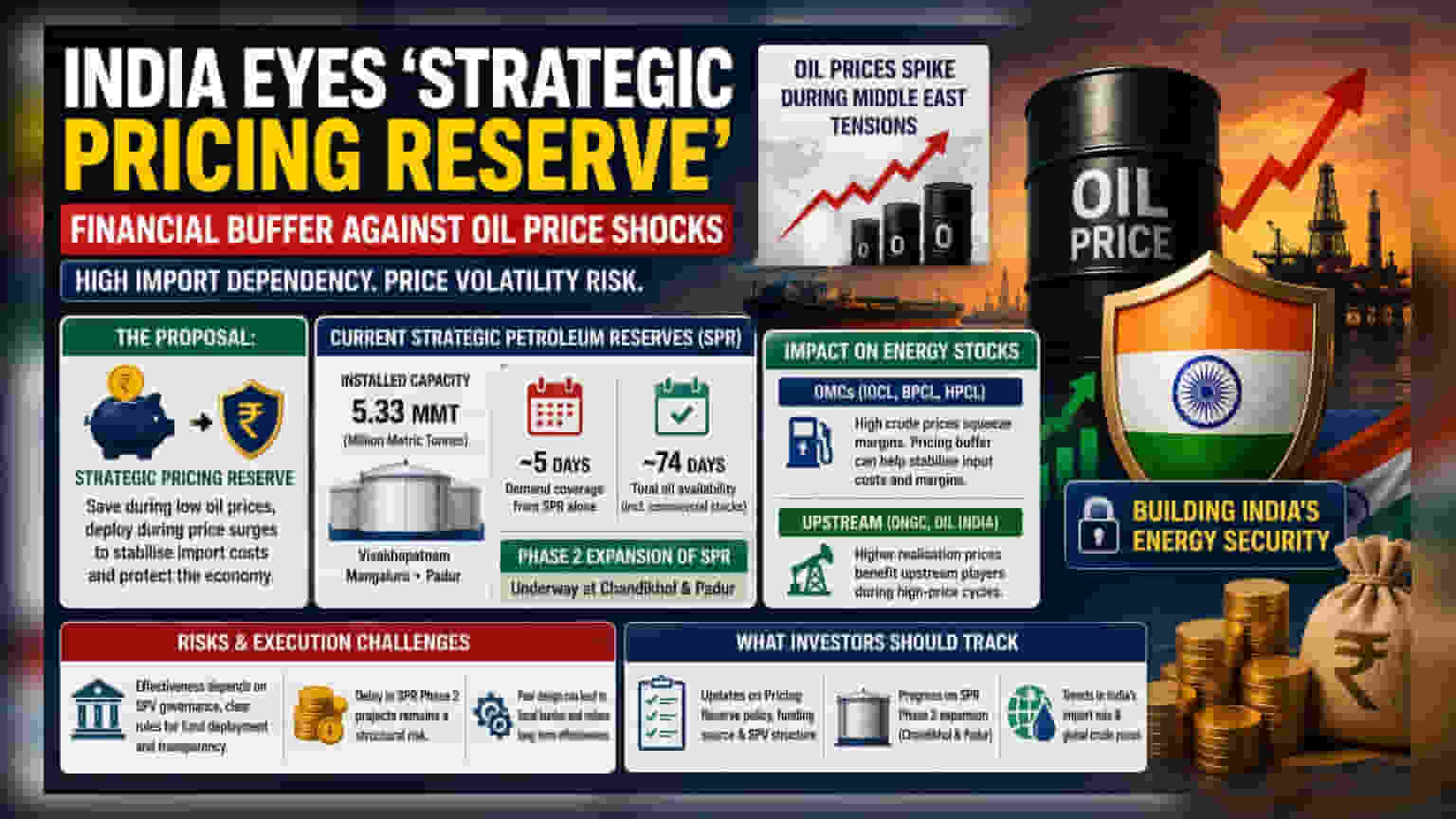
India is evaluating the creation of a 'Strategic Pricing Reserve' to manage future energy price volatility after recent supply disruptions. With an 88% crude import dependency, the move aims to provide a financial cushion, reducing the burden on oil marketing companies and the national budget during global price spikes.
What Happened
Following recent geopolitical tensions in the Middle East that caused a significant spike in global oil prices, the Indian government is exploring a new framework to bolster energy security. The core proposal is to establish a 'Strategic Pricing Reserve'—a financial fund built during periods of lower oil prices to act as a buffer against sudden market volatility. This initiative aims to address the vulnerability exposed by India's high import dependency, which remains at approximately 88% of its total crude oil requirements.
The Need for Strategic Reserves
India currently manages its energy security through Strategic Petroleum Reserves (SPR) with an installed capacity of 5.33 million metric tonnes (MMT). These underground rock caverns, located in Visakhapatnam, Mangaluru, and Padur, are designed to provide an emergency supply cushion. However, recent data highlights that these reserves provide only about 5 days of demand coverage on their own. While total oil availability—including commercial stocks held by refiners—is higher (roughly 74 days), the government recognizes the need to accelerate the 'Phase 2' expansion of storage facilities.
Why a Pricing Reserve Matters
The proposed 'Strategic Pricing Reserve' is distinct from physical oil storage. It functions as a financial corpus, similar to a sovereign wealth fund or a contingency budget. The model suggests diverting savings from the import bill when global crude prices are low—for instance, when oil trades below a certain price range—into a dedicated fund. This money would then be deployed during price surges to stabilize import costs, protect the national budget, and reduce the immediate shock to the economy.
Impact on Energy Stocks
Crude oil volatility affects different segments of the Indian energy sector in specific ways. For Oil Marketing Companies (OMCs) like Indian Oil Corporation (IOCL), Bharat Petroleum Corporation (BPCL), and Hindustan Petroleum Corporation (HPCL), high crude prices typically squeeze marketing margins unless they can pass the cost to consumers. A strategic pricing buffer could, in theory, help stabilize the input cost environment for these firms. Conversely, upstream oil companies such as ONGC and Oil India generally benefit from higher realization prices when crude costs rise, making them a natural hedge during high-price cycles. Investors often differentiate between these two groups when global energy prices fluctuate.
Risks and Execution Challenges
The effectiveness of such a fund depends heavily on its design and management. A key monitorable for the market will be the governance structure of the proposed Special Purpose Vehicle (SPV) that would manage the fund. Clear rules on when and how funds are deployed are essential to ensure the mechanism remains effective without creating long-term fiscal liabilities. Additionally, the delay in the existing SPR Phase 2 projects remains a structural risk that physical storage infrastructure needs to address alongside any financial mechanisms.
What Investors Should Track
Investors may look for updates on the government's policy on this pricing reserve, including funding sources and the proposed SPV structure. Beyond policy, continued monitoring of the 'Phase 2' SPR expansion progress in Chandikhol and Padur is essential, as physical storage is the first line of defense. Finally, market participants will continue to watch trends in India's import mix and global crude prices, as these remain the primary drivers of volatility for Indian energy stocks.