

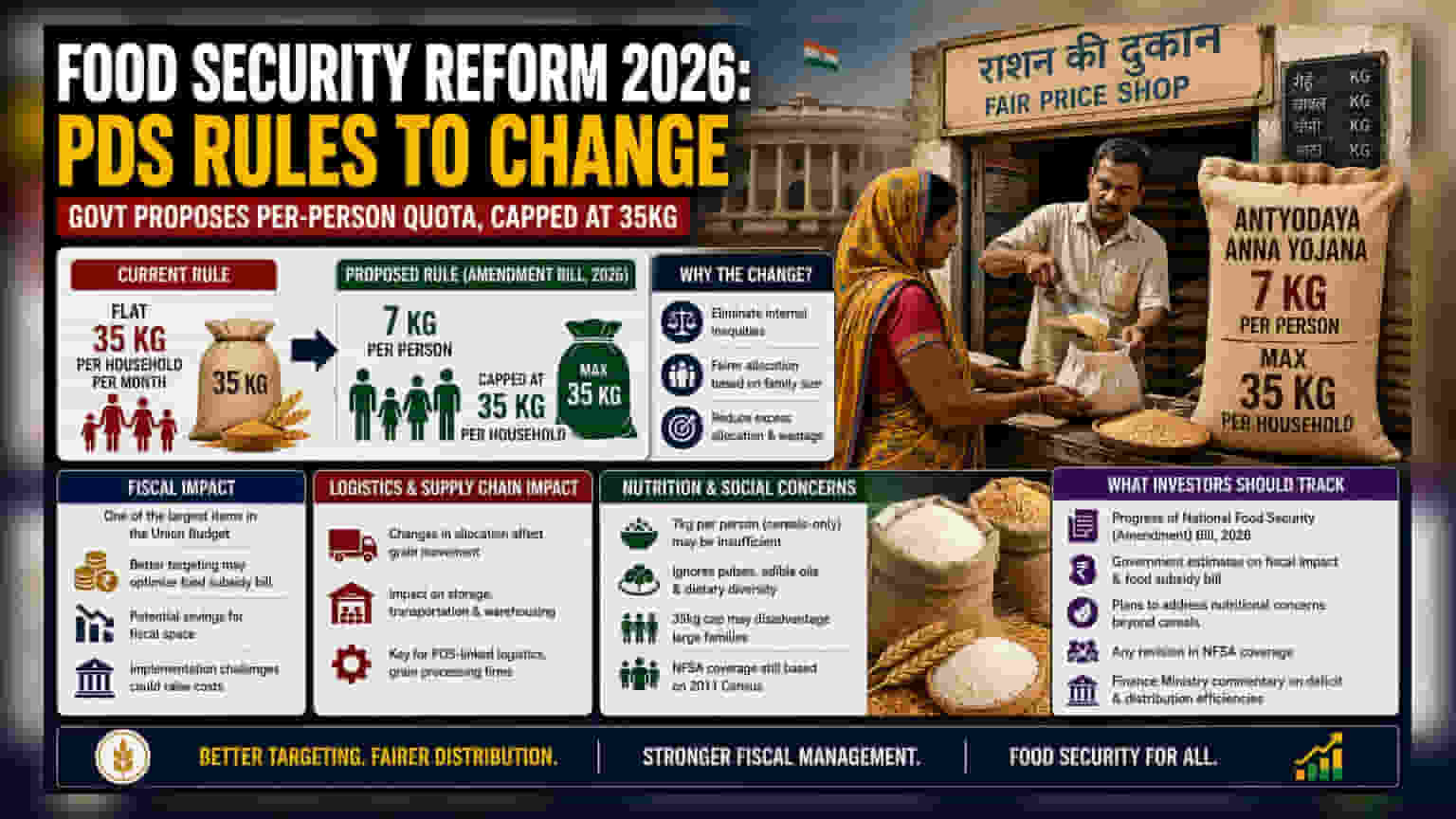
The Union government has introduced the National Food Security (Amendment) Bill, 2026, proposing a shift to a 7kg per-person monthly grain quota, capped at 35kg per household. This change aims to streamline food grain allocation under the Antyodaya Anna Yojana. For the economy, the key monitorables are the potential impact on the national food subsidy bill, fiscal targets, and operational logistics for the public distribution system.
What Happened
The Union government has introduced the National Food Security (Amendment) Bill, 2026, in a move to reform the Public Distribution System (PDS). The proposed legislation seeks to change how food grains are allocated to the poorest families under the Antyodaya Anna Yojana (AAY). Currently, these households receive a flat 35 kilograms of food grains monthly, regardless of family size. The new amendment proposes a per-person entitlement of 7 kilograms, subject to a maximum cap of 35 kilograms per household.
The Department of Food and Public Distribution has stated that this shift aims to eliminate internal inequities, as the existing fixed quota can lead to smaller families receiving a disproportionately higher per-capita amount than larger households.
Why This Matters For The Fiscal Budget
For the Indian economy, the food subsidy bill is one of the largest expenditure items in the Union Budget. Any restructuring of the PDS has direct implications for fiscal management. By moving to a per-person model capped at 35 kilograms, the government may be looking to optimize allocation and reduce wastage or excess supply to households that do not require the full 35-kilogram quota.
Investors typically watch fiscal deficit targets closely. If this reform leads to better-targeted distribution and reduced procurement costs for the Food Corporation of India (FCI), it could provide some room in the fiscal space. Conversely, if the implementation faces operational hurdles, it could impact government expenditure on food procurement and logistics.
Logistics And Supply Chain Impact
Changes to the PDS quota directly influence the operations of the food supply chain. The distribution system relies on a massive network of storage facilities and transportation. Modifications in grain movement, mandated by potential changes in consumption patterns or allocation, can affect demand for warehousing and logistics services. While this impact is indirect for stock markets, companies involved in large-scale storage, grain processing, and PDS-linked logistics often track changes in government food policy as a barometer for potential volume shifts in government-led procurement and distribution.
Nutritional And Social Considerations
Beyond fiscal metrics, the proposal has drawn significant attention due to nutritional concerns. Critics and experts, including those familiar with past Supreme Court food security cases, have raised questions about whether a 7kg per person allocation—specifically for the poorest families—is sufficient. There is concern that the move focuses exclusively on cereals and neglects other essential items like pulses and edible oils.
Furthermore, the 35kg household cap could impact larger families disproportionately. In states where average family sizes are larger, a family exceeding five members would receive less than 7kg per person, potentially undermining the goal of the reform. The broader macroeconomic backdrop also includes the challenge of NFSA coverage, which has not been updated since the 2011 Census, leaving a significant portion of the population outside the current framework.
What Investors Should Track Next
The next important developments for market participants will be the legislative progress of the 2026 Amendment Bill in Parliament and the specific implementation guidelines issued by the government. Investors may watch for:
- Updates on the fiscal impact, specifically whether the government estimates a reduction or optimization in the food subsidy bill.
- Official government commentary on how they plan to address the nutritional concerns raised by experts regarding cereal-only quotas.
- Any potential revision in the NFSA coverage, as this would have a more direct impact on the scale of food procurement and the overall fiscal burden.
- Statements from the Ministry of Finance regarding the impact on the national deficit and food distribution efficiencies.