

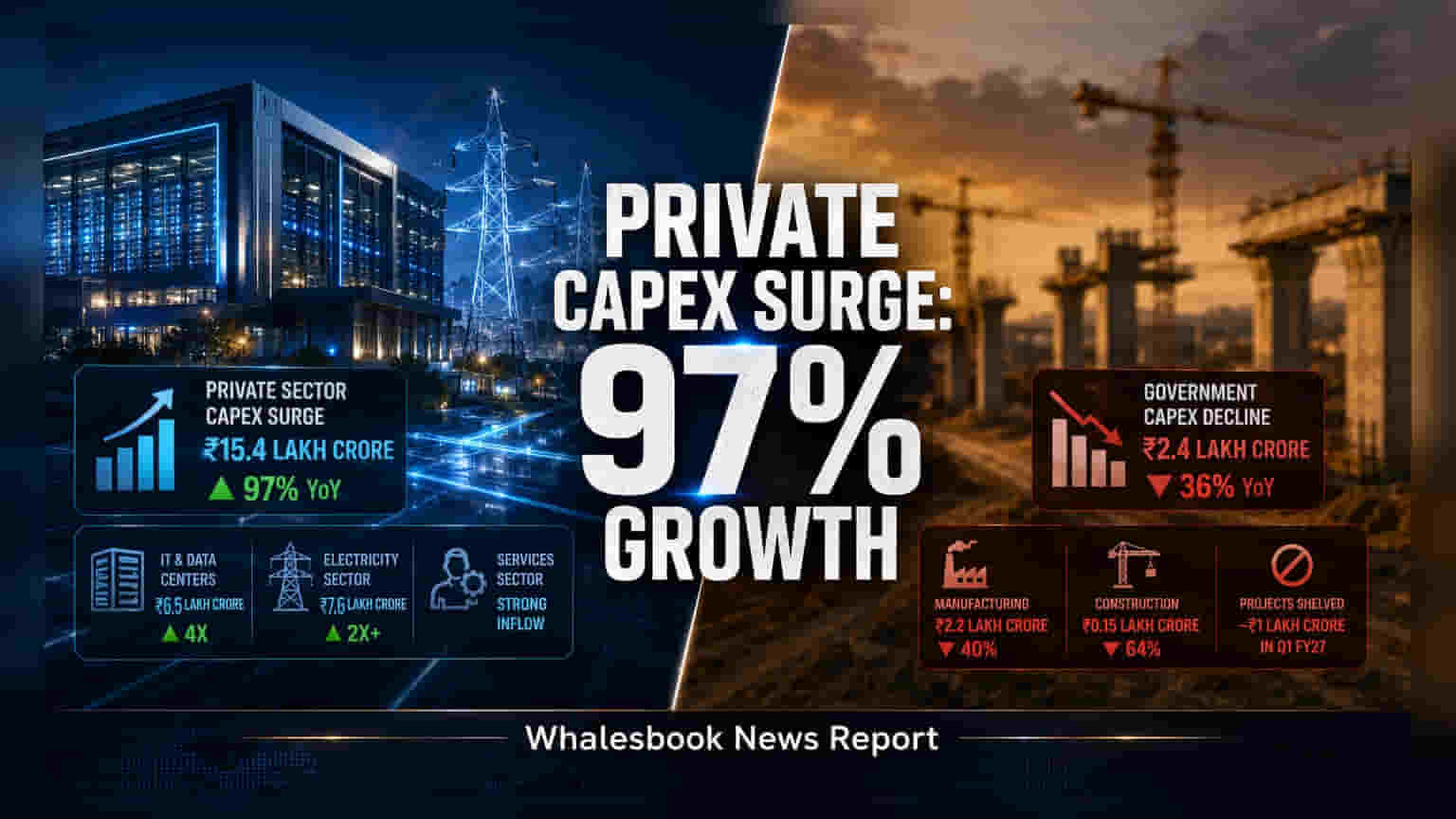
India’s private sector announced Rs 15.4 lakh crore in new projects during Q1 FY27, a 97% surge, while government spending fell 36%. This shift highlights a major focus on data centers and power infrastructure, even as traditional sectors like manufacturing and construction struggle to gain momentum.
The Indian economy witnessed a distinct change in investment patterns during the first quarter of fiscal year 2027. New capital spending projects announced by the private sector reached Rs 15.4 lakh crore, a 97% increase compared to the same period a year ago. In sharp contrast, government-led capital expenditure declined by 36% to Rs 2.4 lakh crore. This trend suggests that the private sector has overtaken the government as the primary engine for new investment inflows, a shift that economists are watching closely to see if it sustains momentum.
Tech and Energy Drive Spending
Not all sectors are contributing equally to this surge. The growth is heavily concentrated in specific high-growth areas, primarily the electricity and services sectors. Investments in the electricity sector more than doubled to Rs 7.6 lakh crore, reflecting a massive push to upgrade power capacity. Similarly, the services sector saw a significant influx of capital, largely driven by the IT industry. Investment in IT projects climbed nearly fourfold, reaching Rs 6.5 lakh crore, largely focused on building data centers and the digital infrastructure required for modern tech demand. This suggests that the private sector is currently prioritizing digital and energy assets over broader industrial expansion.
Manufacturing and Construction Lag Behind
While the tech and energy sectors are scaling up, traditional industrial segments are showing signs of caution. Manufacturing investments dropped by 40% to Rs 2.2 lakh crore, with notable weakness in sectors like textiles, chemicals, and food products. The construction sector also faced a sharp contraction, with new project announcements falling to Rs 15,000 crore, down significantly from Rs 40,900 crore in the previous year. Furthermore, the economy saw approximately Rs 1 lakh crore worth of projects being shelved during the quarter, indicating that while companies are willing to spend, they are also being selective and potentially cancelling projects that no longer fit their current strategy.
Economic Implications for Investors
Despite the uneven nature of this spending, the broader economy showed resilience, with GDP growth reaching 7.8% in the first quarter, which outperformed market expectations of 7.3% to 7.5%. For investors, the key monitorable going forward will be whether this investment cycle expands beyond the tech and power sectors. If manufacturing and construction remain soft, the recovery may lack the broad-based depth needed to support consistent long-term growth. Investors may also want to track project execution rates and future announcements in the manufacturing sector to see if the recent pullback is a temporary adjustment or a longer-term trend of business caution.