 Whalesbook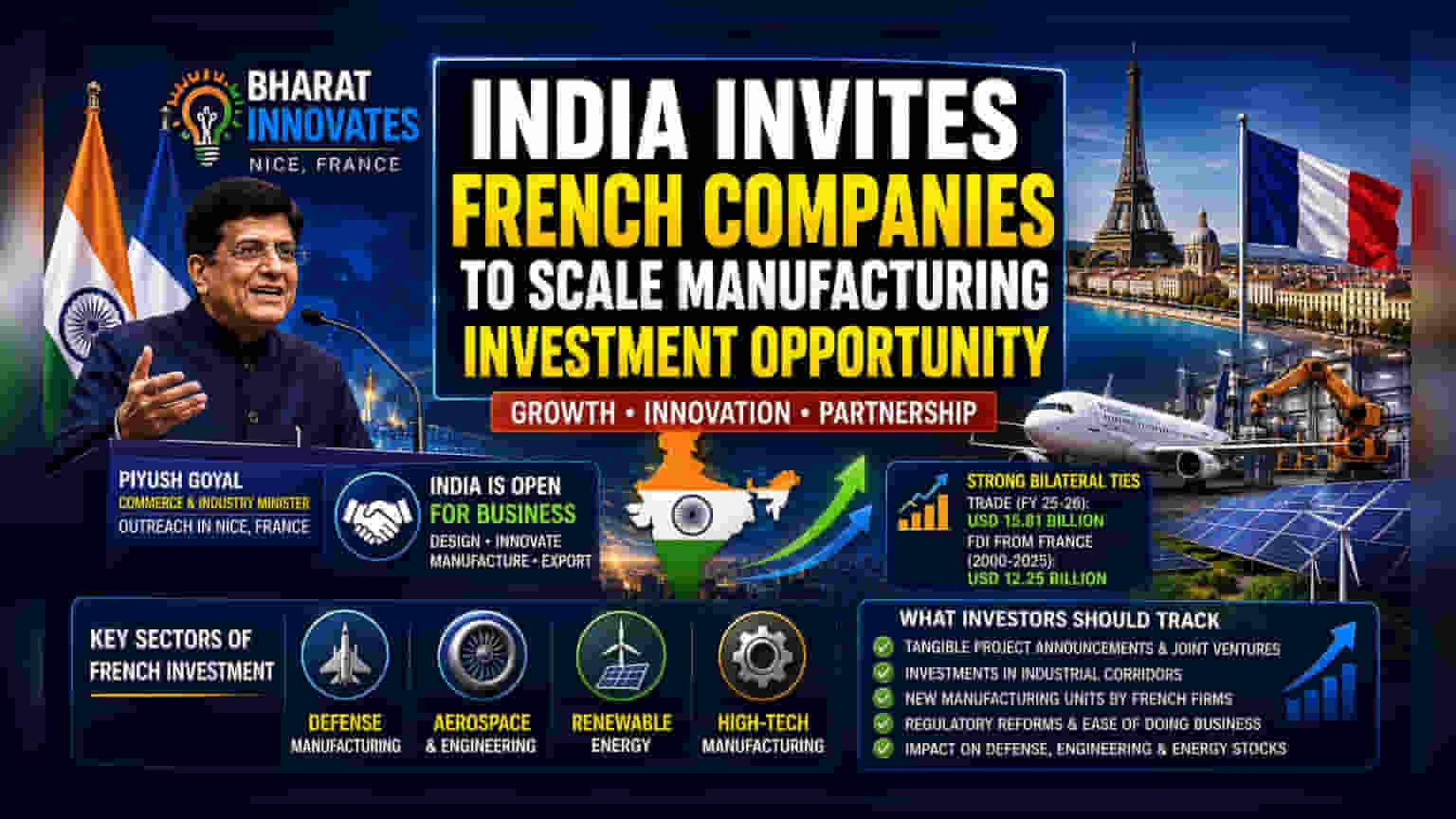


India is aggressively courting French companies to ramp up manufacturing investments, aiming to boost local production for both domestic consumption and exports. Commerce Minister Piyush Goyal highlighted India’s talent pool and startup growth as key draws. For investors, this diplomatic push signals a long-term effort to integrate India deeper into global supply chains, which may benefit sectors like aerospace, defense, and renewable energy if concrete capital inflows follow.
What Happened
Commerce and Industry Minister Piyush Goyal recently led an outreach effort in Nice, France, inviting French companies to expand their manufacturing footprint in India. During the 'Bharat Innovates' event, which took place alongside high-level bilateral discussions, the minister emphasized that India is open for business, specifically targeting firms looking to design, innovate, and manufacture products for both the domestic Indian market and the global export market. The initiative is part of a broader push to position India as a reliable alternative for international companies seeking to diversify their production bases.
Why This Matters For Investors
For the Indian stock market and long-term economic outlook, this move is about more than just rhetoric. Foreign Direct Investment (FDI) serves as a critical indicator of global confidence in a country’s economic stability. When major economies like France—which is already the 11th-largest investor in India—look to increase their presence, it often leads to a transfer of technology, better manufacturing standards, and job creation. If these efforts convert into actual project commitments, it can improve capacity utilization in sectors where French companies are traditionally strong, such as high-end engineering, aerospace, and energy.
The Sectoral Focus
Investors should note that French investment in India typically gravitates toward capital-intensive and high-tech sectors. Historically, partnerships between the two nations have been strong in defense manufacturing, aerospace components, and renewable energy projects. By encouraging French firms to 'make in India,' the government is likely aiming to attract technical expertise in these specific high-value areas rather than just general assembly work. This could eventually improve the technical capabilities of the local supply chain, potentially benefiting ancillary Indian companies that supply parts and services to these large multinational corporations.
Understanding The Economic Context
Official data indicates that bilateral trade between the two nations stood at USD 15.81 billion in the 2025-26 fiscal year, showing growth from the previous year. While the USD 12.25 billion in total FDI from France between 2000 and 2025 represents a solid foundation, the current outreach suggests a desire to accelerate this pace. However, investors should balance this optimism with the reality of international expansion. Global companies move slowly and prioritize infrastructure readiness, labor reforms, and regulatory consistency when deciding where to allocate large capital budgets. While the political willingness is clear, the financial impact will depend on how quickly these invitations translate into signed memorandums of understanding and completed factory setups on the ground.
What Investors Should Track
Moving forward, the primary monitorables for investors will be tangible project announcements rather than just diplomatic statements. Market participants should look for news on actual joint ventures, specific investments in industrial corridors, or the establishment of new manufacturing units by French firms. Additionally, any updates on regulatory hurdles being cleared for these foreign entities would be a positive indicator of the ease of doing business. Investors should also keep an eye on how these potential inflows affect the sector-specific indices linked to defense, engineering, and energy, as these are the most likely areas to see movement if the push for French investment succeeds.