

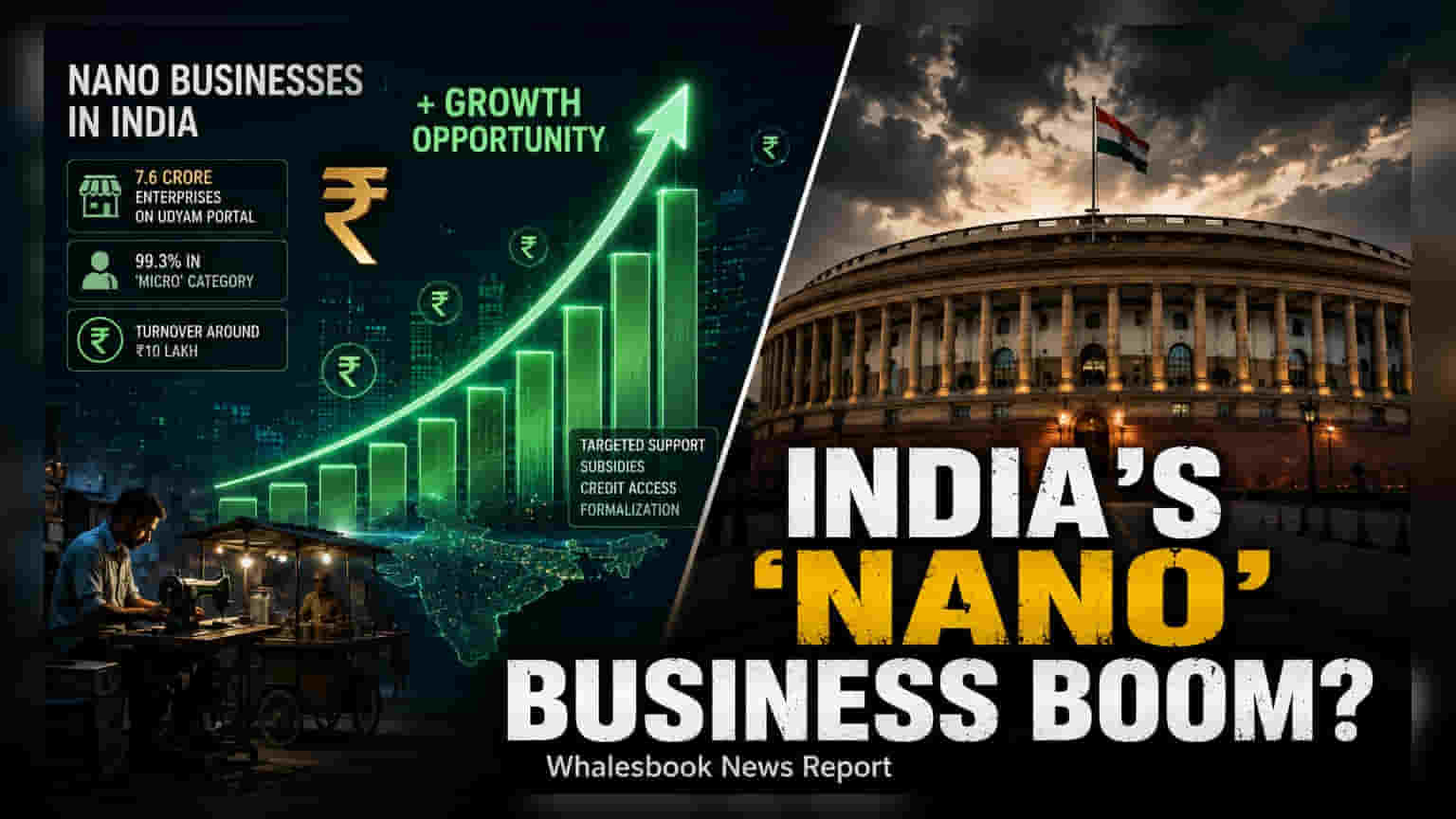
A parliamentary panel is calling for a 'nano' business category to support India's smallest enterprises, which currently get lost in the broad 'micro' classification. This move aims to improve how government aid and credit reach the lowest tier of the economy. However, the MSME Ministry has raised concerns about the practical difficulties of tracking these small, often unorganized units.
A parliamentary committee has renewed its call to create a specific 'nano' business category in India, aiming to provide better support for the country's smallest economic actors. The Rajya Sabha Standing Committee on Industry argues that the current 'micro' category is too broad, which prevents the government from effectively targeting aid, subsidies, and credit to the most vulnerable, ultra-small enterprises.
Why the Current Classification is Considered Too Broad
Under current rules, 99.3% of the roughly 7.6 crore enterprises registered on the government's Udyam portal fall into the 'micro' category. This grouping includes everything from tiny household units to businesses with significantly higher turnovers. The committee suggests that when these vastly different types of businesses are grouped together, the smallest units—those with turnovers around ₹10 lakh—often miss out on the focused support they need. The panel points to Kerala's model as a potential blueprint, where the state already operates a distinct classification for household businesses with a ₹10 lakh investment threshold, allowing for specific aid like margin money assistance.
The Administrative Hurdles Raised by the Ministry
While the parliamentary panel is pushing for this change, the Ministry of Micro, Small and Medium Enterprises (MSME) has maintained its reservations. In recent discussions, the ministry highlighted that creating a new 'nano' tier would be administratively complex. The core issue, according to the ministry, is that these very small businesses often have seasonal operations and frequently lack audited financial statements. Because their scale of operations can change quickly and they often operate in the informal sector, the ministry fears it would be difficult to establish stable, verifiable criteria for this category. There is also a concern that creating new categories could lead to overlapping efforts with existing schemes like PM Vishwakarma and PM MUDRA, which already target smaller borrowers.
Economic Context and Investor Interest
This debate occurs against the backdrop of the government’s broader effort to formalize India's vast informal economy. The MSME Development (Amendment) Bill, 2026, which was passed recently, focuses on improving liquidity and formalization through digital registration and mandatory invoice settlements. For the wider economy, the success of these initiatives matters significantly. If the government can successfully define and track smaller business units, it can theoretically improve credit flow, reduce loan defaults by reaching smaller units with appropriate financial products, and integrate more of the informal sector into the formal banking system.
The committee has rejected the ministry’s concerns, suggesting that the administrative challenges should not be a barrier to development. Instead of dropping the idea, the panel has directed the ministry to form a working group comprising officials from the Reserve Bank of India, the Small Industries Development Bank of India, and state government representatives. The focus for investors and policy watchers now shifts to this working group, as its report will determine whether a 'nano' category becomes a formal part of India's business landscape or if the current definitions remain as they are.