

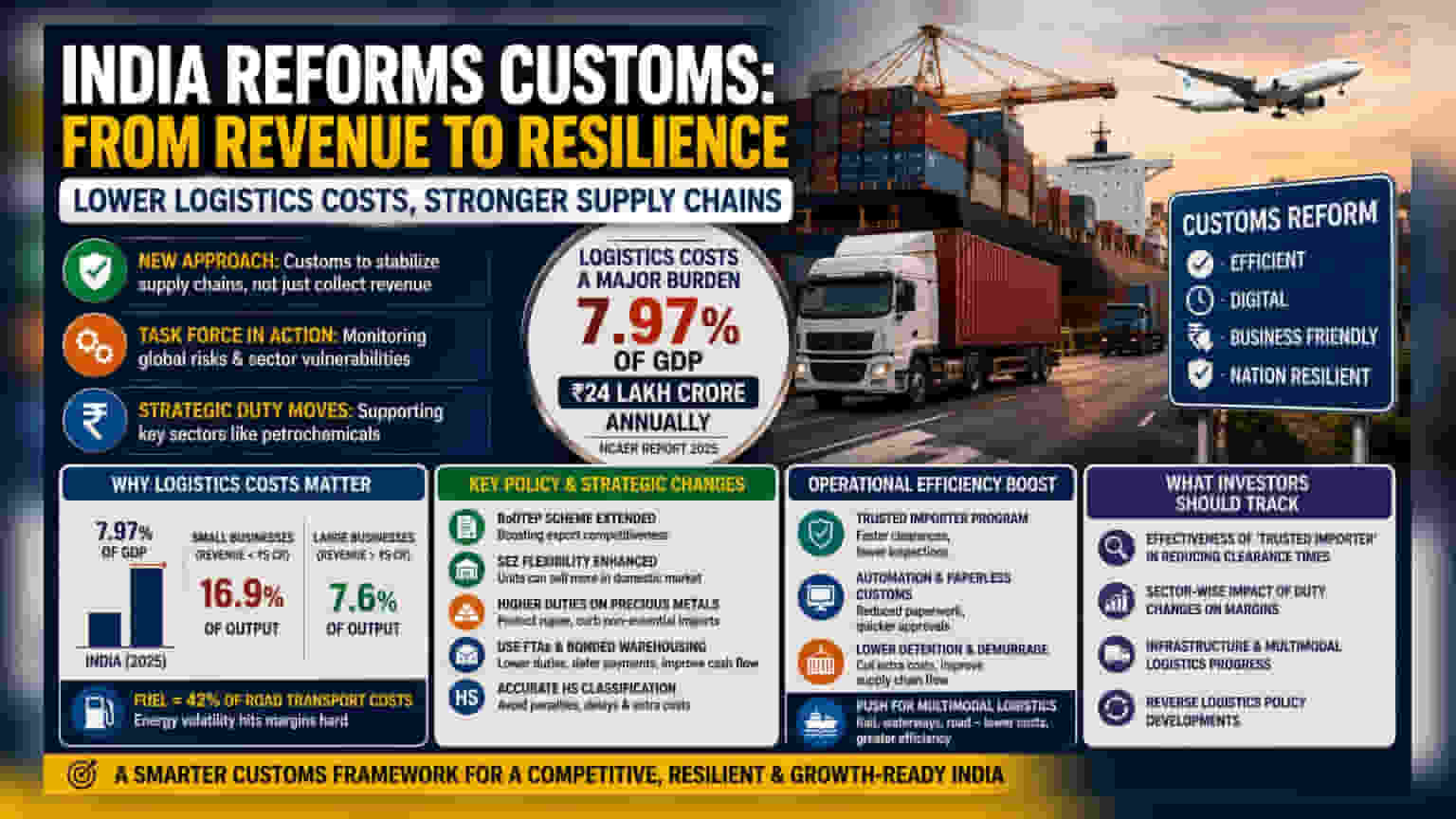
The Indian government is pivoting its customs policy from a revenue-focused tool to an economic resilience framework. By introducing duty rationalization, extending export benefits like RoDTEP, and streamlining cargo clearances, the policy aims to lower logistics costs and stabilize supply chains. This shift helps businesses mitigate risks from global trade uncertainties and rising energy costs.
What Happened
The Indian government has launched a significant shift in its customs and trade strategy. Instead of treating customs primarily as a way to collect revenue, the new framework focuses on stabilizing supply chains and reducing logistics costs for domestic businesses. This change comes as global geopolitical tensions threaten trade routes, particularly those involving energy supplies. To manage these risks, an inter-ministerial task force has been formed to monitor supply chain vulnerabilities, while specific sectors, such as petrochemicals, have seen duty adjustments to support stability.
Why Logistics Costs Matter
High logistics costs remain a major hurdle for Indian businesses. According to a 2025 NCAER report, these costs account for 7.97% of India's GDP, translating to roughly ₹24 lakh crore annually. While this is an improvement from the past, the burden is uneven. Small businesses (with revenue below ₹5 crore) face a much higher strain, with logistics expenses consuming up to 16.9% of their output, compared to just 7.6% for larger firms. With fuel expenses making up 42% of road transport costs, any global energy volatility directly impacts operating margins for companies across the country.
Strategic Changes for Businesses
The policy overhaul includes several practical measures for companies involved in import and export activities. The government has extended the Remission of Duties and Taxes on Export Products (RoDTEP) scheme and granted Special Economic Zone (SEZ) units more flexibility to sell goods in the domestic market. Additionally, to protect the rupee and discourage non-essential spending, import duties on precious metals like gold, silver, and platinum have been increased.
For corporations, the new focus is on lowering the cost of doing business. Companies are encouraged to use Free Trade Agreements (FTAs) to lower duty costs and utilize bonded warehousing, which allows them to defer duty payments and improve cash flow. Accurate classification of goods under the Harmonized System (HS) is also becoming essential to avoid penalties and unnecessary delays at ports.
Operational Efficiency and Future Risks
The government is also introducing a "trusted importer" framework to speed up cargo clearance by reducing physical inspections. When combined with increased automation and paperless approvals, these measures are expected to cut down on extra costs like detention and demurrage, which occur when goods are stuck at ports or warehouses.
However, challenges remain. While these policy changes offer support, businesses still face risks from infrastructure gaps in last-mile connectivity and inland waterways. Investors should also note that relying solely on these benefits may not offset the impact of global supply shocks or significant swings in raw material prices. The transition to multimodal logistics—using rail and waterways instead of relying only on road transport—is a critical area where companies will need to invest to see long-term savings.
What Investors Should Track
Investors may monitor how quickly these customs reforms are implemented on the ground. The key monitorable will be whether the "trusted importer" program effectively reduces clearance times for major import-dependent companies. Additionally, tracking sector-specific demand and the impact of the new duty structures on profit margins will be essential, especially for industries sensitive to import costs like electronics, chemicals, and consumer goods. The development of a clear policy on reverse logistics will also be important for companies in the e-commerce and retail sectors.