

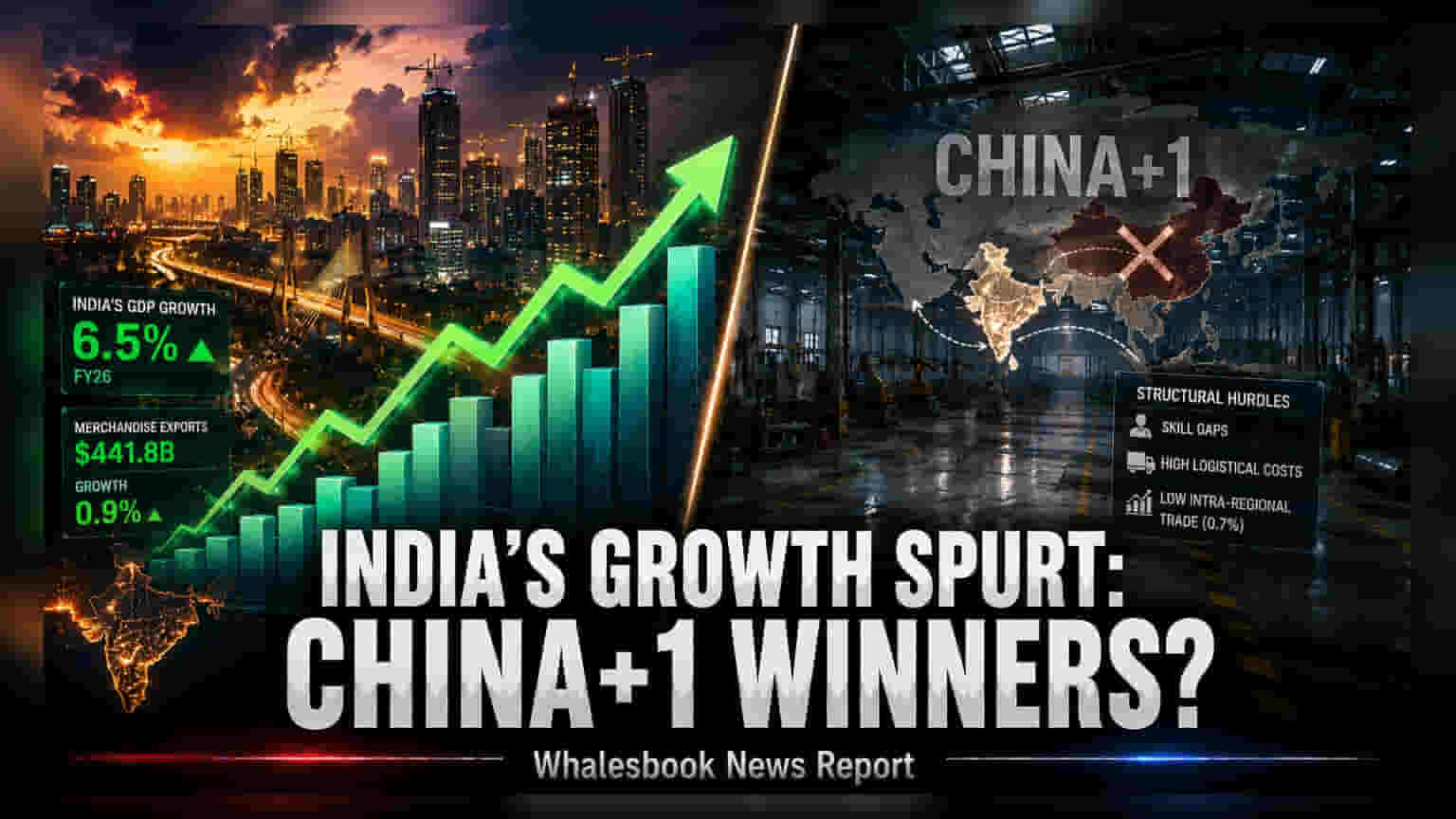
India continues to lead South Asian economic expansion, yet merchandise export growth remains modest at 0.9%, signaling a slow capture of 'China+1' supply chain shifts. While AI emerges as a productivity catalyst for small enterprises, low regional trade connectivity remains a structural hurdle for the economy.
India currently leads the economic growth chart in South Asia, expanding at a pace roughly two percentage points faster than the average for developing economies. Despite this overall growth, the country faces a disconnect regarding the 'China+1' global manufacturing shift. While the strategy encourages companies to diversify supply chains away from China, India has yet to replicate the rapid export surges seen in regional competitors like Vietnam and Cambodia.
Merchandise Export Trends
The most recent data for fiscal year 2026 shows India’s merchandise exports reached approximately $441.8 billion. While this figure is substantial, the growth rate remains modest at about 0.9% compared to the previous year. This stagnation in goods exports suggests that India is not yet capturing a large enough share of the shifting global manufacturing demand. In contrast, peer nations have utilized logistical advantages and deeper integration into global value chains to secure faster export growth. Economists suggest that structural hurdles, such as skill gaps in advanced manufacturing and high logistical costs, continue to act as friction points that prevent a faster transition into these global supply chains.
Regional Trade and Connectivity
A deeper look at South Asia reveals a persistent issue with trade connectivity. The region’s intra-regional trade-to-GDP ratio stands at roughly 0.7%, which is notably lower than the 3% seen in Latin America. This indicates that South Asian economies remain relatively closed to each other. For investors, this lack of internal trade integration means that domestic manufacturing companies are heavily reliant on distant global markets rather than a robust, interconnected neighborhood trade network.
The Role of Artificial Intelligence
While traditional goods exports face pressure, the World Bank has identified Artificial Intelligence as a potential growth driver for India. Unlike high-income markets where AI is often viewed through the lens of labor substitution, the impact in India is increasingly seen as complementary. AI tools are being applied to improve productivity in rural and small business settings, such as optimizing fertilizer pricing and managing business finances. Because a significant portion of India’s workforce is in roles that AI can assist rather than replace, this technology could provide a necessary productivity boost that offsets some of the current challenges in traditional trade sectors.
Investor Monitorables
The key focus for investors moving forward will be whether policy efforts can resolve the current stagnation in merchandise trade. The government’s ability to improve logistical efficiency and scale manufacturing capabilities for global exports will be critical. Additionally, as companies continue to adopt AI, monitoring how these tools impact profit margins for small and medium-sized enterprises will be important, as this could serve as a broader indicator of industrial productivity gains across the economy.