 Whalesbook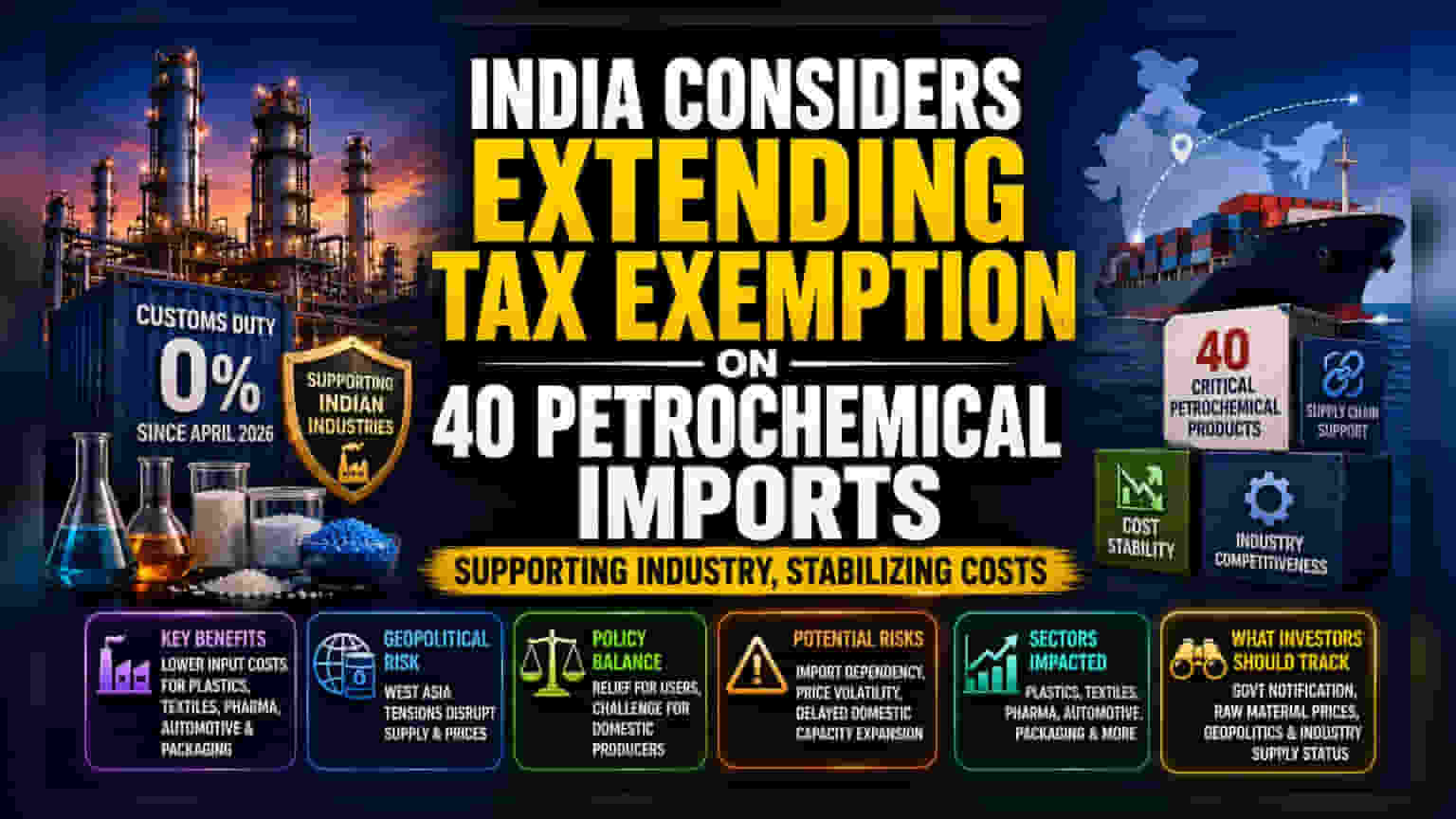


What Happened
The Indian government is considering an extension of the import tax exemptions currently applied to 40 critical petrochemical products. This measure, which reduced customs duties to zero, was initially introduced in April 2026 to support domestic industries facing supply chain bottlenecks and rising costs linked to the conflict in West Asia. Ravi Teja, a deputy director at the Department of Commerce, indicated on Tuesday that the final decision will depend on how the international situation evolves and the continued need for support among Indian manufacturers.
Why This Matters For Investors
The petrochemical industry provides essential raw materials for several major downstream sectors, including plastics, textiles, pharmaceuticals, automotive, and packaging. When these inputs face supply constraints or price volatility, the profit margins of downstream companies often come under pressure. By continuing the duty exemption, the government aims to keep production costs stable for these manufacturers. For investors, this decision is a key monitorable because it impacts the cost structure of companies that depend on imported feedstocks to create finished goods.
The Bigger Business Context
India remains a net importer of several key petrochemical feedstocks, despite having significant domestic production capacity. Geopolitical tensions in West Asia have previously disrupted global supply lines, leading to spikes in raw material prices. In the past, the government has even had to prioritize the diversion of locally produced petrochemical components to meet urgent needs like Liquefied Petroleum Gas (LPG) production for household use. This redirection of resources highlights how sensitive the domestic petrochemical supply chain is to external shocks.
For companies in the downstream space, such as those manufacturing plastic packaging or pharmaceutical intermediates, the cost and availability of these 40 specific petrochemicals are critical. If the duties were to return, these companies might face higher raw material costs, which they may or may not be able to pass on to end consumers, depending on market demand and competition.
How Investors May Read This
Investors typically view such policy decisions as a balancing act. On one hand, a tax exemption lowers the input costs for a broad base of manufacturing companies, which can protect their profit margins during difficult periods. On the other hand, petrochemical producers—the companies that manufacture these materials—may find it challenging to compete with cheaper, duty-free imports if the exemption continues for a long time. Investors in the sector often watch whether such exemptions are truly temporary or if they become a prolonged feature that alters the competitive landscape.
What Could Go Wrong
While the goal is to stabilize the industry, any extension comes with risks. Continued reliance on imported petrochemicals can leave Indian manufacturers vulnerable if global shipping routes remain disrupted or if prices in international markets surge unexpectedly. Furthermore, if the duty exemption stays in place for a long time, it could reduce the incentive for domestic companies to expand their own production capacity for these specific chemicals, as they might find it difficult to compete against duty-free imports. The volatility in global oil and gas prices remains a persistent risk factor that can quickly change the economics of the entire petrochemical value chain.
What Investors Should Track
The most important update for investors will be the official government notification regarding the extension of the duty waiver beyond June 30, 2026. Beyond the policy itself, investors may monitor the broader geopolitical situation in West Asia, as any further escalation could lead to fresh supply chain disruptions. Additionally, tracking raw material price trends and the operational status of major domestic petrochemical producers will provide insight into whether the industry is managing to keep costs under control.