

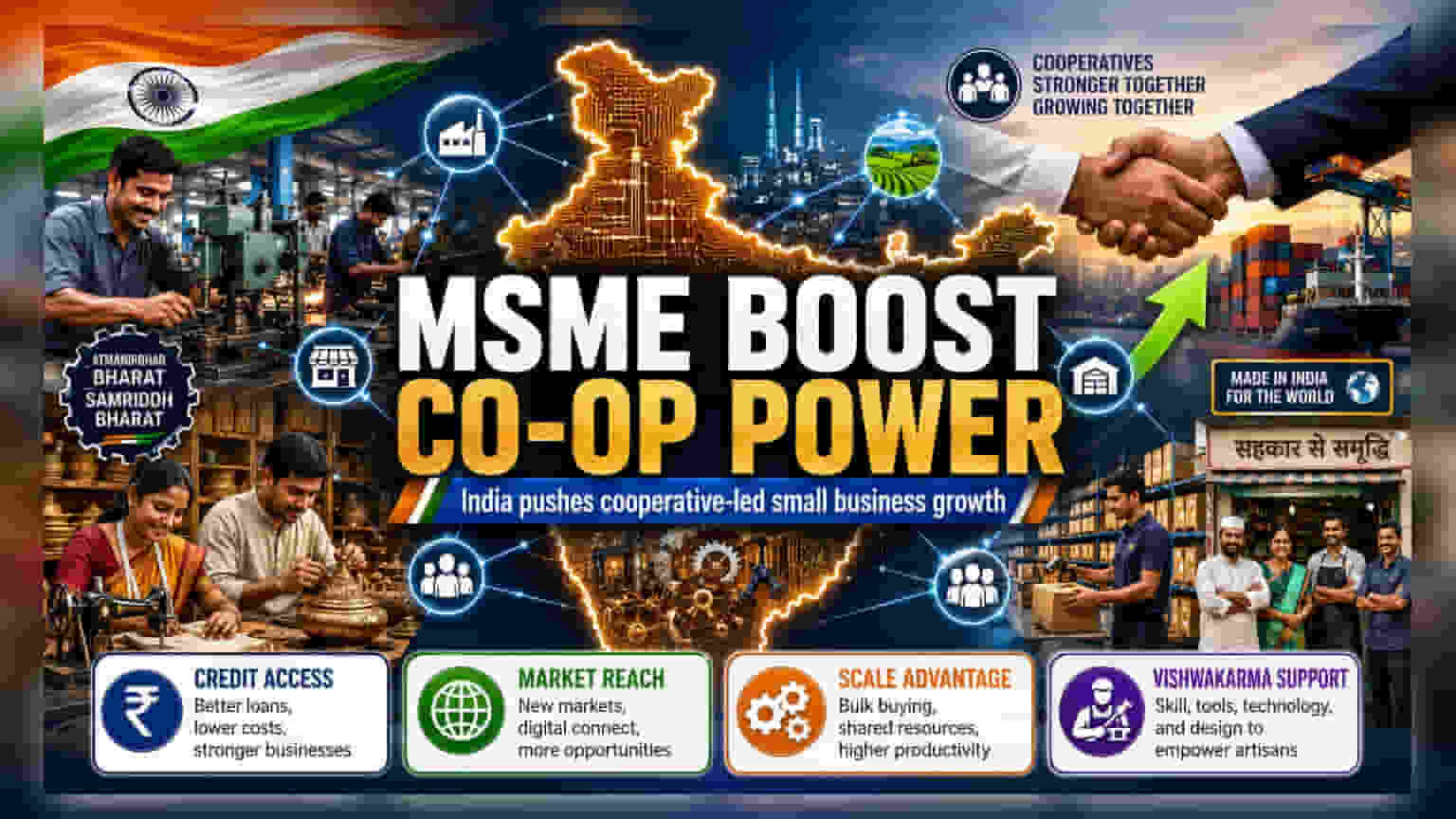
India celebrates MSME Day on June 27, highlighting the potential of integrating 50,557 cooperative entities into the formal MSME framework. This strategic alignment aims to boost employment and local value creation by leveraging the vast MSME network. For stakeholders, the focus remains on how policy support, like the PM Vishwakarma Scheme, can strengthen supply chains and broader industrial growth.
What Happened
India observes MSME Day on June 27, a significant date for the millions of micro, small, and medium enterprises that drive the nation’s economy. This year, the focus has shifted toward a strategic integration: blending the strength of the cooperative sector with the existing MSME framework. The objective is to utilize the scale of cooperatives—ranging from credit societies to agricultural marketing bodies—to solve challenges that individual small businesses often face, such as access to finance, market reach, and raw material procurement.
The Strategy: Why Cooperatives Matter
The Indian government is actively looking to bridge the gap between traditional cooperative models and modern MSME policy. With over 8.79 crore registered MSMEs and roughly 50,557 cooperative entities, the potential for collective action is high. Cooperatives, such as Amul in the dairy sector or IFFCO in fertilizers, have historically proven that community-owned models can achieve large-scale commercial success while maintaining social inclusion. By bringing these entities under the broader umbrella of MSME support schemes, policymakers aim to reduce the fragmentation that often plagues small-scale industrial units.
The Economic Backbone
The MSME sector remains a critical pillar of India’s economic growth, contributing significantly to employment generation and exports. Historically, the sector has accounted for a substantial portion of India's manufacturing output and total exports. The current focus on ‘Viksit Bharat@2047’ places these enterprises at the center of grassroots industrialization. Programs like the PM Vishwakarma Scheme, which provides skill development and credit to traditional artisans, represent the government's effort to formalize and upgrade these local units, helping them move up the value chain.
Challenges for Small Businesses
While the policy intent is to boost growth, the sector faces ground-level realities that investors and businesses should understand. Credit access remains the most prominent hurdle. Many small units struggle to secure affordable capital compared to larger corporations, often relying on informal lending channels. Furthermore, delayed payments from larger buyers continue to be a systemic issue, despite the existence of government portals meant to resolve these disputes. Regulatory compliance and the ability to modernize technology also remain significant barriers for smaller firms trying to compete with larger, organized players.
What Investors Should Track
For those monitoring the industrial and manufacturing space, the effectiveness of this MSME-cooperative synergy will be key. Investors should watch for improvements in the credit flow to these sectors, as reported in banking sector data, and the speed at which government schemes like the PM Vishwakarma initiative translate into measurable capacity expansion. Additionally, the ability of these small enterprises to integrate into global supply chains—partly through the economies of scale offered by cooperatives—will be an important indicator of the sector's long-term health and export competitiveness.