 Whalesbook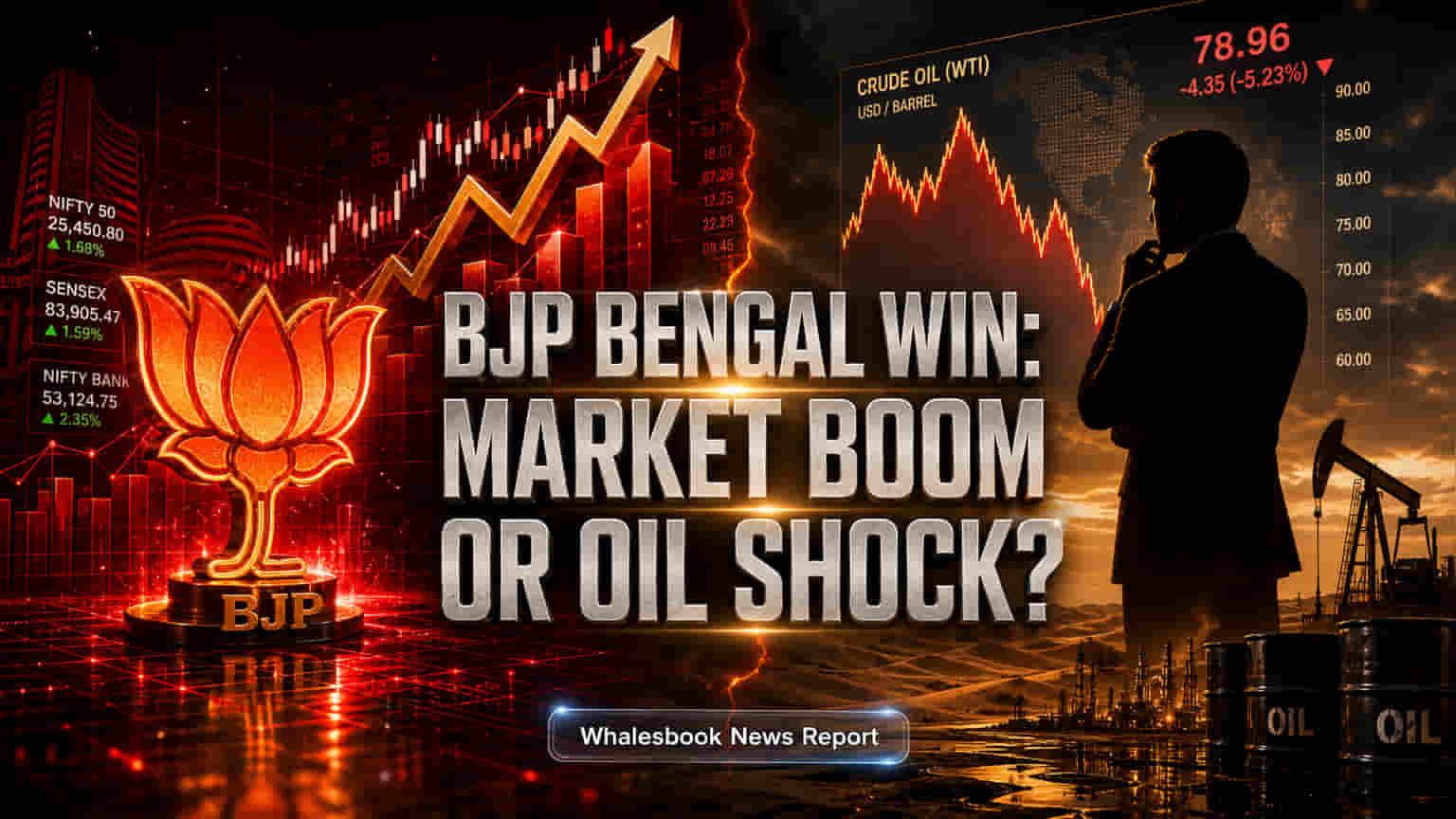


Market View: West Bengal Election Hopes Clash with Global Pressures
The market is factoring in the anticipated outcome of the West Bengal assembly elections, with analysts suggesting a Bharatiya Janata Party win could spur short-term investor interest and potentially unlock greater corporate investment. The prospect of stable, investor-friendly policies is seen as a catalyst for sectors like real estate and automobiles. West Bengal's economy is projected for robust growth, with an estimated 7.62% expansion in FY26, reaching a nominal Gross State Domestic Product (GSDP) of Rs 19.91 lakh crore. However, this optimism faces challenges from broader macroeconomic and geopolitical concerns, including elevated crude oil prices and sustained foreign institutional investor (FII) divestment from Indian equities.
Local Growth Potential: What a BJP Victory Could Mean for West Bengal
Should the BJP secure a victory in West Bengal, the expectation is for a more conducive environment for corporate investment, potentially reversing trends of industries moving out of the state. Sectors such as real estate and automotive are poised for revival. The state's ambition to grow its economy is seen as more attainable under pro-growth policies. West Bengal's projected GSDP of Rs 19.91 lakh crore for FY26 indicates positive momentum.
Economic Comparison: West Bengal's Growth vs. Larger States
While West Bengal shows growth potential, its projected FY26 GSDP of Rs 19.91 lakh crore lags behind economic powerhouses like Maharashtra (projected Rs 51 lakh crore GSDP in FY26) and Uttar Pradesh (projected Rs 36 lakh crore GSDP in FY26), highlighting the scale of the challenge ahead. Furthermore, West Bengal's debt level approaching Rs 8 lakh crore raises fiscal sustainability questions, in contrast to states like Uttar Pradesh which maintain more favorable debt-to-GSDP ratios.
Valuation and Sectoral Trends: Navigating Market Sentiment
The Indian equity market, represented by the Nifty 50, currently trades at a Price-to-Earnings (P/E) ratio of approximately 20.9, which is slightly above its 10-year average of 24.79. The auto sector carries a higher P/E of around 30.7 for the Nifty Auto index, with the broader auto industry average P/E at 21.6. Notably, both the auto and realty indices have faced corrections of approximately 15% amid geopolitical tensions. This suggests that while domestic political developments may offer specific stock opportunities, broader sectoral health faces external pressures.
Global Headwinds: Oil Price Surge and Foreign Investor Selloff
The optimistic narrative surrounding domestic political events is tempered by escalating geopolitical risks and persistent FII selling. The ongoing conflict in West Asia continues to exert upward pressure on crude oil prices, which stood at approximately $108 per barrel on May 4, 2026. Analysts predict prices could remain elevated, with risks of exceeding $100 per barrel through 2026. This scenario directly impacts India's import bill, fuels inflation concerns, and constrains monetary policy flexibility. Concurrently, foreign investors have demonstrated a consistent aversion to Indian equities in 2026. FIIs divested over Rs 60,847 crore in April alone, bringing cumulative outflows in the first four months of the year to Rs 1.92 lakh crore, surpassing total outflows for the entirety of 2025. This trend, totaling over $20 billion in early 2026, is driven by global uncertainties, India's relatively higher valuations compared to peers, and concerns over the impact of high oil prices on growth.
Investor Outlook: Strategy Amidst Competing Forces
Despite prevailing macro headwinds, domestic fundamentals remain supportive for the Indian market. While the immediate future may be range-bound due to geopolitical and FII pressures, there is an expectation of improved corporate earnings growth in FY27. Investors are advised to remain selectively invested, focusing on specific opportunities rather than broad market plays, as the market navigates a complex interplay of local political events and potent global economic forces. Persistent high crude oil prices remain a key swing factor influencing growth, inflation, and monetary policy.