

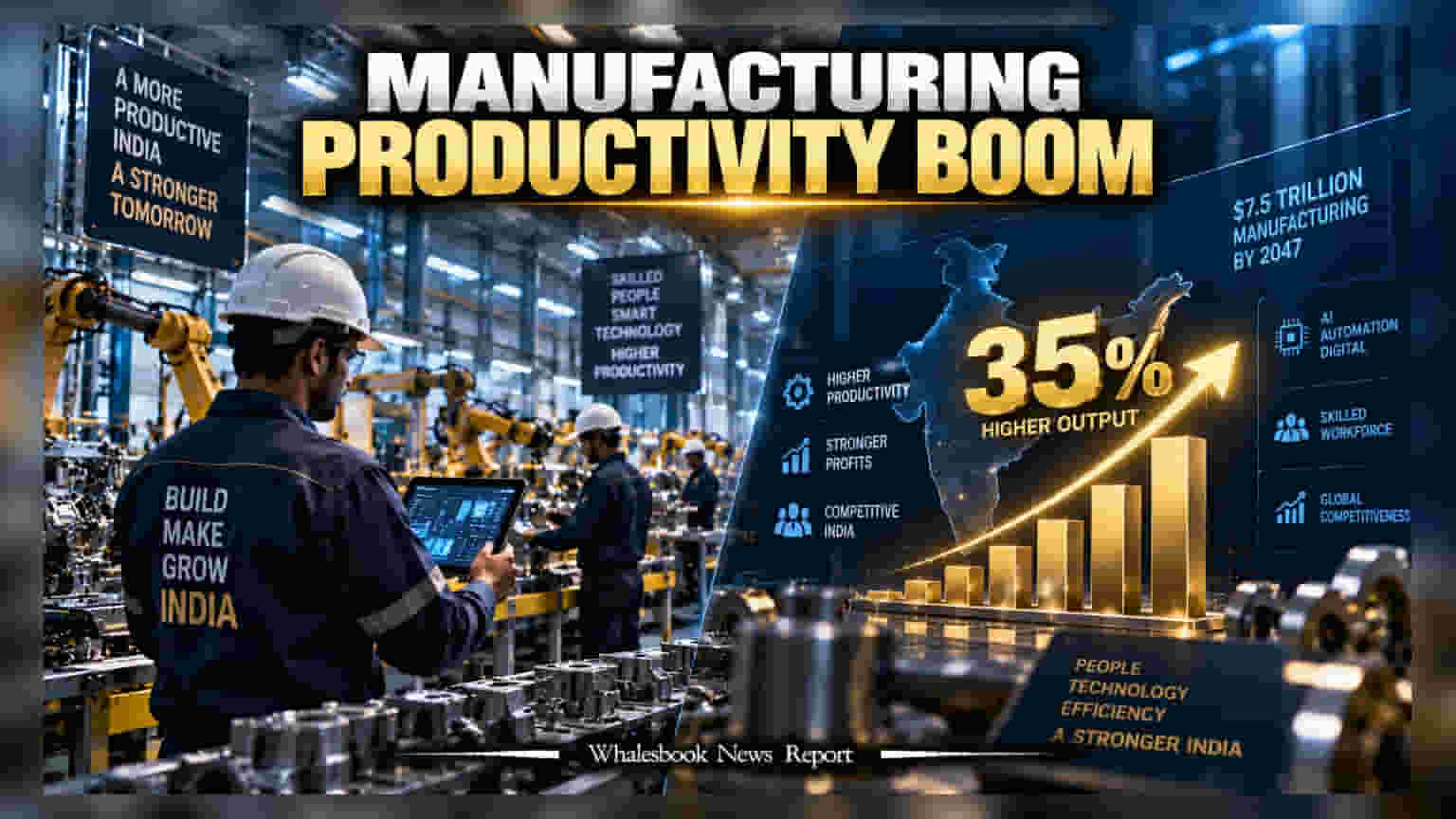
A KPMG report suggests India’s manufacturing sector can drive 35% of future output through a 30% rise in workforce productivity. Investors should monitor how firms modernize operations, as data shows productivity-focused companies outpace peers in profit and market value.
A recent report by KPMG has identified workforce productivity as the primary lever for India’s manufacturing sector to reach its target of $7.5 trillion by 2047. The analysis reveals that a sustained 30% improvement in productivity could contribute roughly 35% of the total manufacturing output in the coming years. This suggests that future growth will depend more on how efficiently companies use their labor and technology than on simply expanding in size or relying on current demand trends.
For investors, the report highlights a clear link between operational efficiency and stock performance. Data tracking over 130 large manufacturing companies shows that organizations prioritizing productivity recorded annual net profit increases of 10% to 11%, significantly higher than the 7% growth seen by their average peers. This trend extends to shareholder value, with productivity-focused companies achieving a 19% compound annual growth rate in market capitalization, nearly double the 10% growth rate of those with standard efficiency levels. These figures indicate that operational refinement can serve as a buffer against market volatility.
However, the sector faces significant hurdles. The report points to a potential shortfall of $4.8 trillion by 2047 if the manufacturing sector continues at its current 7.9% compound annual growth rate instead of the required 13.1%. A major risk identified is the "productivity illusion," where companies mistake high activity levels for true performance, masking underlying inefficiencies. Furthermore, there is a wide structural gap in the industry. Smaller, unorganized facilities currently produce less than 20% of the output per worker compared to larger entities, creating a bottleneck that hinders the country’s broader industrial competitiveness.
KPMG estimates that over 70% of large manufacturing firms need fundamental changes to their organizational structure and workforce deployment to meet these growth targets. The report emphasizes that long-term success requires moving beyond simple scale-based expansion. Instead, it suggests a shift toward digital integration, including the use of artificial intelligence and updated performance management systems.
As investors look at the industrial sector, the key monitorable will be how companies navigate this transition. Future performance will likely favor firms that can successfully implement these operational shifts rather than those relying on traditional methods. Tracking management commentary on capacity utilization, digital spending, and workforce efficiency will be essential to gauge which companies are positioning themselves to capture this growth.