

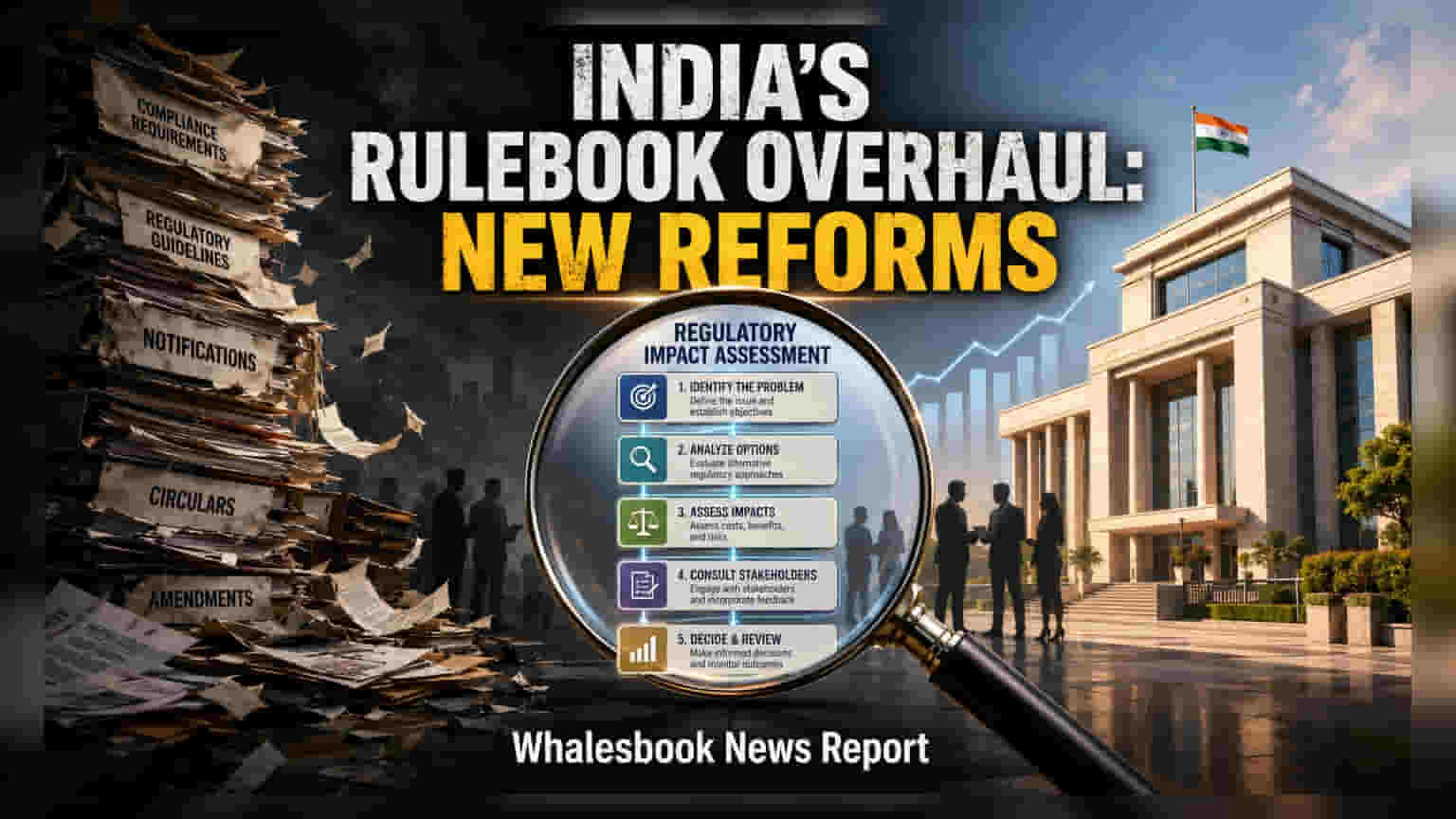
The Department for Promotion of Industry and Internal Trade (DPIIT) has introduced a new Regulatory Impact Assessment (RIA) guidebook to help government ministries evaluate the impact of new rules. This framework aims to reduce policy uncertainty by moving from ad-hoc decisions to evidence-based regulations. Investors will be watching how effectively government departments adopt this approach, as it could lead to more stable and predictable business environments.
The Department for Promotion of Industry and Internal Trade (DPIIT) has released a new Regulatory Impact Assessment (RIA) guidebook for Union ministries and departments on August 11, 2026. This initiative is a step toward making the government's rule-making process more scientific and structured. Instead of introducing regulations based on immediate reactions, the guidebook provides a toolkit to evaluate the costs, benefits, and potential side effects of any new rule before it is implemented.
Why Policy Predictability Matters for Business
For investors and companies, sudden policy shifts can disrupt operations and create uncertainty. Often, a well-intentioned rule—such as a ban on a specific product category—can lead to unintended consequences, such as forcing users toward unregulated offshore platforms or disrupting supply chains. The new RIA framework, which includes a toolkit developed by CUTS International, is designed to catch these problems early. By requiring ministries to scientifically assess the impact of their decisions, the government hopes to create regulations that are stable and better aligned with economic realities.
This move is part of the broader 'Viksit Bharat-by-2047' initiative. It reflects a shift in approach, moving away from 'ad-hoc' rule changes toward a system that treats regulation as a tool that should be carefully calibrated rather than just applied or removed.
Implementation Challenges and Real-World Risks
While the guidebook provides a roadmap, the real test lies in how government departments actually use it. A major risk is bureaucratic inertia. Government bodies are often accustomed to traditional methods of rule-making, and shifting to a data-driven, evidence-based process requires a significant change in culture. Critics have noted that without statutory backing—meaning a legal requirement to follow these assessments—departments might treat the guidebook as optional rather than mandatory.
Another concern is the potential for bias. If a ministry conducts its own impact assessment, there is a risk that the analysis might be skewed to justify a pre-decided policy. Establishing independent oversight bodies or using neutral third-party assessments would be necessary to ensure the process remains objective. Additionally, if the process becomes too time-consuming, it could lead to delays in necessary policy decisions, creating a different kind of bottleneck for businesses.
What Investors Should Monitor
This policy framework is not a direct trigger for stock market movements, but it is an important development for the long-term business environment. Investors should monitor how different ministries start using this guidebook in upcoming policy drafts. If major departments in sectors like technology, manufacturing, or finance begin to publish impact assessments for new rules, it would signal a genuine shift toward more stable policy-making. Conversely, if the framework is ignored in practice, it may limit the actual benefit to the ease of doing business. The next key update will be observing the adoption rate of these guidelines across various government departments and whether this leads to more transparent rule-making processes.