

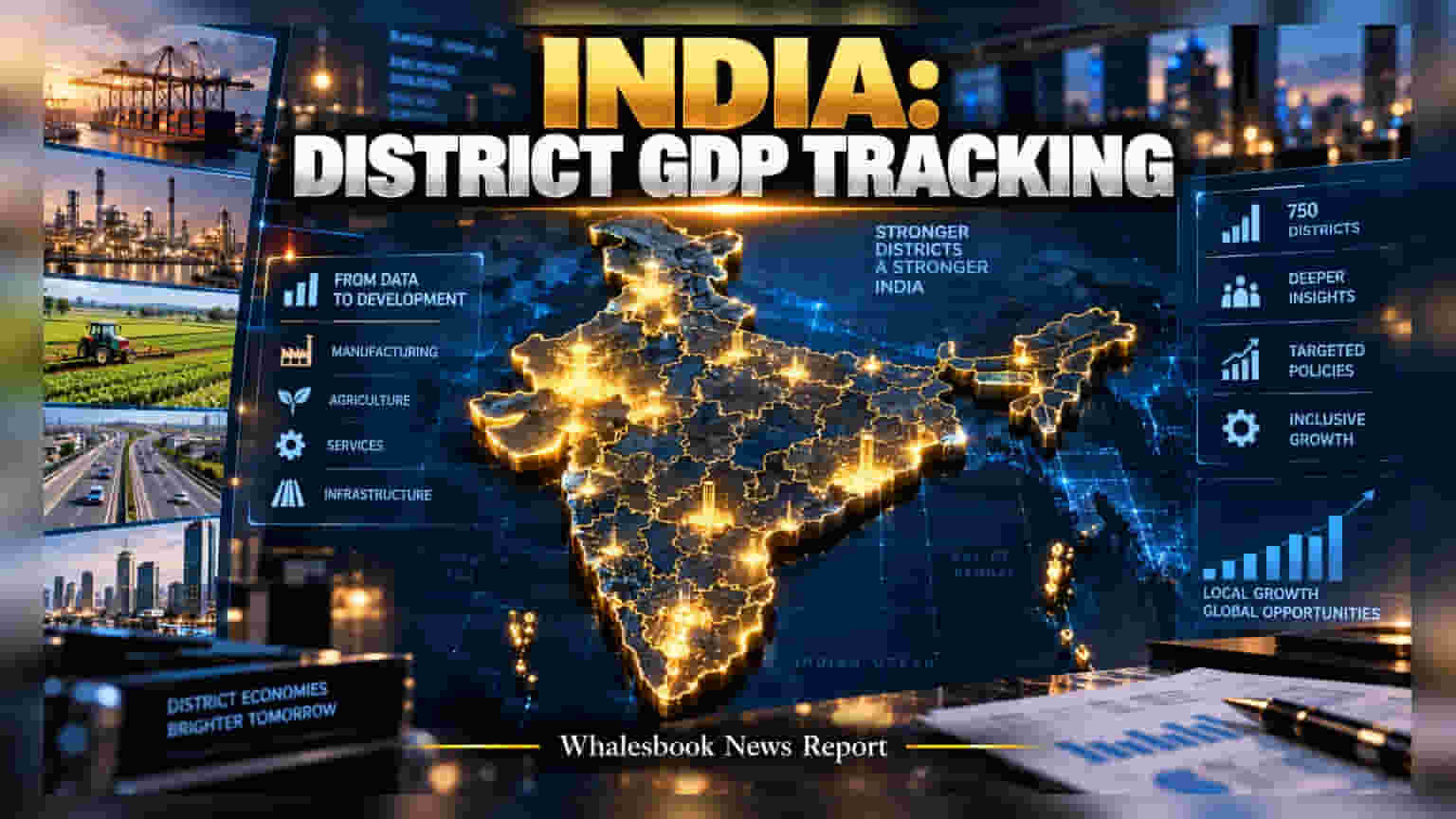
The Ministry of Statistics and Programme Implementation has introduced new guidelines for calculating District Domestic Product (DDP). This shift from state-level reports to district-specific data will help officials identify economic clusters and development gaps. For investors, this granular tracking offers a clearer picture of regional growth, industrial corridor strength, and infrastructure investment patterns across India.
The Ministry of Statistics and Programme Implementation has officially released new, uniform guidelines to track District Domestic Product, or DDP. This move marks a significant change in how India measures its economic health, shifting the focus from broad state-level Gross State Domestic Product (GSDP) figures to more specific, district-level data. By breaking down the economy into smaller units, the government aims to uncover localized growth patterns that often remain hidden within larger state averages.
For decades, GSDP has acted as the main benchmark for state economic performance. However, this metric can be misleading. A state might report strong overall growth driven by a few prosperous cities, while other districts in the same state remain economically stagnant. This broad aggregation masks severe internal disparities, making it difficult for policymakers to understand where economic activity is actually concentrated and where it is lacking.
Recent data suggests that the Indian economy is highly concentrated. Roughly half of India’s GDP is produced by just five states. Diving deeper, about 100 districts out of the total 750 account for 85% of the country’s GDP and 87% of its exports. This reality shows that growth is often limited to specific industrial clusters, logistical corridors, and metropolitan centers rather than being spread evenly across the country. The new DDP guidelines are designed to map these specific hubs more effectively.
This shift toward granular data has direct implications for public policy and investment. Currently, policymakers often struggle to allocate funds for infrastructure, industrial corridor development, and skilling programs because they lack clear, local-level economic data. With DDP in place, the government can adopt a more targeted, place-based approach. If two states show identical growth rates of 8%, the DDP data will reveal whether that growth is broad-based across manufacturing and services, or if it is coming from a single booming district.
For the investment community, this development is a long-term monitorable. As the government aims for its 2047 development goals, this statistical framework will likely guide future public spending. Regions identified as emerging economic corridors or under-indexed areas might receive greater attention, potentially affecting industrial policy, land allocation, and infrastructure rollout. By making local economies visible, the government is creating a diagnostic tool to ensure that growth is not just a high-level headline figure, but a tangible change in local industrial and service-sector capacity. Investors and analysts may track these upcoming district-level releases to better assess which regions are gaining industrial momentum and which areas are struggling to participate in the broader economic expansion.