

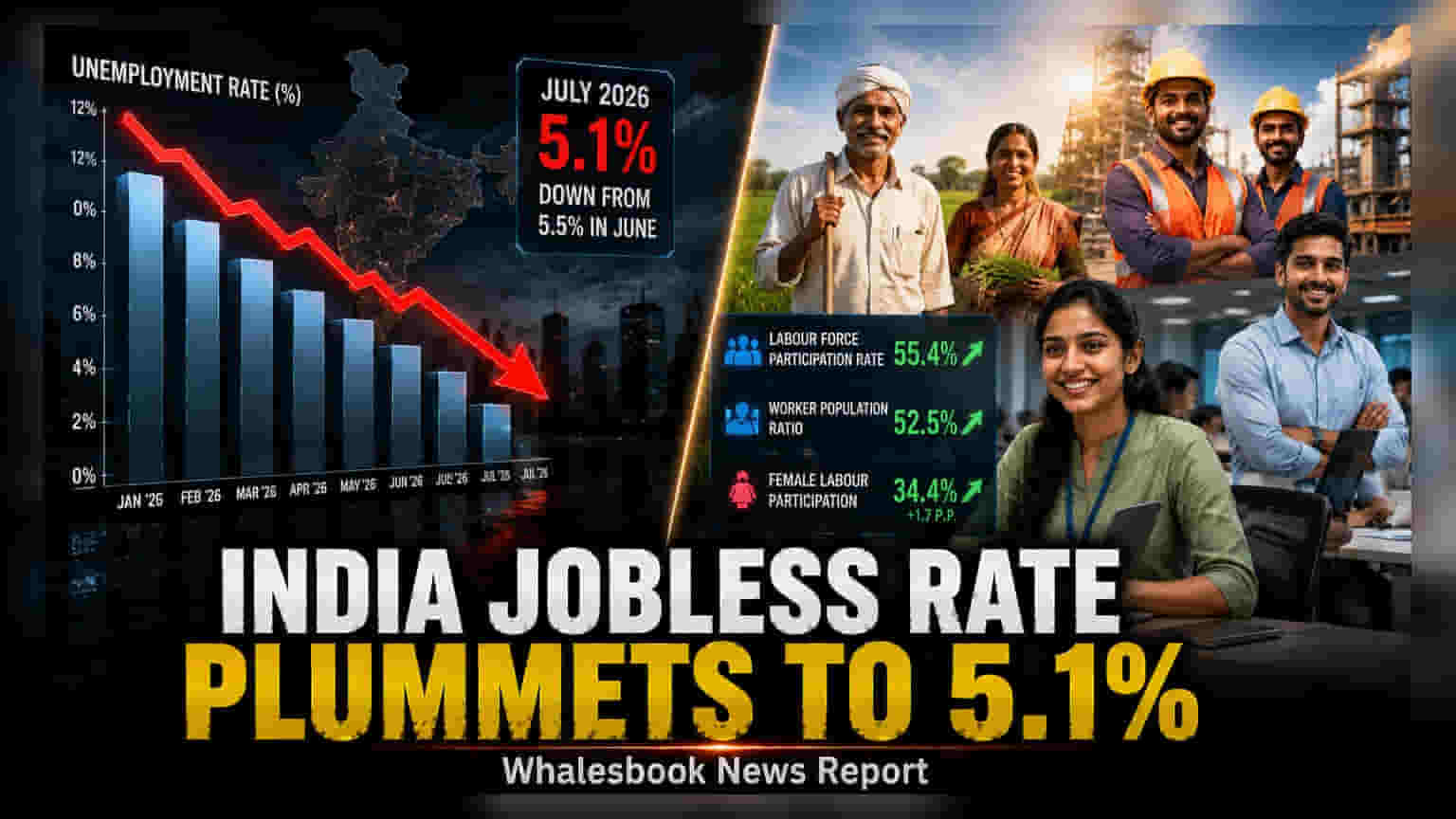
India’s unemployment rate fell to 5.1% in July 2026, performing better than the 5.4% market expectation. While rural job availability improved significantly, urban unemployment showed a slight increase. Investors are now balancing these employment trends against cooling manufacturing activity and future monetary policy signals.
India’s labor market showed signs of resilience in July 2026 as the unemployment rate dropped to 5.1%, a level lower than the 5.4% predicted by market analysts. This decline from the 5.5% reported in June suggests that more people are successfully entering or returning to the workforce.
Several key metrics highlighted this positive trend. The Labour Force Participation Rate, which measures the percentage of people who are working or actively looking for jobs, increased to 55.4% in July from 54.4% the previous month. Additionally, the Worker Population Ratio reached 52.5%, marking its first rise since February 2026. These figures indicate a broader engagement of the working-age population in economic activities.
Driving the overall improvement was a recovery in rural employment. Rural unemployment fell to 4.5% in July, down from 5.0% in June. This was complemented by a rise in female labor participation, which grew by 1.7 percentage points to 34.4%.
However, the economic picture has mixed elements. While rural job numbers were strong, urban unemployment saw a slight uptick, rising to 6.7% from 6.6% in June. This divergence highlights a structural challenge where job creation in formal urban sectors, such as services and technology, remains uneven compared to the rural recovery.
Investors are also looking at how these employment figures align with broader industrial health. While employment numbers are encouraging, recent data indicated that manufacturing activity in India hit a five-year low in July. This contrast is important because employment can sometimes lag behind industrial cycles. If manufacturing activity remains under pressure, it may affect future job creation in the formal sector.
The Reserve Bank of India (RBI) often looks at these labor trends alongside inflation data when deciding on interest rates. While a strong labor market can support consumer spending, the central bank’s primary focus remains on keeping inflation within its target range. Therefore, while falling unemployment is a positive indicator for domestic consumption, policy decisions will likely continue to be driven by price stability rather than employment numbers alone.
Looking ahead, stakeholders will monitor upcoming monthly economic data to see if the rural employment recovery continues and if urban job creation can pick up pace. Tracking the balance between consumption demand and manufacturing output will be essential for understanding the direction of the economy in the coming months.