

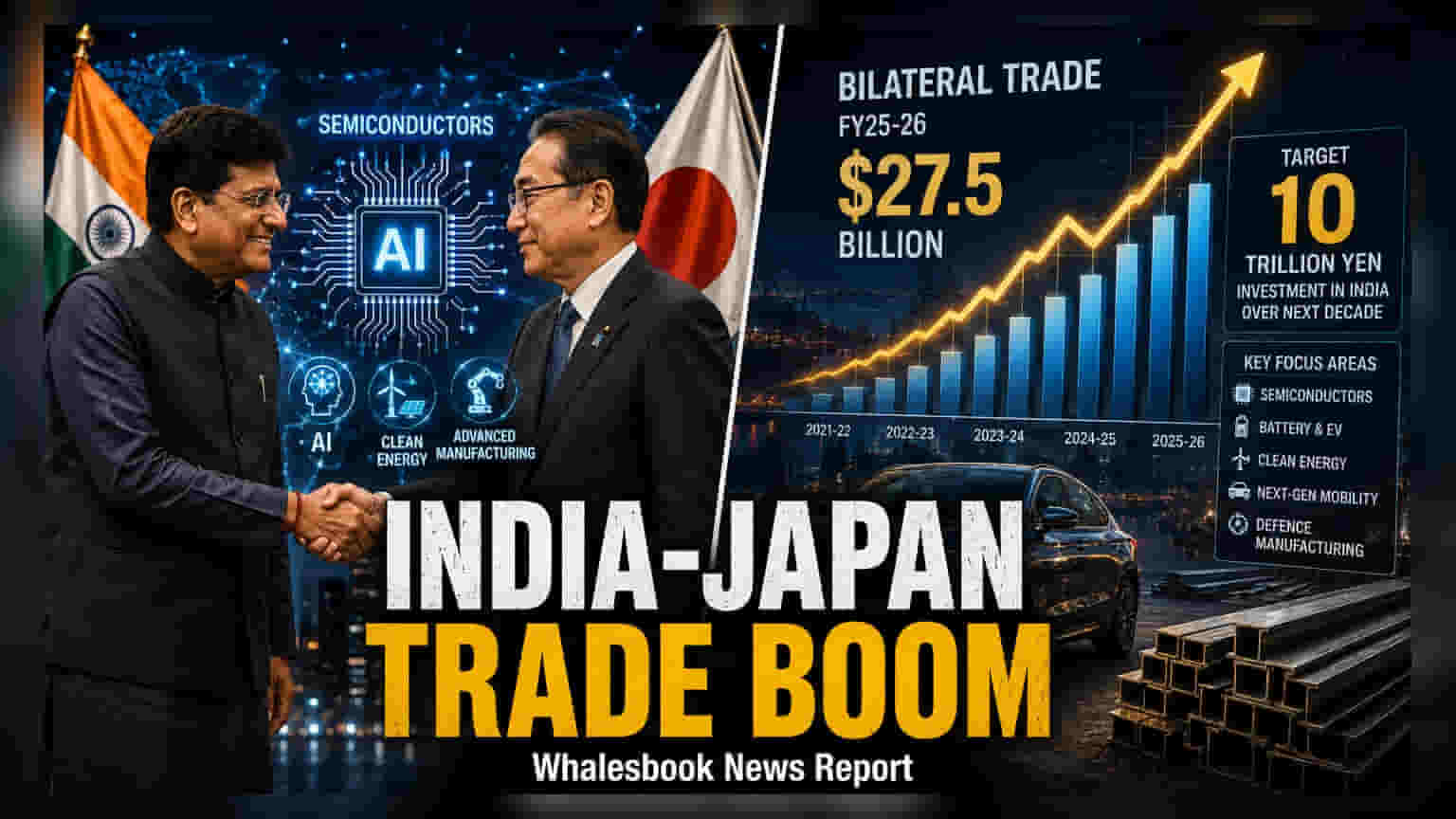
Commerce Minister Piyush Goyal is leading a 200-member delegation to Japan to drive investment in semiconductors, AI, and green energy. This push supports the target of 10 trillion yen in Japanese investment over the next decade. Investors are tracking potential benefits for the manufacturing, defense, and technology sectors, even as negotiators aim to address existing trade imbalances.
Union Commerce and Industry Minister Piyush Goyal is leading India’s largest-ever business delegation, consisting of over 200 representatives, to Japan this week. The mission, running from August 24 to August 27, 2026, aims to strengthen the ‘Special Strategic and Global Partnership’ between the two nations, moving beyond traditional trade to focus on high-technology growth areas.
Strategic Shift Toward High-Tech Industries
The primary focus of this visit is to accelerate technology transfer and industrial collaboration. While Japan has long been a key partner in the automobile and steel sectors, the current discussions are shifting toward advanced manufacturing. The delegation plans to engage with the Japan Business Federation (Keidanren) and regional industrial bodies to explore specific joint ventures in semiconductors, artificial intelligence, and clean energy.
This initiative aligns with the ambitious goal announced by both governments to attract 10 trillion yen in Japanese investment into India over the next decade. For investors, this shift represents a potential long-term boost for companies operating in the semiconductor ecosystem, battery production, and critical mineral processing. Strengthening these supply chains is a core objective for both countries as they look to reduce dependence on China for essential technology components.
Balancing Trade and Investment Flows
While investment momentum is high, the trade relationship faces scrutiny regarding its current structure. Bilateral trade reached approximately $27.5 billion in the 2025-26 fiscal year. However, government officials have indicated that this figure remains below the true potential of the two economies. India has been advocating for a review of the existing trade agreement to create a more balanced environment, as the current gap between imports and exports remains a point of negotiation.
Japan remains a top-five source of foreign direct investment for India, with over 1,400 companies already present. The current government focus is on improving the ease of doing business to ensure that the planned 10 trillion yen in capital enters the country effectively. Sectors such as defense manufacturing and next-generation mobility are expected to be primary beneficiaries if these discussions translate into concrete project approvals.
Key Challenges for Long-Term Execution
Investors should consider the risks inherent in large-scale international industrial partnerships. Success depends on the ability of the private sector to scale projects and the government's ability to provide infrastructure readiness and policy stability. Transitioning supply chains away from existing dependencies, such as those involving Chinese battery components, involves significant operational and financial complexity. Furthermore, the goal to rebalance trade flows may lead to extended negotiations, which could impact the speed at which new trade concessions are implemented. Market watchers will monitor future updates on specific deal announcements and project commissioning timelines resulting from this mission.