
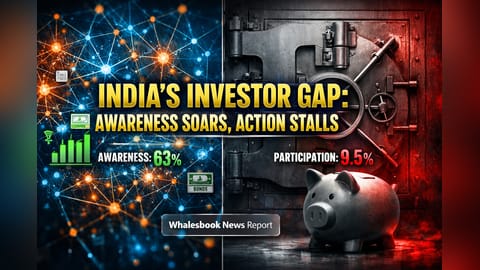
The Disconnect: Awareness vs. Action
India's capital markets have seen significant transformation and expansion over the past decade. Despite this growth and product diversification, investor engagement has not kept pace. A large gap exists between awareness of financial products and actual investment, suggesting deeper issues than just financial literacy.
Market Growth vs. Investor Engagement
Investor numbers have surged, with over 15 crore demat accounts opened by March 2024. However, active participation remains low. The Indian equity market, as tracked by the Nifty 50 index, boasts a market capitalization of approximately ₹1,83,55,757 crore and a P/E ratio around 20.0 as of early April 2026. Strong domestic liquidity supports this market. Retail investors now hold a significant 18.75% of NSE market capitalization as of Q2 FY26, the highest in 22 years. Yet, this rise in account numbers doesn't translate into widespread, confident investing.
Barriers to Entry: Trust and Risk
India's equity market penetration stands at about 8% of the adult population, well below the US (62%) and China (13%). This indicates substantial untapped potential. However, the SEBI survey highlights deep-seated behavioral patterns and hesitancy. Globally, the OECD's 2026 Consumer Finance Risk Monitor notes that consumers navigate challenging financial environments. They face pressures from the economy, low financial literacy, high debt, and a growing distrust fueled by digital risks, scams, and fraud.
Inflation in India adds another layer to investor behavior. While rising prices might encourage a move from low-yield fixed deposits to assets like equities and mutual funds for inflation-beating returns, the fear of volatility and potential losses often stops investors. The same digital platforms that have made market access easier also bring fears of sophisticated scams, unclear algorithms, and data breaches, creating a major barrier for many. SEBI is working to improve regulations, with recent amendments to LODR Regulations for transparency and accountability, and launching initiatives like the Verified App Label. However, a fundamental trust deficit remains a major obstacle. SEBI's focus on financial literacy is vital but may not fully overcome the psychological barriers and distrust identified by behavioral finance.
Deep-Seated Caution and Systemic Hurdles
Despite SEBI's efforts, the gap between awareness and participation highlights structural problems. While SEBI's investor protection measures are crucial, frequent regulatory changes can create compliance burdens for smaller market players and affect competition. Digital fraud, from phishing to impersonation, remains a serious threat that education alone might not fully stop. A single major scam can leave lasting fear and deter many potential investors. Investor choices are also shaped by how well grievance redressal works, the nature of competing financial products, and tax policies. These factors mean that simply knowing about markets isn't enough. With nearly 80% of households preferring to preserve capital and being low-risk, there's a deep-seated caution. Digital access hasn't changed this conservatism much. This caution, combined with fear of scams and distrust of digital platforms, creates strong resistance that SEBI's current methods may struggle to overcome.
Moving Forward: Building Trust and Participation
To increase investor participation sustainably, a strategy beyond just financial education is needed. Collaboration among regulators, cybersecurity experts, and financial institutions is essential to protect the digital investment environment from new threats. Adapting investor protection rules for emerging risks, simplifying financial products, and building trust are crucial steps. Analysts note that while retail participation has grown, its quality and depth need development. A comprehensive approach addressing investor psychology and systemic issues is key to unlocking India's market potential.