 Whalesbook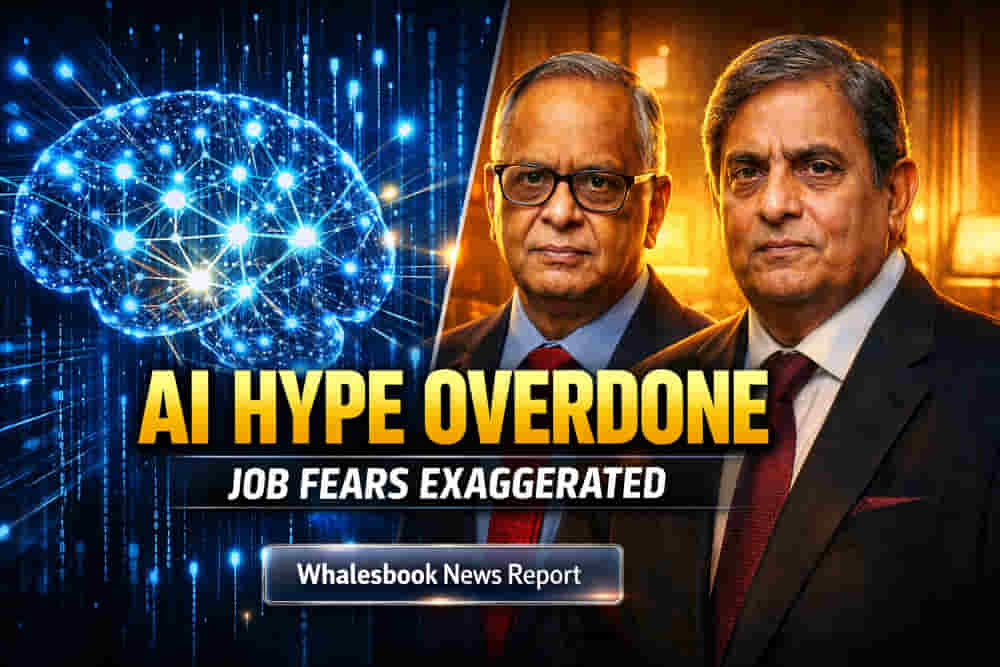


Institutional Wisdom vs. AI Hype: Indian Titans Champion Enduring Profitability Amidst Tech Frenzy
In a rare joint appearance, industry stalwarts NR Narayana Murthy, co-founder of Infosys, and Aditya Puri, former CEO of HDFC Bank, have provided a sobering perspective on the prevailing market sentiment, advocating for fundamental business principles over speculative technological trends and short-term financial engineering. Their dialogue serves as a critical institutional signal amidst a period marked by rapid AI advancements and an ebullient startup IPO market.
The Pragmatic Core: Profitability and Fairness
Puri and Murthy unequivocally emphasized the primacy of unit profitability and long-term value creation. Puri dismissed metrics like adjusted EBITDA as obfuscations, asserting that "You either have unit profit... If you don't have bottom line, it doesn't work." He underscored that the fundamental purpose of business lies in profit, employment generation, growth, and fairness. Murthy echoed this by advocating for "deferred gratification," urging entrepreneurs to make short-term sacrifices for sustainable medium- and long-term returns. This focus on tangible financial health stands in contrast to some new-age startups prioritizing rapid scaling and market share, often through significant investor funding. As of February 2026, Infosys trades with a P/E ratio of approximately 17.83-19.85, while HDFC Bank's P/E stands around 18.10-22.40, figures that analysts scrutinize, particularly when compared to sector averages.
AI's Measured Impact: Adaptation, Not Annihilation
The leaders countered widespread anxiety surrounding AI-driven job losses, particularly within the IT sector. Puri characterized the current AI discourse as excessively hyped, acknowledging that while some job roles will transform, mass unemployment is unlikely. He anticipates AI adoption unfolding over decades, involving a symbiosis between human and artificial intelligence. Murthy added that smart, disciplined individuals who master AI as an assistive technology will ultimately benefit. This view aligns with a recent ICRIER study (Nov 2025-Jan 2026) surveying IT companies, which found AI is reshaping work, enhancing productivity, and marginally impacting entry-level hiring, while demand for mid- and senior-level talent remains steady. This contrasts sharply with earlier projections in India's 2024-2025 Economic Survey, which warned of significant job displacement in the service sector due to automation. A report by Citrini Research, however, highlights a potential worst-case scenario by 2028 where AI coding agents could severely disrupt Indian IT majors like TCS, Infosys, and Wipro due to significantly lower costs, potentially impacting service exports and the rupee.
Analytical Deep Dive: Sectoral Dynamics and Market Valuations
The Indian banking sector remains underpenetrated, offering substantial growth prospects. Scheduled Commercial Banks' credit outstanding reached over ₹200 lakh crore by December 2025, with growth projected between 10.4-11.3% for FY26, though with a recalibrated focus on quality. Despite this underlying strength, HDFC Bank, with a market capitalization around $165-174 billion, faces analyst caution. One rating downgraded HDFC Bank to a "Sell" in February 2026, citing stretched valuations and headwinds, despite strong trading volumes and institutional delivery activity suggesting long-term investor accumulation.
In the IT services domain, while Infosys and TCS remain dominant in revenue and scale respectively, both are navigating AI's transformative potential. Wipro is often perceived as having a stronger focus on digital transformation and AI projects compared to TCS's integration approach for efficiency. The competitive landscape is intensifying, with reports suggesting that Wipro and Cognizant might trail Infosys and TCS if they fail to invest adequately in AI innovation and employee upskilling.
The Indian IPO market demonstrated remarkable buoyancy in 2025, with 18 startups raising INR 41,284 crore. India was the world's most active IPO market by volume in 2025. Looking ahead to 2026, 44 startups are expected to file for IPOs, aiming to raise INR 70,000 crore. However, caution persists, as over one-third of 2025 IPOs traded below issue prices by early 2026, underscoring the need for investors to look beyond market hype and focus on fundamental financial metrics.
The Forensic Bear Case: Structural Vulnerabilities
Despite positive macro indicators and sector growth, several risks loom. For the IT sector, the existential threat posed by AI coding agents represents a fundamental challenge to established business models built on cost arbitrage. Infosys's P/E ratio, while showing a recent decline, still necessitates strong earnings growth to justify its valuation, especially with a forward P/E in the lower quartile of its sector. HDFC Bank, despite its market leadership, faces potential valuation corrections, with some analysts issuing Sell ratings. The banking sector's profitability could also be affected by increased competition from fintech and potential stress in unsecured retail lending segments, even as overall credit growth remains robust. Furthermore, India's workforce faces a significant skills gap in AI, with only about 4% of firms having trained over half their workforce in AI skills. This lag in upskilling could hinder adaptation and create a vulnerability to displacement in sectors heavily reliant on human capital.
Future Outlook: Navigating Transformation
The confluence of technological advancement and evolving economic conditions demands a strategic re-evaluation. For IT companies, the imperative is to integrate AI not just as a tool for efficiency but as a driver of new service offerings, while simultaneously addressing potential disruption. Banks must continue to leverage digital innovation for customer reach and operational efficiency, balancing growth with prudent risk management and robust governance, especially as the IPO market matures and investors increasingly demand sustainable unit economics. The focus for entrepreneurs and enterprises alike must remain on building resilient, profitable businesses grounded in ethical practices and long-term vision.