 Whalesbook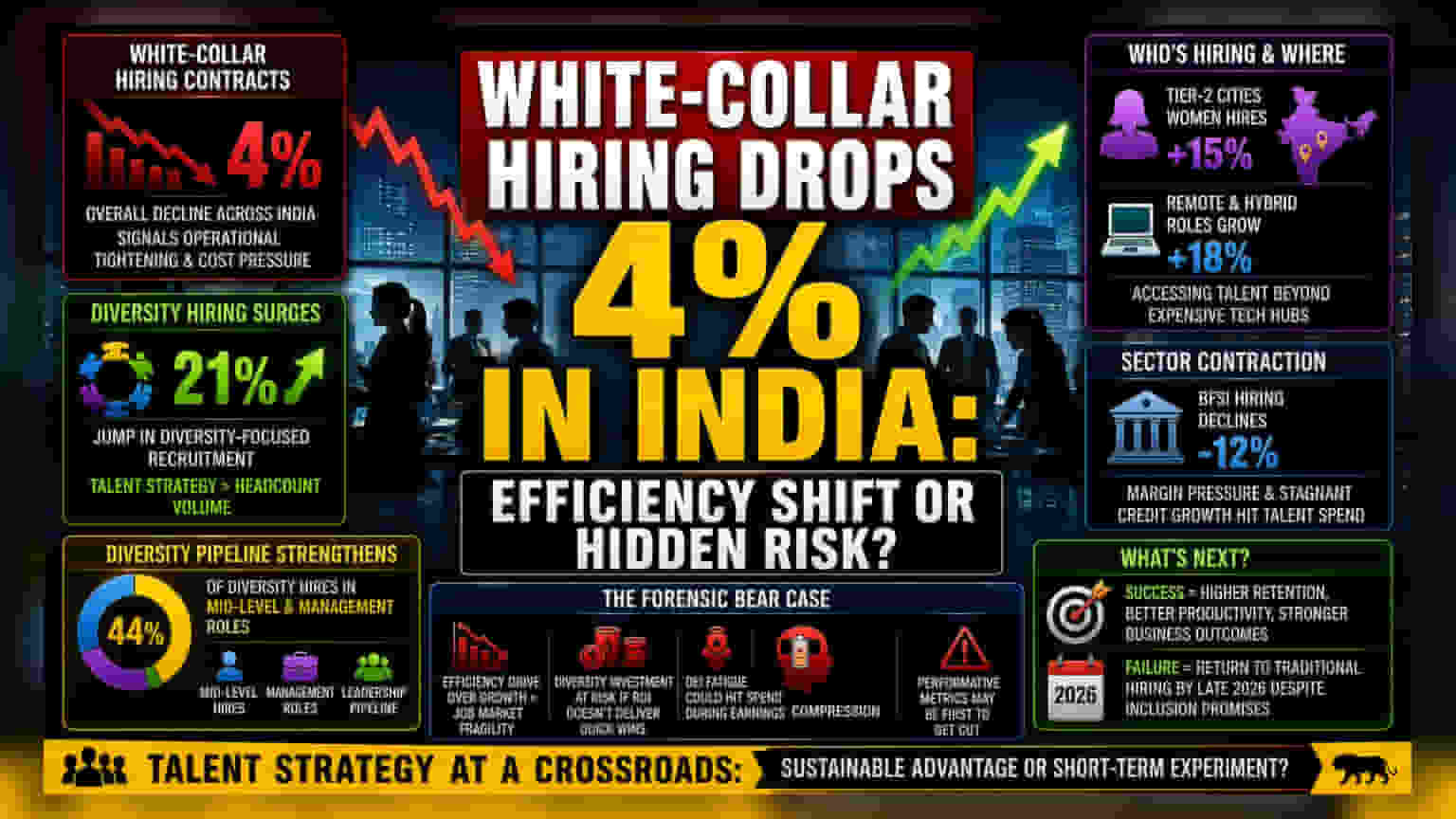


The Efficiency Paradigm
The 4% contraction in white-collar hiring across India is not merely a cyclical pullback; it is a manifestation of corporate operational tightening. When scrutinized against rising input costs and global capital market volatility, the data reveals a transition from growth-fueled acquisition to efficiency-focused talent selection. Firms are no longer rewarding headcount volume but are instead optimizing for specialized output, as evidenced by the 21% surge in diversity-focused recruitment, which functions as a proxy for identifying high-potential, non-traditional talent pools.
The Capital Allocation Shift
Unlike traditional hiring cycles, where human capital expenditure is tied directly to revenue growth targets, the current movement suggests a re-evaluation of long-term risk. By directing resources into neurodiverse and LGBTQIA+ hiring—segments that have seen significant expansion—companies are hedging against groupthink in high-stakes environments like software development and analytics. While the banking sector has retreated, effectively consolidating its DEI footprint due to margin pressures, the surge in Tier-2 city hiring for women-led roles highlights a geographic arbitrage strategy. Companies are leveraging remote and hybrid configurations to access talent beyond the expensive, overheated tech corridors of Bengaluru and Delhi-NCR.
The Forensic Bear Case
While the narrative emphasizes strategic inclusion, the underlying metrics suggest potential fragility. The sharp contraction in BFSI hiring indicates that sectors historically relied upon to stabilize the job market are now under pressure to manage overhead, likely due to stagnant credit growth or higher cost-of-capital environments. Furthermore, relying on senior leadership diversity to drive business strategy introduces a risk of execution lag. If these diverse, higher-cost appointments fail to deliver immediate efficiency gains, the focus on inclusion may be the first budget line item culled during the next quarterly earnings compression. There is also the reality of 'DEI Fatigue'—a documented phenomenon in Western markets where performative metrics are discarded when bottom-line profitability is threatened, a risk factor that remains unaddressed in current corporate disclosures.
Forward Trajectory
Institutional focus will likely pivot toward the success of these new hires in mid-level and management roles, which now constitute nearly 44% of the diversity intake. If these hires demonstrate superior retention and productivity metrics compared to traditional hires, the current model will institutionalize. However, if performance gaps emerge, expect firms to revert to conservative, legacy hiring practices by late 2026, regardless of current stated commitment to inclusive workforce goals.