 Whalesbook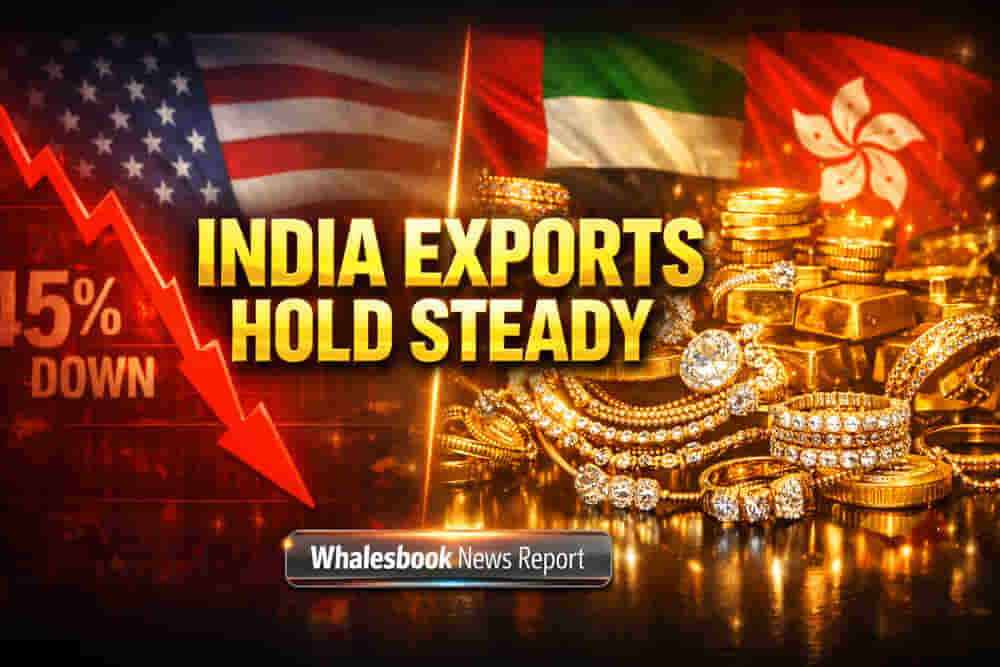


THE SEAMLESS LINK
This reported stability in aggregate export figures is not a sign of uniform sector health but rather a testament to exporters' strategic recalibration amidst significant market headwinds, most notably the dramatic contraction in trade with the United States. The resilience highlights a sector adept at navigating volatility through geographic diversification and product category adjustments.
The Core Catalyst: US Drag vs. Market Diversification
India's gem and jewellery sector navigated a challenging fiscal year, posting cumulative exports of $23.19 billion between April 2025 and January 2026, a marginal 0.64% decrease year-on-year in dollar terms, while a 3.57% increase was observed in rupee terms, reflecting currency fluctuations. This overall steadiness belies a severe 45% decline in shipments to the United States, India's largest export market. This sharp fall was largely attributed to elevated tariffs and pricing disadvantages, which disproportionately impacted diamonds and higher-value jewellery segments. However, a proactive strategy of market diversification proved effective in mitigating a steeper overall decline. Shipments to the United Arab Emirates surged by 23.7%, Hong Kong saw a 33.5% increase, and Australia and France each posted growth exceeding 36%. Other markets like Belgium, Thailand, and Israel also contributed with double-digit gains. This geographical pivot demonstrates the industry's capacity to adapt its trade flows away from over-reliance on any single market, a crucial development given past tariff shocks.
Diamonds Under Pressure, Jewellery Shows Resilience
The performance across product categories reveals a bifurcated market. Cut and polished diamond exports declined 7.46% to $9.97 billion, impacted by tepid consumer demand in key markets like the US and China, cautious retailer buying, and intensified competition from lab-grown diamonds (LGDs). The LGD segment itself experienced a value decline of 9.73% to $923.62 million, a direct consequence of global price softness driven by oversupply and aggressive competition, with wholesale prices seeing precipitous drops. This price collapse for LGDs has eroded consumer confidence in synthetic gems and pushed demand back towards natural stones.
In stark contrast, jewellery segments exhibited significant resilience. Total gold jewellery exports rose 5.53% to $9.71 billion, primarily propelled by studded gold jewellery. Plain gold jewellery saw a more modest increase, suggesting that higher gold prices, which surged to approximately $2,910.32 per ounce by March 2025, dampened demand due to price sensitivity. Silver jewellery exports witnessed an impressive 51.21% surge to $1.28 billion, benefiting from strong international demand and its positioning as an "affordable luxury" option amidst elevated gold prices. Platinum jewellery also performed strongly, climbing 49.09% to $215.15 million, driven by increasing acceptance in niche markets and price appreciation.
The Analytical Deep Dive
India's position as the world's largest diamond exporter, accounting for approximately 18.4% of global value in 2023, is being tested by a softening global market. While India maintained its lead, overall global diamond exports shrank by approximately 28% in 2024 compared to the prior year. The US market, a critical destination, saw its diamond imports from India decline sharply. The significant price crash in lab-grown diamonds, driven by overproduction in China and India, has created a challenging environment, with wholesale prices for LGDs falling over 58% in 2023 alone. This pressure on diamonds is juxtaposed against the strong performance of jewellery, particularly silver, which benefits from its industrial applications (solar panels, EVs) and its role as a more accessible luxury. The broader luxury market is showing signs of recovery, with US consumer demand holding up despite earlier decelerations, although European tourist spending has softened. The proposed India-US trade framework, which aims for 18% tariffs on jewellery and zero duty on diamonds and coloured gemstones, is seen as a critical development. This could significantly alter export trajectories, potentially adding up to $3 billion in annual exports by restoring competitiveness, especially considering the US's historical trade deficit with India in this sector.
⚠️ THE FORENSIC BEAR CASE
Despite the reported stability, underlying vulnerabilities persist. The sector's reliance on a few diversified markets, while successful in the short term, leaves it exposed to potential future trade policy shifts or economic downturns in those regions. The dramatic price collapse in lab-grown diamonds poses a significant risk, potentially devaluing inventory and eroding profitability across the supply chain, and further cannibalizing demand for natural diamonds. The overall global luxury market, while showing some green shoots, is still grappling with macroeconomic headwinds and evolving consumer tastes, making future demand uncertain. Furthermore, the Indian rupee's depreciation against the US dollar, while aiding exporters by making their goods cheaper abroad, also increases the cost of imported raw materials and can lead to capital outflows, adding another layer of financial complexity. Historical tariff actions by the US administration underscore the potential for abrupt policy changes that can swiftly impact trade flows.
The Future Outlook
The future trajectory for India's gem and jewellery exports hinges on the successful implementation of the India-US trade framework and ongoing domestic reforms. Measures aimed at improving ease of doing business, customs efficiency, and access to finance are expected to reduce transaction costs and improve liquidity. Industry leaders remain optimistic that these combined efforts, alongside the continued exploration of new markets, can support recovery in FY27 and align with the ambitious long-term goal of scaling gem and jewellery exports to $100 billion by 2047.