

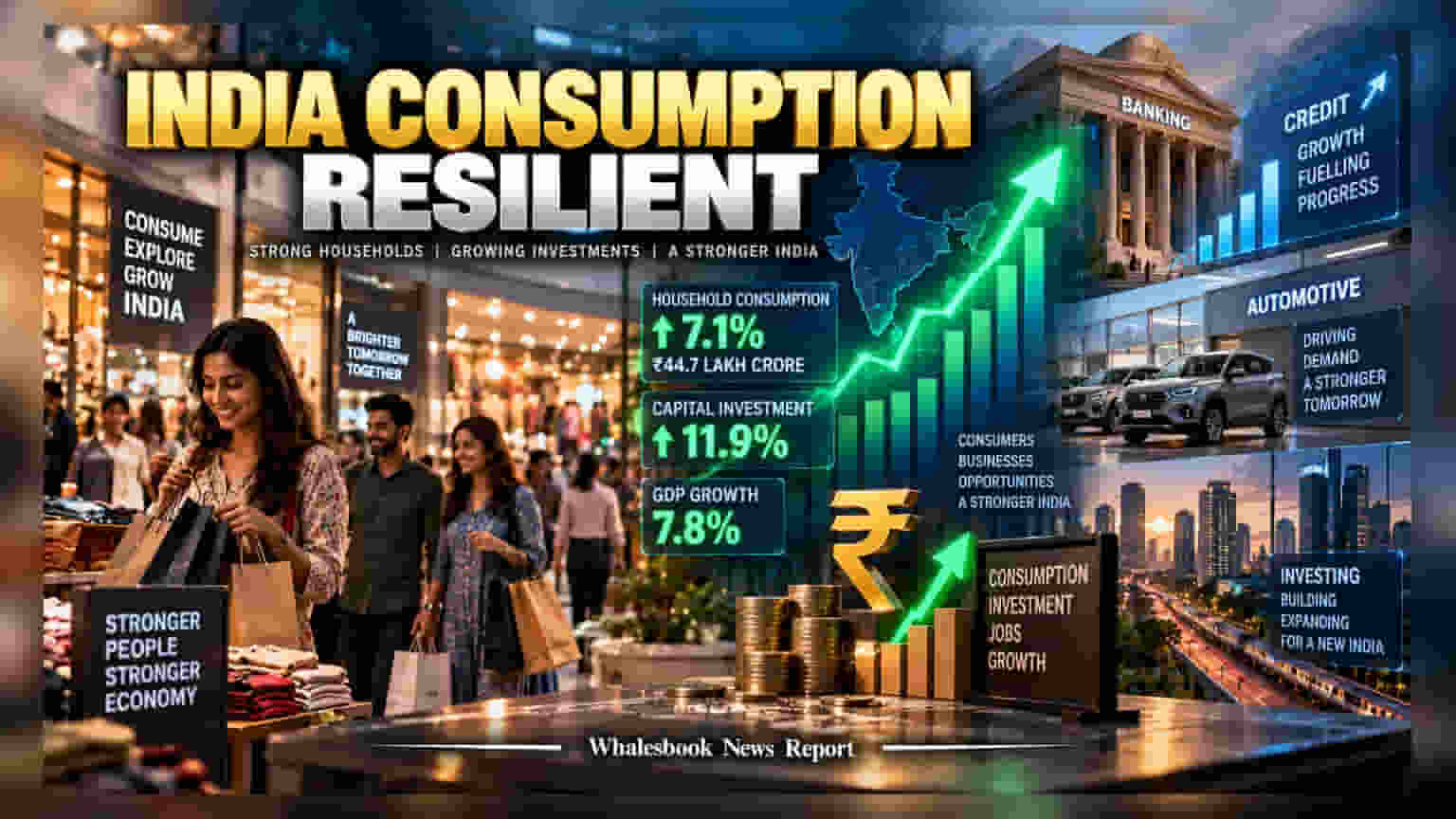
India’s Private Final Consumption Expenditure rose 7.1% year-on-year to ₹44.7 lakh crore in Q1 FY27. While consumer spending remains a key economic pillar, the data shows a healthy shift toward a balanced economy, with investment spending surging by 11.9%. Investors should track these dual-engine growth indicators alongside risks like monsoon patterns and energy costs.
India's economic performance in the first quarter of the 2027 fiscal year highlights a significant shift in growth drivers. While Private Final Consumption Expenditure (PFCE)—the total spending by households on goods and services—increased by 7.1% year-on-year to reach ₹44.7 lakh crore, the broader story lies in the balancing act between consumer spending and capital investment.
For a long time, the Indian economy has relied heavily on domestic consumption to drive growth. However, in Q1 FY27, Gross Fixed Capital Formation (GFCF)—which measures business spending on assets like factories, machinery, and infrastructure—recorded a strong growth of 11.9%. In a notable sign of a more balanced economic model, both private consumption and investment each contributed 3.95 percentage points to the overall 7.8% GDP growth. For investors, this shift indicates that economic expansion is now supported by both household demand and corporate expansion, rather than relying on one alone.
Mixed Signals in Market Data
While the aggregate numbers are strong, high-frequency indicators reveal a mixed picture across different sectors. Vehicle retail sales remain a standout performer, posting an 18.4% year-on-year increase, signaling that urban demand is holding up. In contrast, other segments show caution. Passenger air travel growth has slowed to just 1.7%, while LPG usage dropped by 16.6%. The decline in LPG consumption is largely attributed to supply chain disruptions near the Strait of Hormuz, serving as a reminder that external geopolitical factors can impact domestic consumption patterns.
Managing Economic Risks
Investors looking ahead should monitor three specific factors that could influence the growth trajectory. First, the statistical 'base effect' is a factor; because consumption grew by a robust 8.15% in the same quarter last year, the numbers for the upcoming September quarter will be measured against a high benchmark, which may create volatility in year-on-year comparisons.
Second, the rural economy remains a point of focus. With reports of a 14% deficit in rainfall across key agricultural regions, there is ongoing concern about potential impacts on rural income and food inflation, especially with potential weather uncertainties like El Niño. Finally, geopolitical tensions in West Asia continue to present risks to energy prices and global supply chains. If global energy costs rise, it could put pressure on household budgets and profit margins for industries dependent on imported fuels. The interplay between these external risks and domestic demand will likely define the market's momentum in the coming months.