 Whalesbook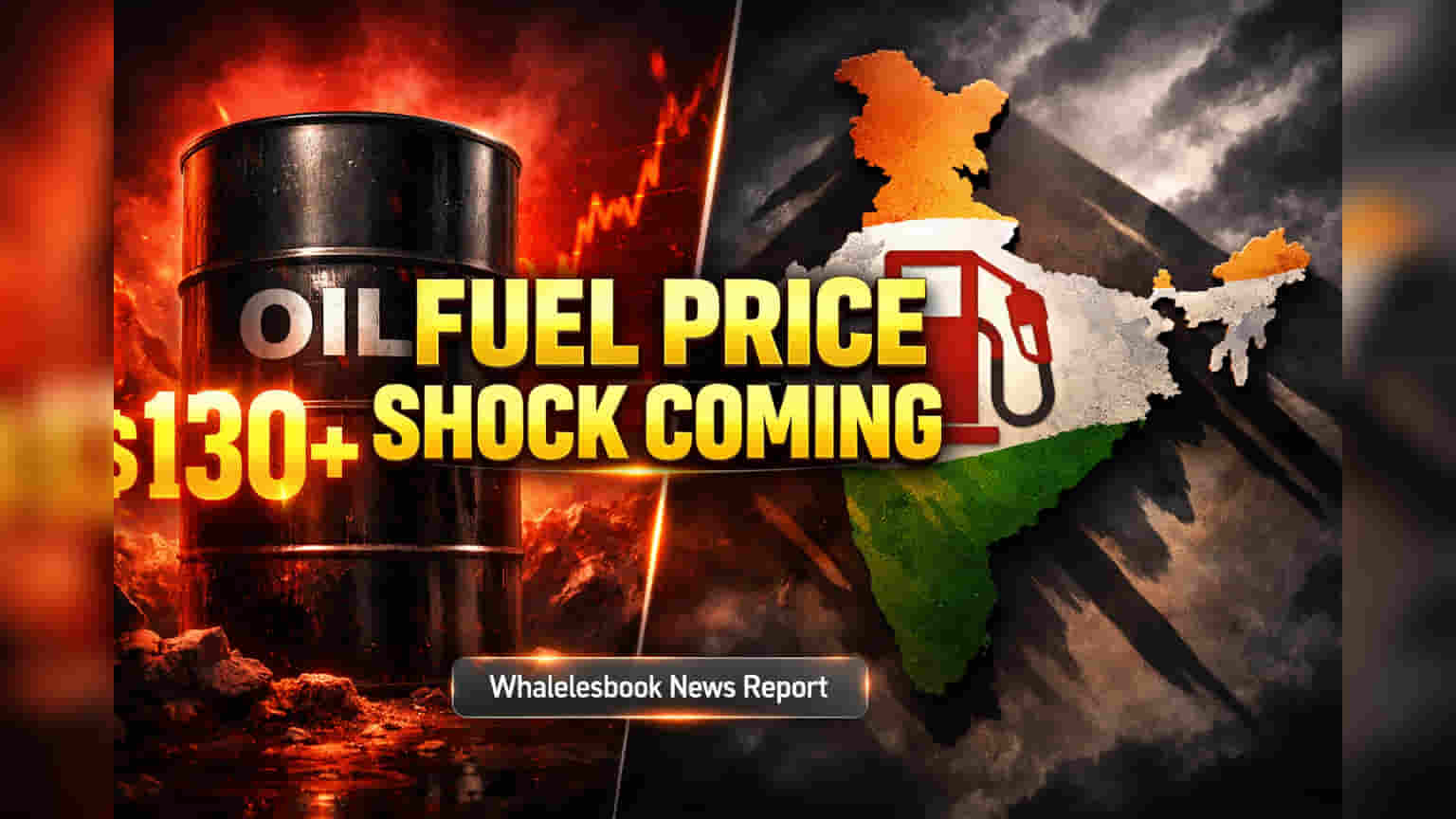


Election Pause Masks Rising Costs
Retail fuel prices in India are on hold until after key state elections, offering temporary relief. Despite global crude oil prices surging past $130 a barrel due to conflicts in West Asia, state-owned Oil Marketing Companies (OMCs) have kept pump prices unchanged. The government has supported this freeze through significant fiscal actions, such as cutting special excise duties and reimposing taxes on oil company profits. However, this approach of balancing election priorities with market conditions creates a difficult situation for government finances and company profits.
Private Players Hike Prices as State Firms Absorb Losses
Consumers have seen stable petrol and diesel prices for a while, but the market is expecting changes. Nayara Energy, India's largest private fuel seller, has already raised petrol prices by ₹5 per litre and diesel by ₹3 per litre, citing higher costs. This shows the pressure on private companies, which do not receive government compensation for losses like their state-owned rivals. OMCs such as Indian Oil Corporation (IOCL), Bharat Petroleum Corporation (BPCL), and Hindustan Petroleum Corporation (HPCL) are still covering losses, keeping their pump prices the same for now. This freeze cannot last. Historically, OMCs have adjusted prices to match global rates after elections, for example, in May 2019. Current crude prices above $130 a barrel are very different from the $65-$70 range that analysts previously suggested as ideal for balancing government intervention and company profits. Market watchers anticipate price increases of ₹2–4 per litre by the end of the first quarter of fiscal year 2027 if crude prices stay high.
Government Faces Fiscal Strain Amid Price Freeze
The government's effort to shield consumers from fluctuating global energy prices comes with a high fiscal price. The Union Budget for 2026-27 aims for a budget deficit of 4.3% of GDP, but sustained high crude prices and related government actions are severely challenging this goal. Cutting the special excise duty on petrol to ₹3 per litre and removing it for diesel—down from ₹13 and ₹10 respectively—means a significant loss of tax revenue. Economists suggest this could lead to the budget deficit widening by 0.3% to 0.9% of GDP, due to higher subsidy payments and these duty reductions. Additionally, the government has reintroduced taxes on diesel and aviation fuel profits to recover some costs, while offering duty relief on petrochemical inputs until June 2026. Signs of market concern about the government's financial health can be seen in India's 10-year government bond yields, which are trading around 7.05%. As India imports about 85-90% of its crude oil, the economy is very exposed to global price swings.
OMC Profitability Under Threat from High Crude and Downgrades
Rising crude oil prices, combined with minimal government support and possible currency weakening, pose significant risks for OMCs. Several financial analysts are now cautious. Ambit has downgraded IOCL, BPCL, and HPCL to 'Sell', expecting Brent crude to settle between $80-$100 a barrel and warning of balance sheet risks. HSBC also moved these OMCs to 'Hold' or 'Sell' ratings, predicting lower profits due to higher crude costs and possible marketing losses. Citi rated IOCL and BPCL 'Neutral' and HPCL 'Sell', lowering profit forecasts. Investec rates all three 'Sell', noting their current stock prices seem high compared to historical averages and that regulatory limits restrict potential gains. OMCs, including IOCL (market cap ₹1.9 lakh Cr) and HPCL (₹70.4k Cr), with P/E ratios from 4.54 to 7.98, are trading at higher valuations than usual. The past shows governments often intervene to control prices, particularly before elections. This means OMCs face uncertainty in achieving stable profits and are vulnerable to policy changes and unrecovered costs.
Inflation Risks Cloud Sector Outlook
While some analysts like Morgan Stanley previously saw positive outlooks for OMC cash flow and profits, the current sentiment is more cautious. Geopolitical events in West Asia are keeping crude prices above $100 a barrel, which is expected to significantly push up India's inflation. A $10 rise in crude oil prices could increase headline Consumer Price Index (CPI) inflation by 0.55% to 0.60%. Such inflation might force the central bank to adopt stricter monetary policies, adding complexity to the economic forecast. The future for OMCs depends heavily on stable crude prices and government decisions. When crude prices stay above $70-$80 a barrel, alongside government efforts to control its budget deficit and delayed price adjustments due to elections, it creates an uncertain environment. The government is trying to meet its fiscal goals while also ensuring energy security and managing inflation. This balancing act means OMCs will likely remain sensitive to government policies and global market movements.