 Whalesbook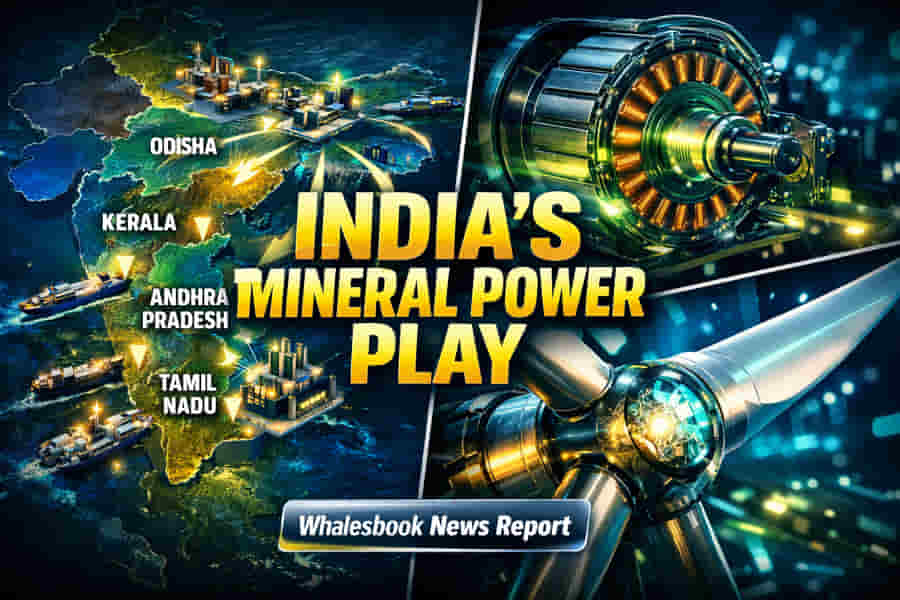
The Global Scramble for Critical Minerals Intensifies
Global supply chains for rare earth elements, vital for modern technology from EVs to defense, are characterized by significant geopolitical risk, largely due to China's dominant position in processing and refining. This concentration creates vulnerabilities, as evidenced by past export controls that have disrupted downstream industries. Recognizing this precarious dynamic, India has taken a significant step by announcing the establishment of dedicated rare earth corridors within its Union Budget 2026-27.
Strategic Alignment with National Objectives
The initiative, unveiled by Finance Minister Nirmala Sitharaman, proposes to support mineral-rich states, specifically Odisha, Kerala, Andhra Pradesh, and Tamil Nadu, in developing these corridors. This move is a direct extension of the November 2025 scheme aimed at promoting the domestic manufacturing of rare earth permanent magnets, essential for sectors like renewable energy and electronics. Without secure access to raw minerals, these manufacturing ambitions face significant hurdles. The corridors are designed to create an organized network for mining, processing, and distribution, thereby streamlining operations, cutting costs, and accelerating domestic output.
India's Broader Critical Minerals Strategy
This development aligns with India's escalating focus on mineral security and self-reliance. The National Critical Mineral Mission (NCMM), a seven-year program from 2024-25 to 2030-31, underscores this commitment with a ₹16,300 crore outlay, aiming to fortify supply chains from exploration to recycling. Recent legislative adjustments to the Mines and Minerals (Development and Regulation) Act now classify critical minerals, facilitating private investment and simplifying regulatory pathways for these strategic resources. India's dependence on imports for minerals like Lithium, Cobalt, and rare earths necessitates such measures, especially for its clean energy transition and technological advancements. The recent announcement of Semiconductor Mission 2.0, backed by a ₹40,000 crore outlay, further emphasizes this drive to build domestic capacity in strategic sectors, where critical minerals are foundational.
Sector Dynamics and Company Landscape
The Indian mining sector, encompassing a broad range of commodities, represents a significant portion of the economy with a market capitalization of over ₹4.22 lakh crore and an average P/E ratio around 9.62. While specific companies directly involved in rare earth mining are still developing, entities like Vedanta are actively exploring extraction from bauxite residue. Hindustan Copper (HCL), India's sole vertically integrated copper producer, has seen substantial stock gains (over 175% in the past year) following a recent mineral block acquisition, although its P/E ratio of over 107 appears stretched compared to peers like Vedanta (P/E 16-22) and Hindalco (P/E ~12). MOIL, a leading manganese ore producer, and Gujarat Mineral Development Corporation (GMDC), which is expanding into rare earths, also hold positions within the sector, with GMDC noted for its debt-free status. State-owned Coal India, with a P/E below the industry average, has shown strong bullish momentum in its stock options, hitting a new 52-week high recently. IREL (India) Limited also plays a role in rare earth extraction and research. The current market environment shows the Metals & Mining sector up by approximately 13.96% for the quarter.
Outlook: Securing Future Supply
The creation of rare earth corridors is a calculated move to mitigate global supply chain risks and foster indigenous industrial growth. By developing these specialized zones, India aims to create a more robust and resilient ecosystem for critical minerals, reducing its import dependency and positioning itself as a key player in the global technology and manufacturing landscape.