

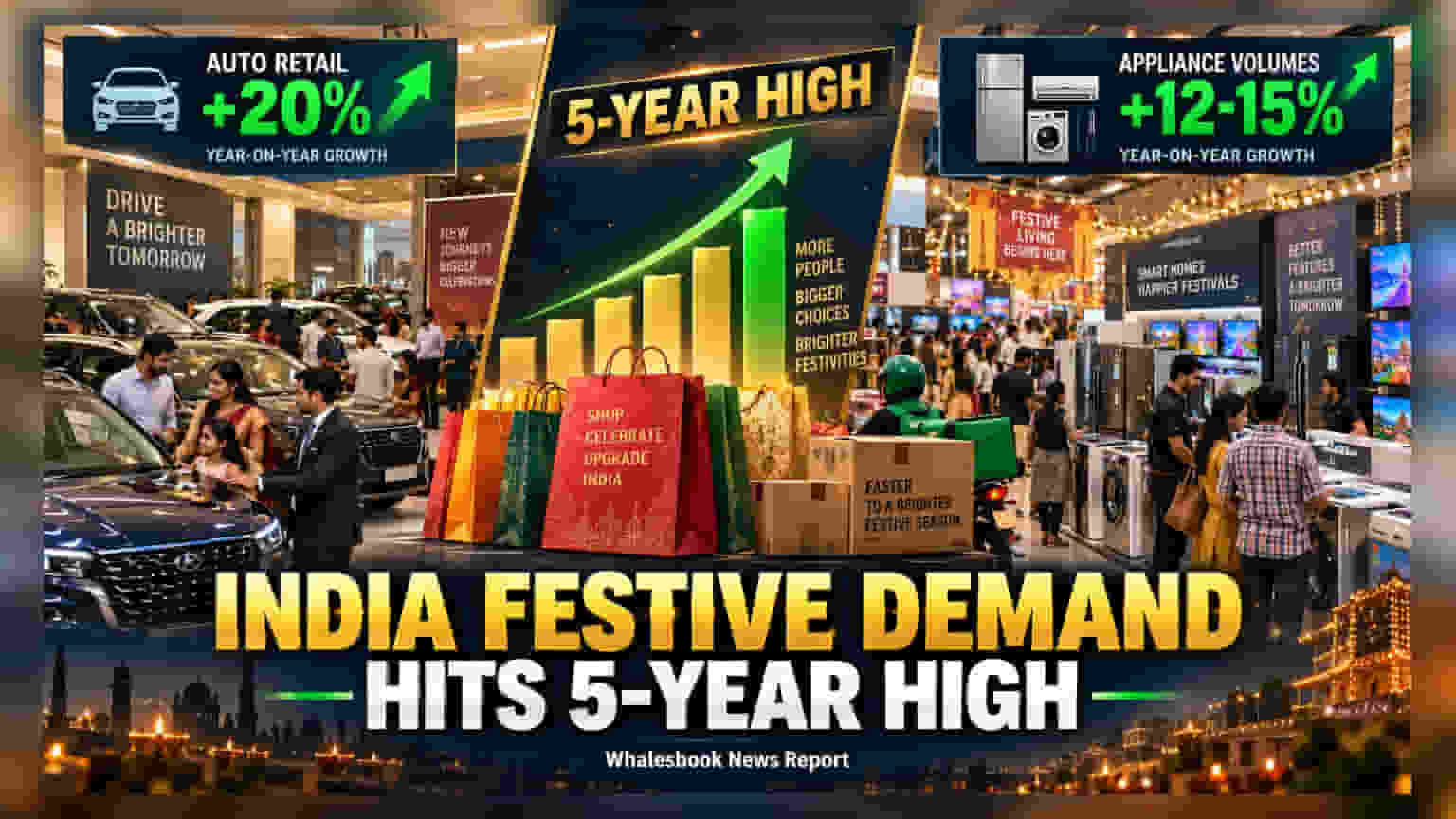
Festive consumption in India has surged to a five-year peak, driven by strong growth in automobiles, home appliances, and quick commerce. While premium products and easy financing are fueling sales, investors are now watching whether this momentum can last through the Navratri-Diwali period amid persistent inflation.
Festive season demand has hit a five-year high, with data showing a surge in retail activity across automobiles, home appliances, and quick commerce platforms. This growth indicates that consumers are actively spending on big-ticket items despite price increases across several categories. The positive trend is supported by a mix of consumer financing and a shift toward premium, higher-value products.
In the automotive sector, dealers reported an approximate 20% year-on-year growth in retail sales during the initial festive phase. Specific manufacturers are seeing strong numbers, with Maruti Suzuki reporting a 61% jump in retail sales during Onam, while Hyundai Motor India saw its sales nearly double. Hyundai is responding to this demand by commissioning a new shift at its Talegaon facility. Maruti Suzuki currently maintains a backlog of roughly 180,000 orders, suggesting that production volume is a key focus area for the company to meet current demand.
Home appliance manufacturers are also seeing similar trends. Volume growth for products like refrigerators, washing machines, and air-conditioners reached 12-15%, while value growth was higher at 18-23%. This gap between volume and value suggests that consumers are choosing more expensive, feature-rich products. The shift is also visible in quick commerce, with platforms like Flipkart reporting 2.5 times growth in sales compared to last year.
However, investors should consider the broader economic context. While demand is currently high, inflation remains a challenge for the mass-market segment. Consumers are increasingly using credit facilities to manage higher prices, which helps sustain purchasing power in the short term. For companies, a key risk is the potential for inventory buildup. If manufacturers overstock dealers expecting the demand to continue indefinitely, they may face pressure if consumption patterns cool after the peak festive period of Navratri and Diwali.
Since the Indian stock exchanges are closed today, September 14, 2026, for Ganesh Chaturthi, there is no immediate trading reaction. When markets resume, investors will likely track management commentary on inventory levels and whether the current sales momentum holds through the full festive cycle, especially as companies navigate the impact of rising costs on their profit margins.