 Whalesbook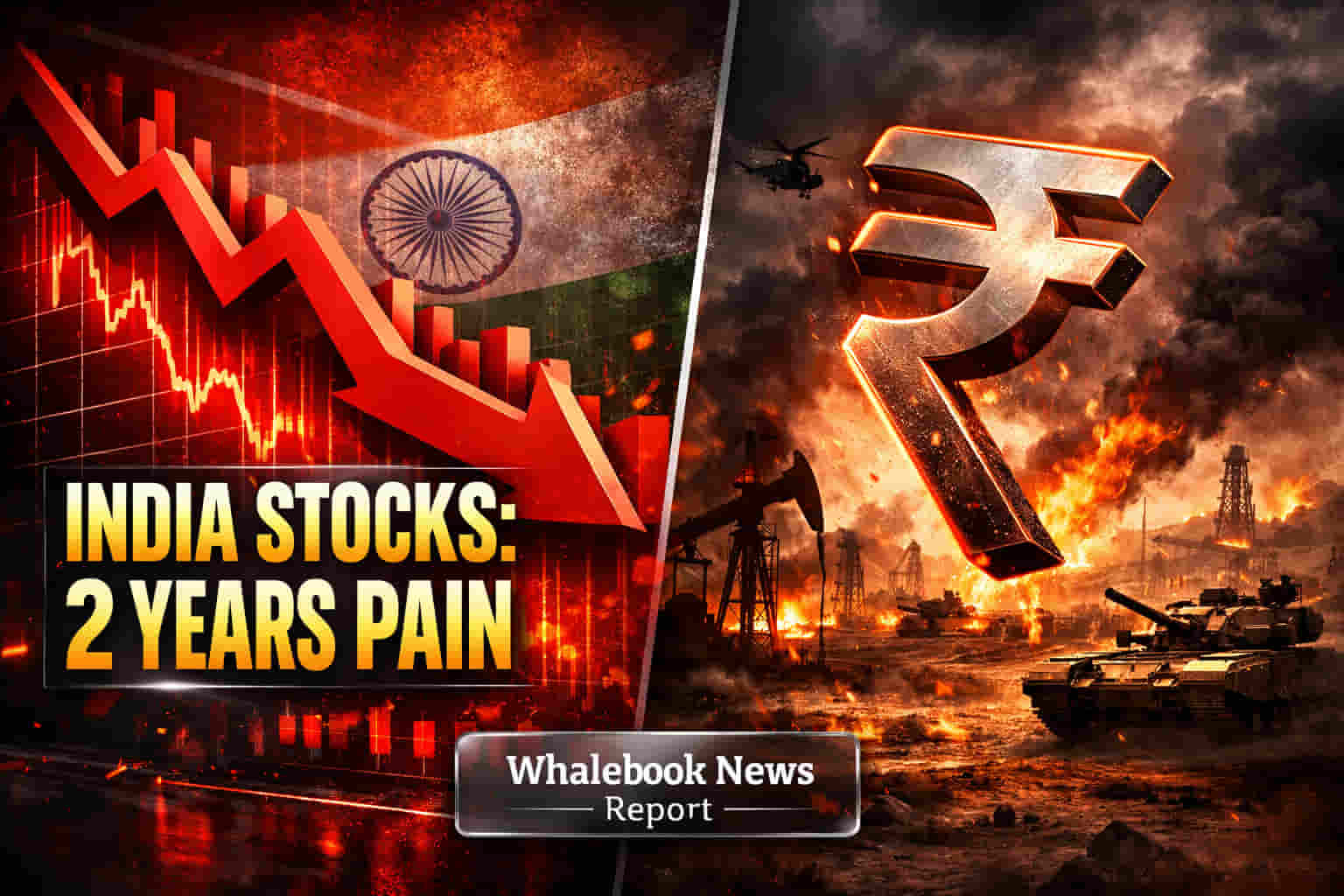


THE SEAMLESS LINK
The stark assessment from Shankar Sharma paints a challenging two-year outlook for Indian equities, moving beyond simple market cycles to a fundamental structural reset. His view suggests that the confluence of volatile energy prices, persistent currency depreciation, and perceived foreign policy missteps creates a multi-faceted headwind that the market has yet to fully internalize. This scenario implies a stark contrast to the recent past, where easy global liquidity masked underlying economic fragilities.
The Geopolitical Oil Squeeze
Sharma's bearish thesis is anchored in the critical nexus of Middle East geopolitical instability and India's profound dependence on imported crude oil. He anticipates Brent crude oil could surge to $100-$120 a barrel due to the U.S.-Iran confrontation, a scenario not entirely reflected in current trading levels around $85 per barrel. This outlook is compounded by the Indian Rupee's structural weakness, with the exchange rate hovering around 83.50 against the U.S. dollar. Sharma argues this combination effectively raises the landed cost of oil to approximately $100 per barrel, even before factoring in significant freight expenses, particularly if sourcing from distant markets like Venezuela. India's annual oil import bill already stood at a substantial $137 billion in FY2025, underscoring its vulnerability to price shocks.
Strategic Missteps and Currency Erosion
The investor’s critique extends to India's foreign policy, suggesting that a pivot towards transactional relationships with Western powers has eroded long-standing, loyalty-driven ties with Russia and Iran. Sharma contends that India has lost crucial bargaining power for energy pricing, contrasting its position with that of Russia and China, which he believes have maintained their strategic leverage. This perceived isolation exacerbates the economic fallout, as a sustained oil price spike to $110-$120 per barrel, coupled with a weaker rupee, is projected to widen India's current account deficit to over 2% of GDP and pressure its fiscal deficit, which is forecast to remain around 5.5% of GDP for FY2025-26. While Nifty 50 saw modest gains of 5-7% in the year to March 2025, Sharma's call for zero returns over five years, referencing a previous period of flat returns, highlights a concern about the sustainability of market gains driven by domestic flows and global liquidity.
The Forensic Bear Case
From a risk-averse perspective, Sharma's analysis reveals critical vulnerabilities. Unlike China, which has built alternative supply chains, India appears strategically exposed, facing higher oil costs, a weaker rupee, and strained relationships with historical energy partners like Iran and Russia, whose trade has become complex under Western sanctions. The argument posits that India's reliance on imports, despite diversification efforts, leaves it susceptible to external shocks. Sharma's historical parallels, invoking India's self-reliance during past sanctions and geopolitical standoffs, implicitly criticize current policy choices. The market capitalization of the Nifty 50, approximately $4.5 trillion, and a forward P/E ratio around 22x suggest a premium valuation that could be at risk if these structural headwinds materialize. The U.S.-Iran confrontation specifically threatens critical chokepoints, amplifying oil supply disruption risks.
A Diminished Outlook
While many analysts maintain a neutral to positive long-term view on Indian equities, citing domestic demand and reforms, Sharma’s perspective suggests that such optimism may not fully price in the confluence of these specific geopolitical and economic pressures. His contrarian stance suggests that the era of easy money and passive market gains is concluding, potentially leaving India as a significant loser in the current global economic recalibration. Sharma's projection implies that the market may have underestimated the cascading effects of a crude price shock, a depreciating currency, and a loss of strategic energy sourcing options.