 Whalesbook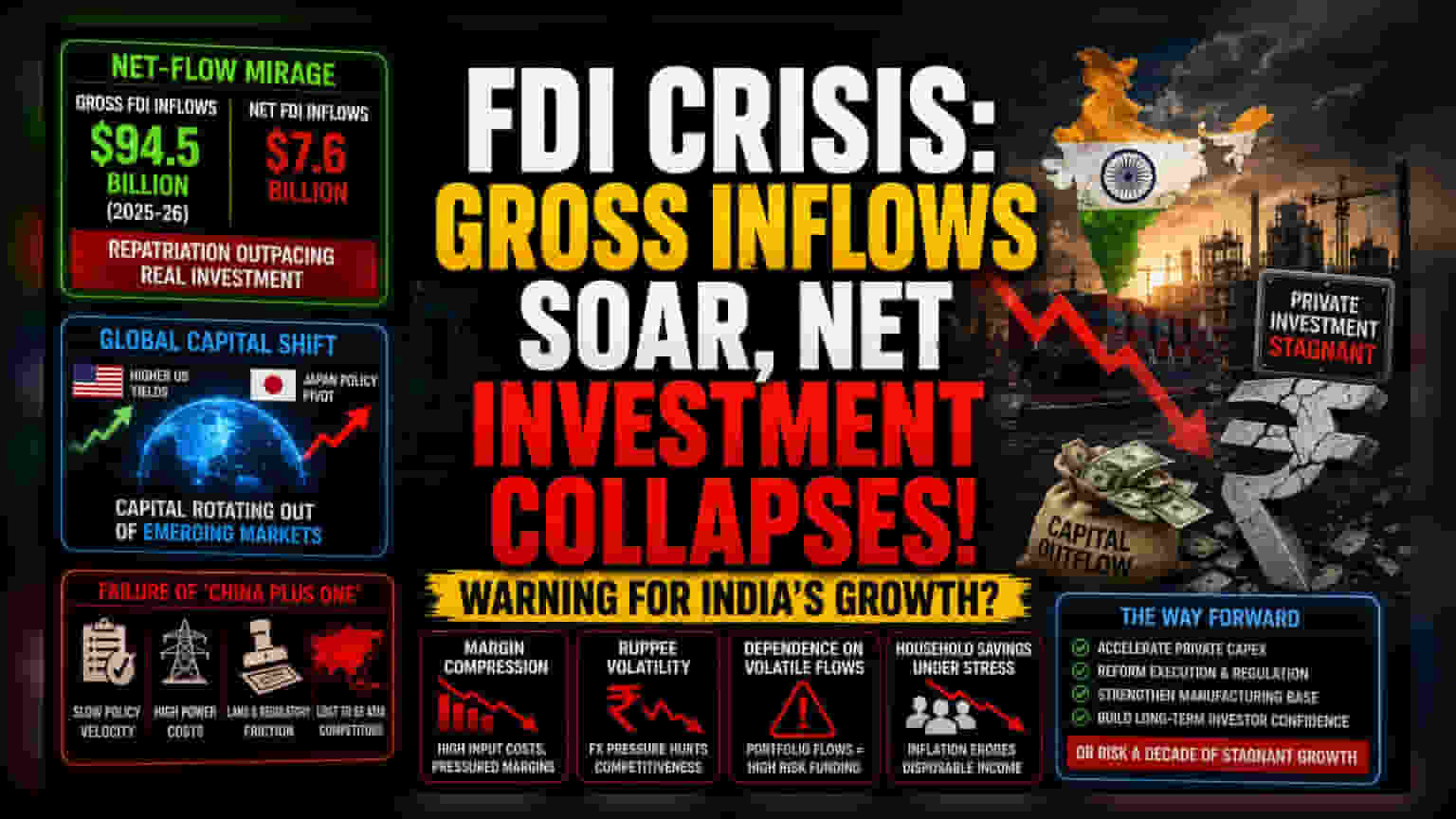


The Net-Flow Mirage
The gap between gross and net Foreign Direct Investment (FDI) has reached a critical threshold, raising questions about the sustainability of India's current capital account. While gross inflows rose to $94.5 billion for the 2025-26 period, the divergence toward a measly $7.6 billion net figure suggests that repatriation and divestment are outpacing genuine long-term commitment. This discrepancy is not merely a statistical anomaly but a reflection of a corporate sector that remains cautious despite state-led infrastructure investment. The reliance on government capital expenditure as the primary engine for GDP growth is failing to produce a multiplier effect, as private entities prioritize debt reduction and liquidity over expansion.
Arbitrage and the Global Capital Shift
The exodus of capital is largely a response to shifting global yield curves. For years, emerging markets benefited from the search for yield, but the normalization of interest rates in the United States and the pivot in Japanese monetary policy have fundamentally altered the risk-adjusted return profile. When developed sovereign debt offers competitive yields with significantly lower geopolitical risk, capital naturally rotates out of developing nations. This shift challenges the efficacy of current domestic policy, which assumes that tax incentives and manufacturing subsidies can substitute for high-interest-rate environment parity.
The Failure of 'China Plus One'
Strategic efforts to position India as the premier manufacturing alternative to China face an execution bottleneck. Despite the rhetoric surrounding supply chain diversification, the committee acknowledges that policy support for incoming industries lacks the necessary velocity. Investors seeking to relocate from China require more than just sentiment; they demand streamlined land acquisition, consistent power pricing, and stable regulatory frameworks. The current friction in administrative processes often forces firms to bypass India in favor of Southeast Asian markets that offer greater regulatory certainty. The disconnect between official growth targets and the reality on the ground indicates that India's manufacturing base is not scaling rapidly enough to capture the shifting tide of global production.
Structural Risks and The Bear Case
From a structural standpoint, the economy faces a twin risk of margin compression and currency volatility. As the Reserve Bank of India attempts to stabilize the rupee, the cost of imported inputs for manufacturing remains a persistent drag on profit margins. Should net FDI continue to stagnate, the burden of financing the current account deficit will fall back on volatile portfolio flows, which are notoriously fickle during periods of global market stress. Furthermore, the reliance on household savings to fuel growth is hitting a limit, as inflationary pressures erode disposable income and limit the capacity for domestic debt-financed investment. Unless the private sector accelerates capital expenditure to match government momentum, the risk of a prolonged period of stagnant private investment becomes a structural reality, potentially capping the nation’s growth ceiling for the near term.