

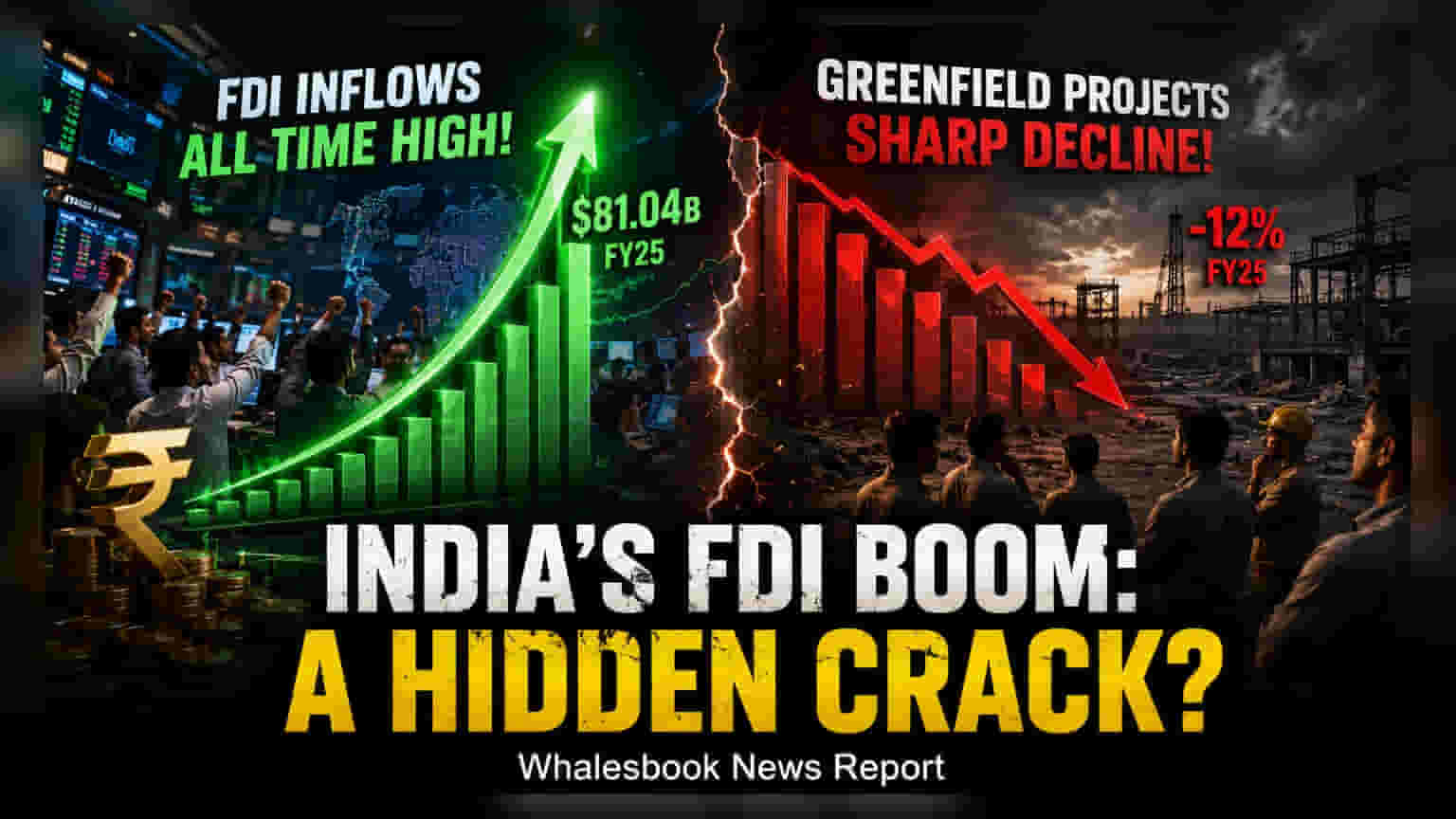
India's foreign direct investment climbed 43.6% in 2025 to $38.89 billion, ranking 11th globally. However, new greenfield investment announcements dropped to $74 billion from $111 billion, driven by a sharp decline in manufacturing interest. This shift toward capital-heavy digital sectors highlights potential challenges for long-term employment creation in the country.
India saw a strong rise in foreign direct investment (FDI) inflows during 2025, reaching $38.89 billion, according to the UNCTAD World Investment Report. This 43.6% increase highlights India’s appeal as an investment destination, supported by infrastructure improvements and initiatives like the Production-Linked Incentive (PLI) schemes. These policies have helped India maintain its standing among the world's top FDI recipients despite broader global economic uncertainties.
Greenfield Investment Contraction
While the headline numbers for total FDI are positive, there is a clear shift in the nature of incoming capital. Announced greenfield investments—new projects that typically signal future economic expansion and infrastructure building—fell to $74 billion in 2025, down from over $111 billion in 2024. This decline is most visible in the manufacturing sector, where announced values dropped significantly to roughly $27 billion from $65 billion. For investors, this cooling in manufacturing signals a potential slowdown in the creation of large-scale industrial assets.
Digital Shift and Employment Concerns
Capital flows are increasingly moving toward the Information and Communication Technology (ICT) sector rather than labor-intensive manufacturing. A major example of this trend is Alphabet's $14.5 billion investment in a data center, which was the largest greenfield project in developing Asia for the year. While such digital infrastructure projects boost the country's technological capabilities, they often require fewer employees compared to large manufacturing plants. This trend poses a long-term challenge for India, as manufacturing remains a critical engine for creating jobs for the country's young workforce.
Competitive Pressures and Outflows
India is also navigating an increasingly competitive regional environment. Southeast Asian nations, including Malaysia and Thailand, have recorded strong FDI growth, presenting competition for companies looking to diversify supply chains under the 'China+1' strategy. Additionally, Indian firms are increasing their own international presence, with FDI outflows rising 47% to $35.7 billion in 2025. While these outflows help firms expand globally and support the currency, they also reduce the net cushion provided by incoming capital. The primary monitorable for investors and policymakers remains whether future industrial policies can effectively bridge the gap between high-tech digital investments and the need for broad-based, labor-intensive growth in the manufacturing sector.