

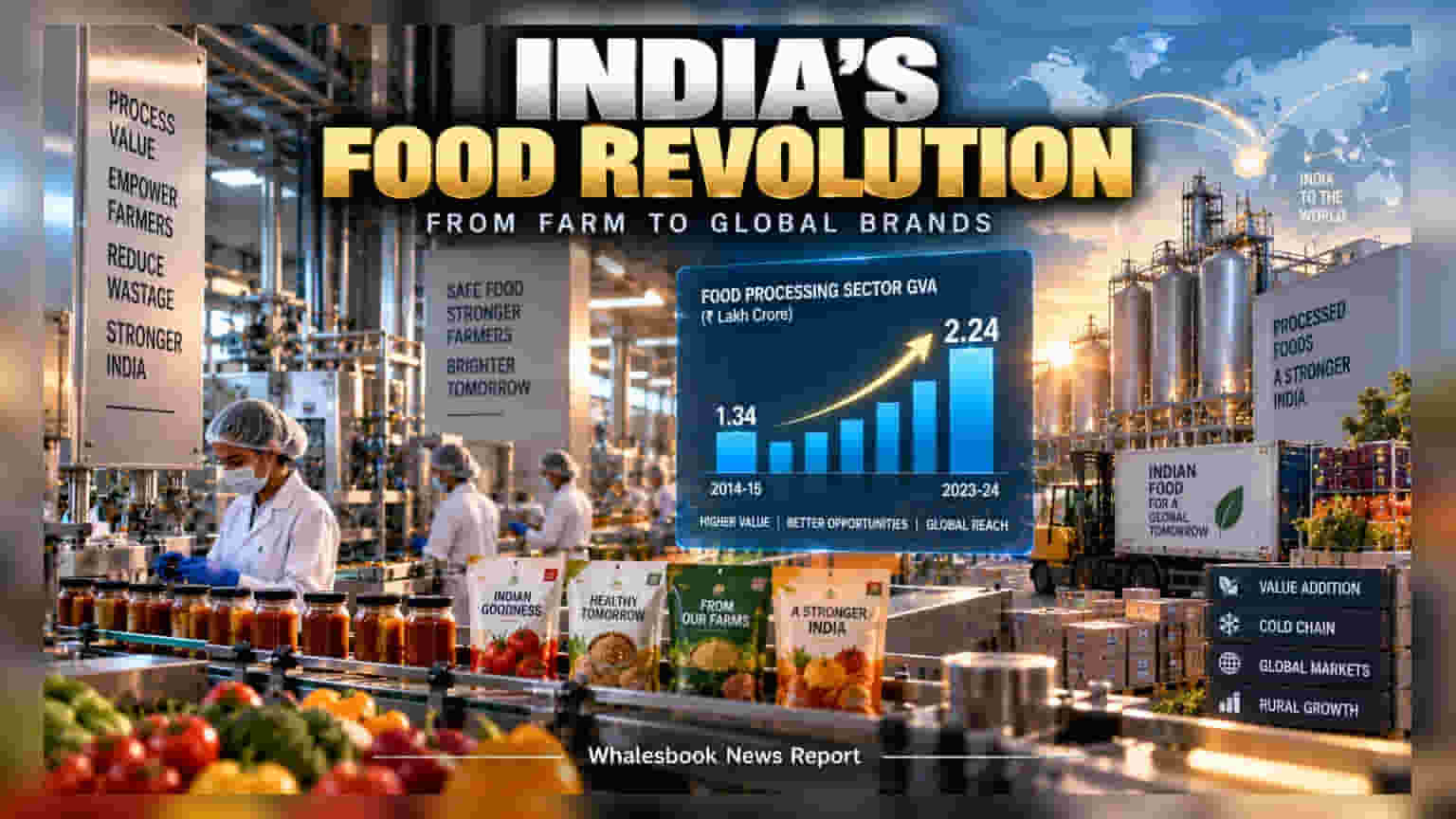
India is shifting focus from exporting raw farm crops to creating processed food brands, with the sector's value addition reaching Rs 2.24 lakh crore in FY24. This transition aims to reduce farm wastage and support local branding, creating potential efficiency gains for organized FMCG companies that rely on consistent and high-quality raw materials.
The Indian government is pushing for a strategic shift in the agricultural sector, aiming to transition the country from a raw commodity exporter to a global hub for processed food brands. Union Minister for Food Processing Industries Chirag Paswan recently highlighted that the sector's Gross Value Added (GVA) rose to Rs 2.24 lakh crore in the 2023-24 fiscal year, compared to Rs 1.34 lakh crore in 2014-15. This move is designed to reduce the high wastage often seen in perishable farm produce while capturing more value for local farmers and companies.
Impact on Organized FMCG and Efficiency
For investors, this growth in the food processing sector is significant because it directly impacts the business models of large FMCG companies. When agricultural produce is processed closer to the source through cold chain infrastructure and modern processing units, companies can source higher-quality raw materials with less risk of spoilage. This is a shift toward a more mature supply chain, which can eventually lead to better profit margins for branded food companies. Additionally, the integration of these products into e-commerce and quick-commerce channels is helping smaller local brands reach urban markets faster, increasing competition in the packaged food space.
Government Schemes and Infrastructure
The growth is being driven by initiatives like the Pradhan Mantri Kisan SAMPADA Yojana, which has supported over 1,200 projects to build processing and cold chain capacity. At the same time, the Pradhan Mantri Formalisation of Micro Food Processing Enterprises scheme is working to organize the unorganized sector. Maharashtra was recently recognized for leading this implementation with nearly 50,000 beneficiaries trained, signaling that rural areas are becoming active participants in the modern food economy.
Risks and Market Challenges
While the expansion of the processing industry is a positive step, it comes with inherent risks. The sector is highly sensitive to raw material cost inflation. Since companies depend on agricultural commodities, any disruption in crop supply due to weather or disease can lead to volatile input costs, putting pressure on profit margins. Furthermore, while processing infrastructure is expanding, scaling up micro-enterprises to a national level involves high execution risk. Building and maintaining nationwide distribution networks, especially for perishable goods, requires significant capital and operational focus. Investors should monitor how well companies manage these raw material costs and how effectively the new processing capacity translates into consistent demand and revenue growth in the coming quarters.