

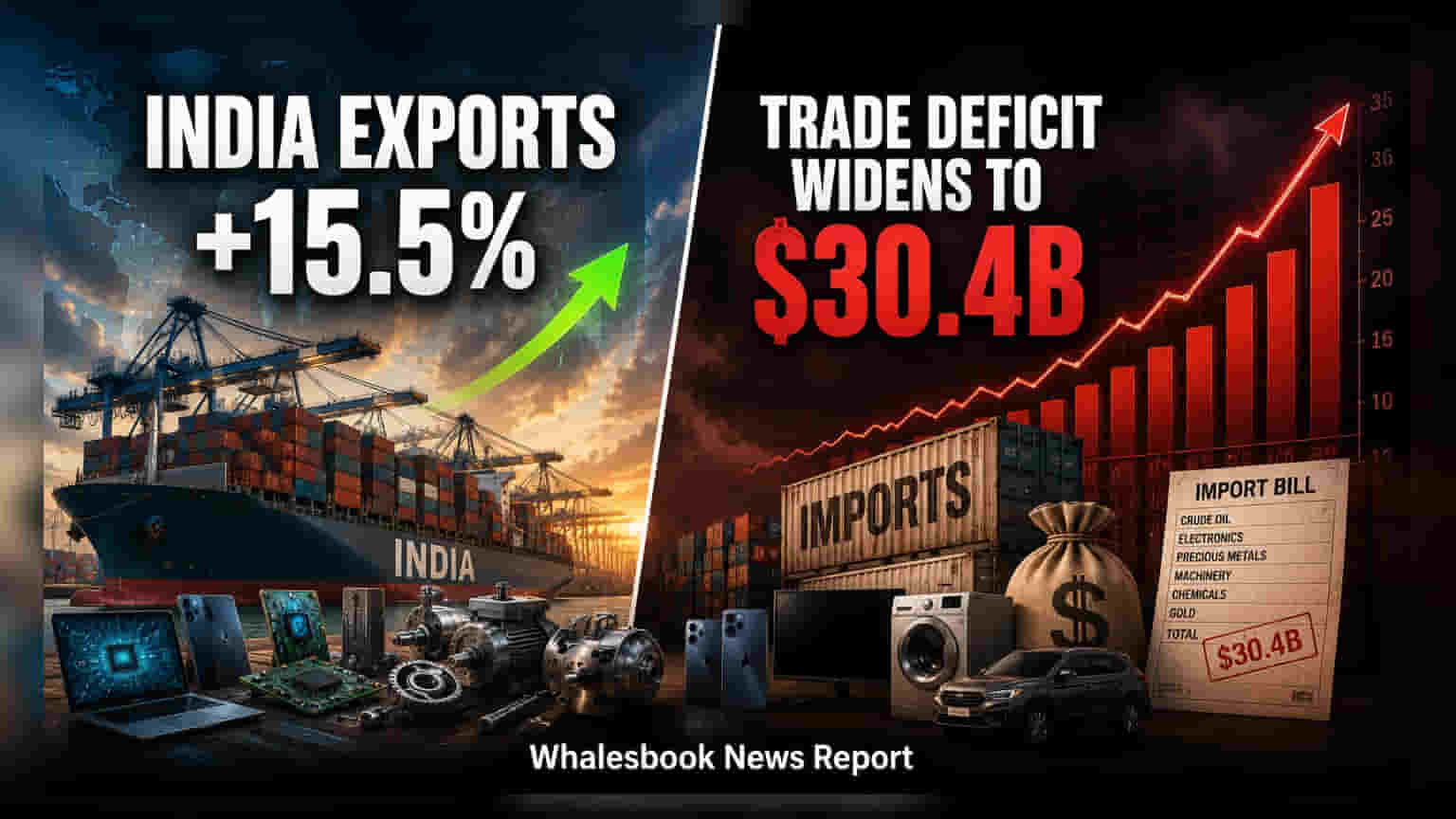
India's merchandise exports grew to $40.41 billion in June 2026, led by electronics and engineering goods. Despite this rise, the trade deficit increased to $30.4 billion as import costs climbed by 31%. The growth in finished goods contrasts with a slowdown in labor-intensive sectors like textiles and leather, reflecting a split in the economy's trade performance.
India’s merchandise export performance in June 2026 presented a mixed picture for the economy. Official data shows total exports reached $40.41 billion, marking a 15.54% increase from $34.98 billion in June 2025. While the double-digit growth in specific high-value segments suggests industrial activity is gaining momentum, the concurrent surge in imports has put significant pressure on the country's trade balance.
Growth in Electronics and Engineering
The positive export trend was concentrated in sectors that often require imported raw materials or complex components. Electronics exports emerged as a key pillar, climbing 18.9% to reach $15.2 billion. Similarly, engineering goods saw strong demand with a 20.7% growth to $11.5 billion. Chemicals and petroleum products also contributed to the export expansion, rising 19.4% and 9.2% respectively. For investors, this trend highlights how sectors integrated into global value chains are capturing growth, though their reliance on imported inputs means these businesses are sensitive to currency fluctuations and global commodity prices.
Challenges in Labor-Intensive Industries
While high-tech and value-added exports flourished, traditional labor-intensive industries faced a notable downturn. Apparel exports dropped by 11.25% in June, and the leather goods sector saw a decline of 6.9%. Other segments, including tea and ceramics, also registered losses. Analysts often view the performance of these sectors as a barometer for employment and domestic manufacturing health. The weakness in these areas, despite the overall rise in headline export numbers, suggests that smaller manufacturers in these segments may be struggling with high input costs, lower global demand, or competitive pressures in international markets.
Impact of Widening Trade Deficit
The overall trade deficit widened to $30.4 billion in June 2026, compared to $19.1 billion in the same month last year. This sharp expansion, driven by a 31% increase in the import bill, reflects both higher commodity prices and an increased demand for machinery and materials needed for domestic production. Economists have noted that while the export growth is a positive signal, the rate at which imports are rising remains a concern for the current account balance. Investors should monitor how the government and the Reserve Bank of India manage these pressures, as a wider trade deficit can sometimes influence domestic interest rates and currency stability.
The next important update for markets will be the July trade data, which will reveal whether the recent surge in imports was a temporary spike or a sustained trend. Additionally, investors in the textile and leather sectors will likely watch for any policy support or demand recovery in major export markets like the US and Europe.