

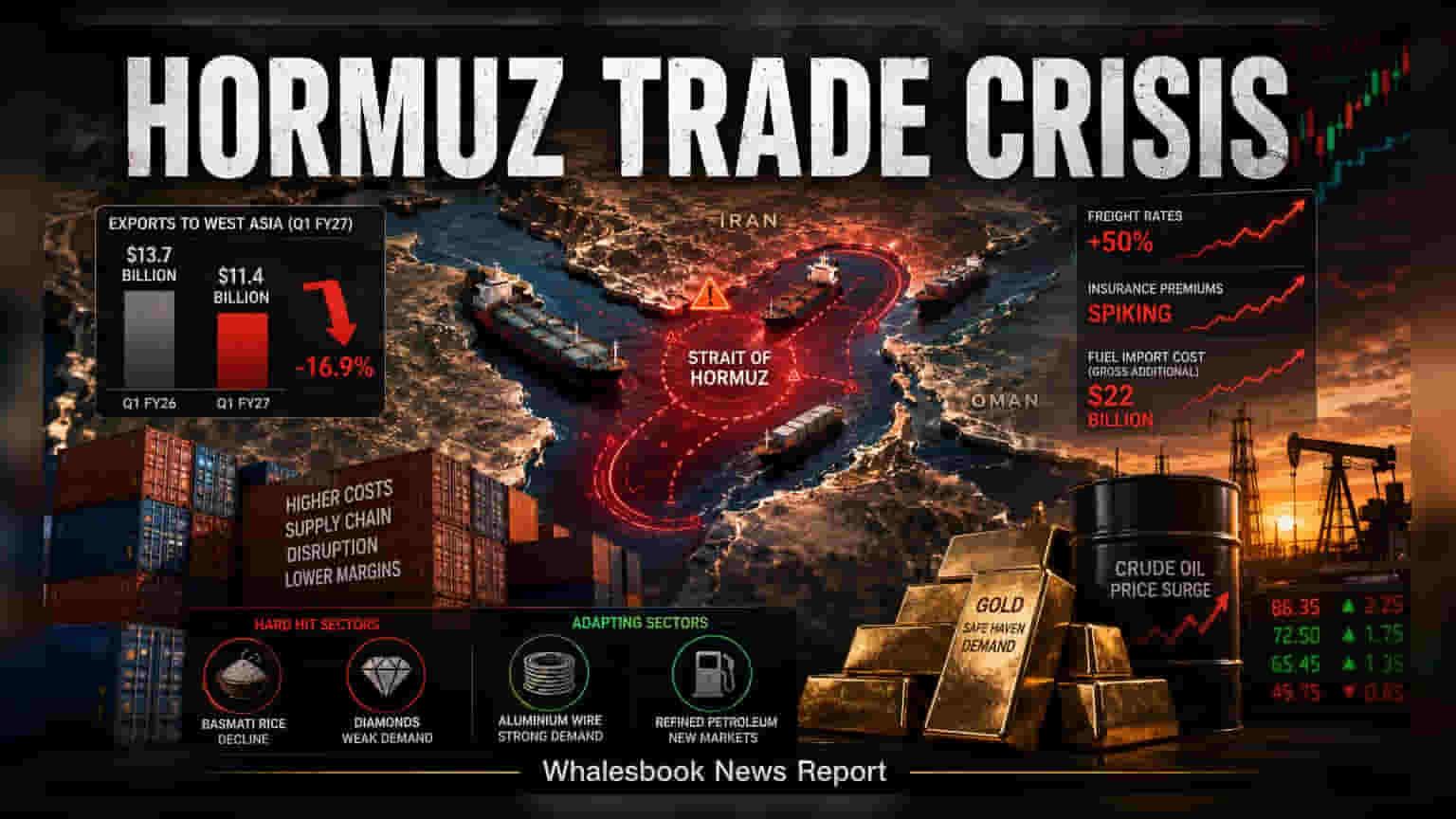
India’s exports to seven key West Asian nations contracted by 16.9% in Q1 FY27, totaling $11.4 billion, as the Strait of Hormuz conflict disrupts trade. Beyond export losses, India faces $14.4 billion in net additional energy import costs. Investors should monitor how rising logistics expenses and payment uncertainties impact profit margins for sectors like agriculture and gems, while noting that some companies are successfully pivoting to other global markets.
India’s trade relationship with seven major West Asian economies—Bahrain, Kuwait, Iran, Iraq, Qatar, Saudi Arabia, and the United Arab Emirates—has faced significant disruption in the first quarter of the 2027 financial year. Official data shows exports to these nations contracted by 16.9 percent, falling to $11.4 billion compared to $13.7 billion during the same period last year. While India’s overall merchandise exports have shown resilience elsewhere, this specific trade corridor is grappling with the direct fallout of escalating regional conflict.
The geopolitical friction has created two-fold pressure for the Indian economy. First, Indian exporters are dealing with severe logistics challenges. Freight rates have climbed by approximately 50 percent, and insurance premiums for shipping through the region have spiked. This poses a direct risk to the thin profit margins, often ranging between 5 and 10 percent, for businesses heavily reliant on these trade routes. Additionally, exporters are navigating payment and liquidity hurdles stemming from banking instability and international sanctions in the region.
Macroeconomic Impact and Energy Costs
Beyond the export hit, the energy sector has felt the strain of the conflict. Between March and August 2026, India incurred a gross additional cost of $22 billion for fossil fuel imports due to price shocks caused by the instability. The net additional cost is estimated at $14.4 billion, or approximately 0.38 percent of GDP. This added expense exerts pressure on the country's current account balance and contributes to domestic inflationary risks, which investors may watch closely in upcoming economic reports.
Sector Divergence and Adaptation
The impact across industries has not been uniform. Commodities such as basmati rice and diamonds have suffered significantly, driven by both the regional instability and a broader softening in global demand. For instance, parboiled basmati rice shipments to these nations saw a sharp decline. Conversely, sectors like aluminium wire and refined petroleum products—including motor gasoline and aviation turbine fuel—have demonstrated greater adaptability. Many manufacturers in these sectors have successfully redirected their supply chains to alternative global markets, effectively mitigating regional losses.
Investors tracking the impact of this conflict will need to monitor two primary indicators in the coming months. First, the trend in logistics costs and shipping insurance premiums will determine how much pressure remains on exporter margins. Second, the stability of energy import prices will be crucial for the country’s broader macroeconomic health. Companies with highly concentrated export exposure to these seven West Asian nations may face continued volatility, while those with diversified global reach are currently better positioned to navigate the supply chain shifts.