

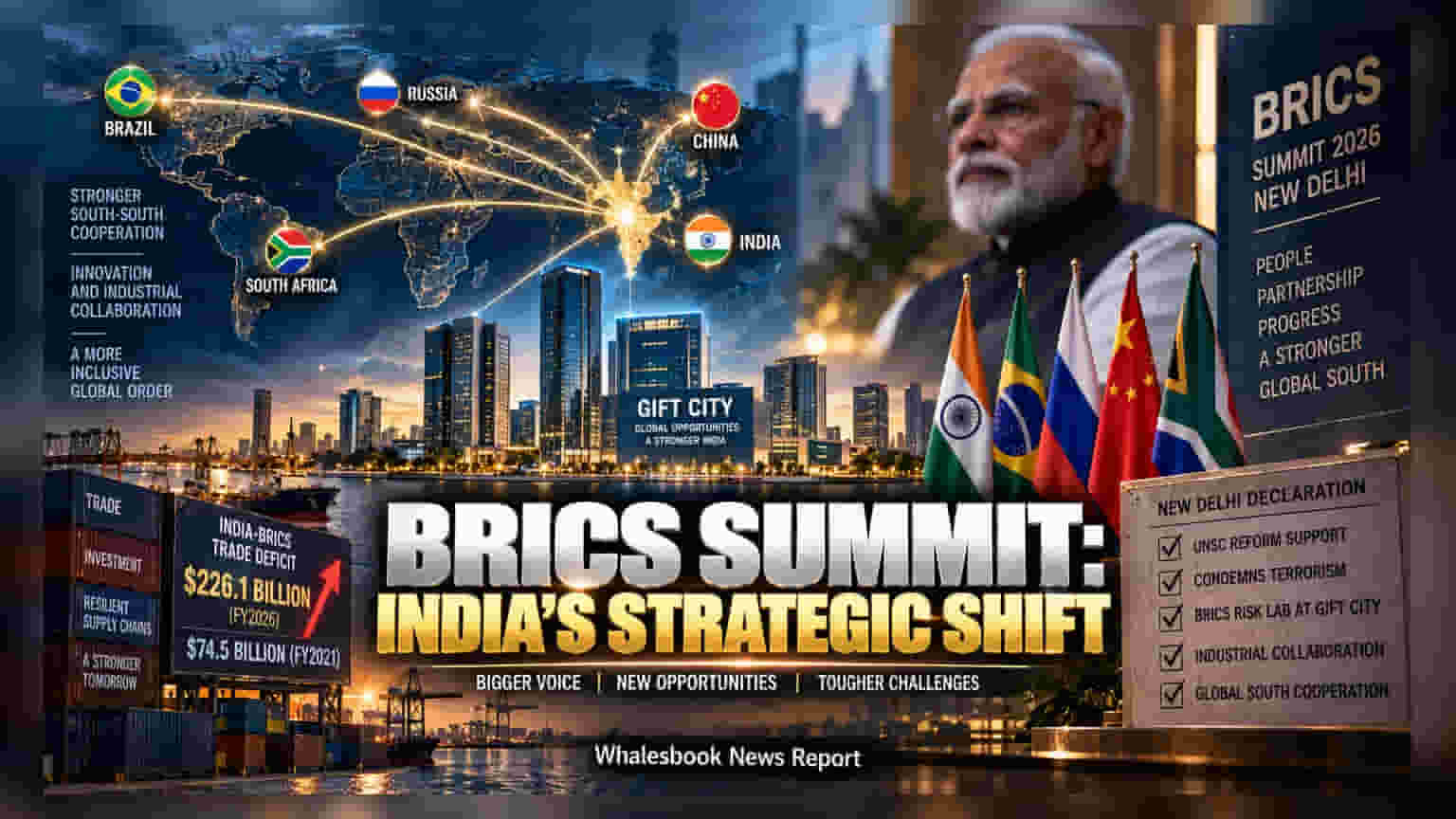
India has officially handed the BRICS chairmanship to China after concluding the 18th Summit in New Delhi. While the country achieved diplomatic wins like support for a UNSC seat and new financial labs in GIFT City, the economic reality remains challenging. India now faces a significant $226.1 billion merchandise trade deficit with the bloc, highlighting ongoing hurdles in balancing trade and currency settlements.
India wrapped up its 2026 BRICS chairmanship this week, passing the leadership responsibility to China. The 18th summit, concluded in New Delhi, resulted in the "New Delhi Declaration," which focused on Global South cooperation, innovation, and industrial collaboration. For market observers and investors, this summit served as a critical balancing act between India's diplomatic ambitions and its pressing domestic economic realities.
Diplomatically, the event provided clear wins for New Delhi. The bloc formally reaffirmed its support for India and Brazil to become permanent members of the United Nations Security Council. Additionally, India successfully secured a collective stance condemning terrorism, a move that serves as a strategic diplomatic gain. These outcomes are seen as vital for India's long-term global standing, though the absence of a fixed timeline for UNSC expansion remains a persistent diplomatic hurdle.
Beneath the headlines, a major economic challenge has come into sharper focus. India’s merchandise trade deficit with BRICS nations has widened to $226.1 billion for the fiscal year 2026, a significant increase from $74.5 billion recorded in fiscal year 2021. This growing gap reflects structural imbalances in trade, particularly with China, where India’s deficit alone accounted for approximately $112.16 billion. For the Indian economy, this large and widening trade gap highlights the difficulty in achieving a balanced trade relationship within the bloc.
To address these long-term frictions, India has focused on establishing new institutional footprints. A key development from the summit is the proposed BRICS Risk Lab to be hosted at the GIFT City International Financial Services Centre (IFSC) in Gujarat. This project is intended to enhance India’s insurance and reinsurance capabilities, aiming to position GIFT City as a premier hub for global financial services. Furthermore, the establishment of the India Centre for BRICS Industrial Competencies provides a structure for future collaboration, though these are long-term initiatives that will require sustained implementation to yield results.
Looking ahead, the market will monitor whether these initiatives can effectively manage trade pressures. The New Delhi Declaration lacked a unified framework for currency exchange, meaning that efforts to promote trade in local currencies face ongoing execution risks. Investors may track how India manages these imbalances, especially as the BRICS leadership transitions to China, given the complex geopolitical and trade relationship between the two nations. The effectiveness of the new GIFT City infrastructure and the stability of the trade environment will be the key areas for observers to watch in the coming quarters.