

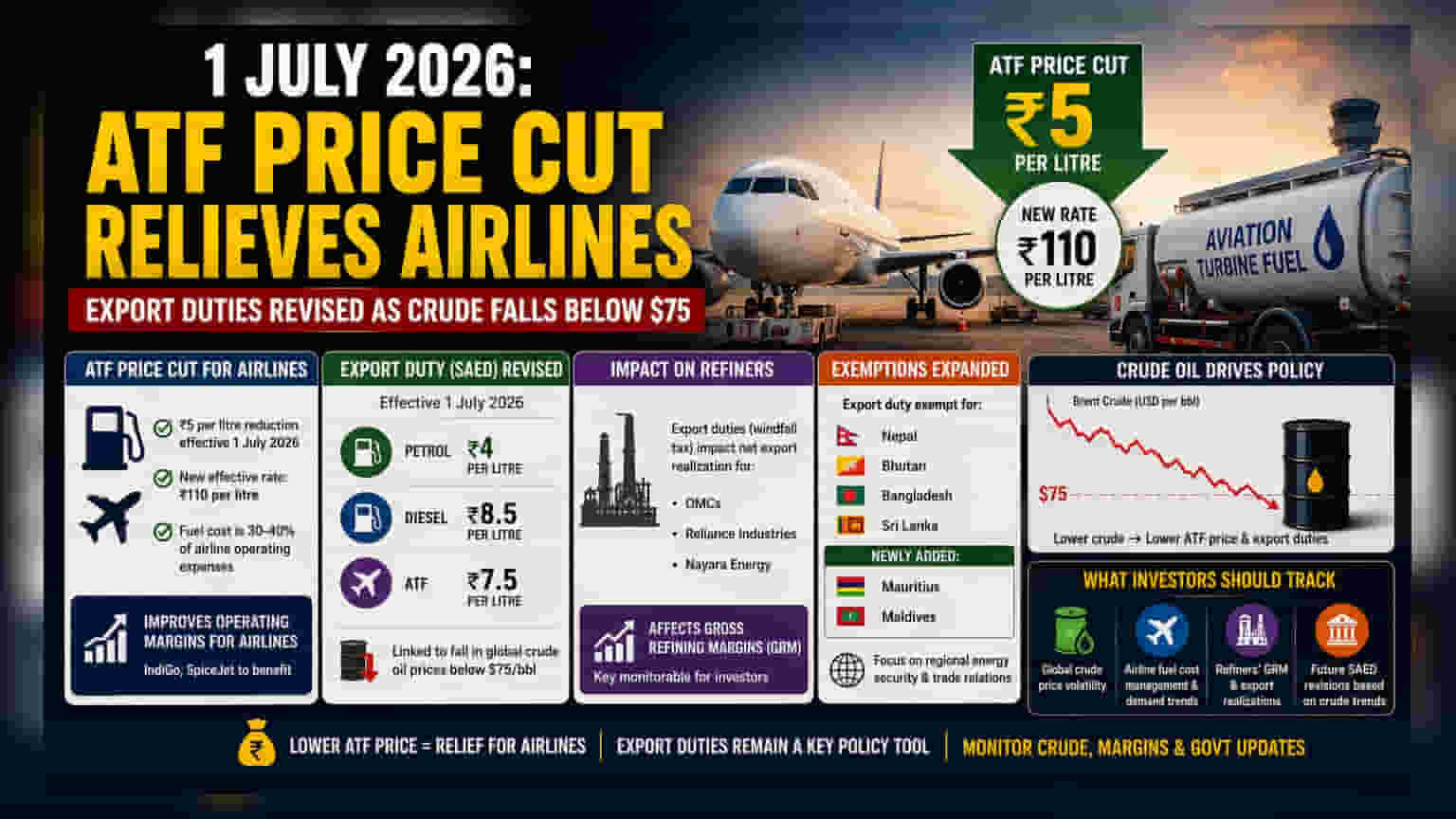
The government has reduced aviation turbine fuel (ATF) prices by Rs 5 per litre and revised export duties on petrol, diesel, and ATF following a drop in global crude prices. This update aims to balance domestic supply needs and global market trends, providing potential relief to domestic airlines while maintaining stable retail fuel prices for consumers.
What Happened
Effective July 1, 2026, the Indian government has reduced the price of Aviation Turbine Fuel (ATF) for domestic airlines by Rs 5 per litre, bringing the effective rate to Rs 110 per litre. Simultaneously, the Ministry of Finance has revised the Special Additional Excise Duty (SAED) on the export of petrol, diesel, and ATF. The export levy is now set at Rs 4 per litre for petrol, Rs 8.5 per litre for diesel, and Rs 7.5 per litre for ATF. These adjustments were triggered by a decline in international crude oil prices, which have dipped below the $75 per barrel threshold.
Impact on Airline Operating Costs
For domestic aviation companies, fuel costs typically represent a significant portion of operating expenses, often ranging from 30% to 40% of total costs. A reduction in ATF prices provides direct relief to the operating margins of airlines like InterGlobe Aviation (IndiGo) and SpiceJet. By lowering the input cost, airlines may see an improvement in their bottom line, provided that ticket pricing dynamics and demand remain stable. Investors generally track fuel price revisions closely, as they directly influence the profitability of the aviation sector.
Export Duties and Refining Margins
The revision of export duties, often referred to as a windfall tax, impacts large oil refiners, including both public sector Oil Marketing Companies (OMCs) and private players like Reliance Industries and Nayara Energy. These duties are designed to ensure domestic fuel availability and tax the excess profits refiners generate when global crude prices are high and export margins expand. While the reduction in duties is linked to falling crude prices, the levy remains a tool for the government to manage export-versus-domestic supply dynamics. Consequently, changes in SAED are a standard operating factor for refiners, affecting their net export realization.
Strategic Expansion of Exemptions
The government has also expanded the list of countries exempted from these export duties. While exports to Nepal, Bhutan, Bangladesh, and Sri Lanka were already exempt, the inclusion of Mauritius and the Maldives highlights the strategic nature of these fuel trade policies. This move suggests a continued focus on maintaining energy security and regional trade relations with neighboring island nations.
What Investors Should Track
Investors should monitor the volatility in global crude oil prices, as these remain the primary driver for future duty revisions. If crude prices stabilize or rise, the government may adjust export duties upward to mop up potential windfall gains. Conversely, further dips in crude could lead to additional relief for domestic fuel consumers and airlines. The key financial metrics for investors in this sector continue to be Gross Refining Margins (GRM) for refiners and fuel cost management for airlines, both of which are directly sensitive to these fortnightly government notifications.