

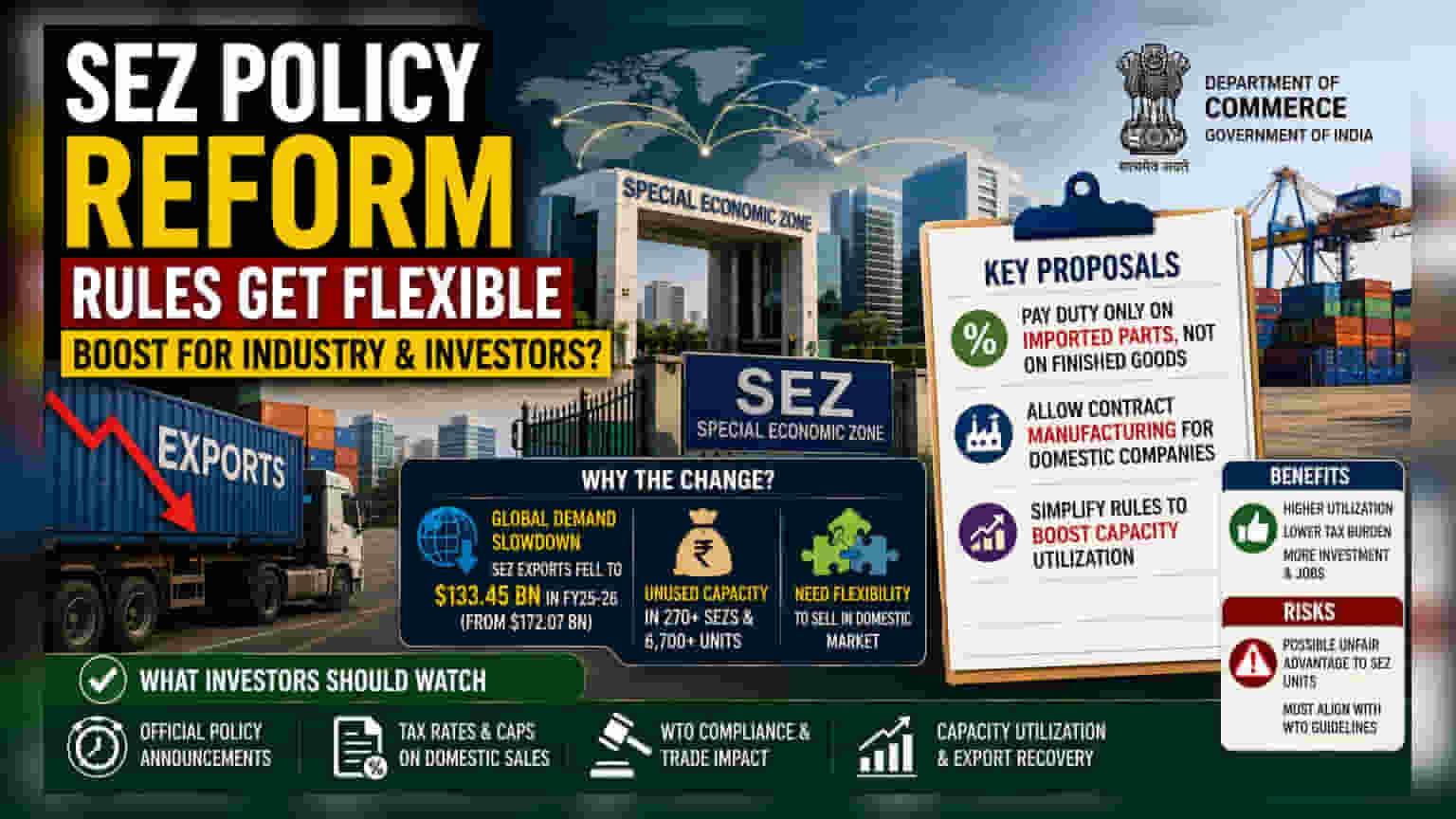
The government is discussing updates to the 2005 SEZ Act to help manufacturing units struggling with low global demand. Proposals include allowing SEZ companies to sell more easily in the local Indian market and simplifying tax rules. These changes aim to help businesses use their full production capacity during a period of slowing international trade.
What Happened
The Indian Department of Commerce has started discussions with industry leaders to reform the rules governing Special Economic Zones (SEZs). Currently, many SEZ units are running below their full capacity due to a drop in global demand, which has made it difficult for them to rely solely on exports. The government is now looking to update the original 2005 SEZ Act to make these zones more flexible and efficient, aiming to support companies that are facing a tough international market.
Why The Rules Are Changing
Under current laws, SEZs are treated like foreign land for customs purposes. This means that if a company inside an SEZ wants to sell its products within India—known as the Domestic Tariff Area (DTA)—it faces complex duty structures that make the final product expensive.
One of the main proposals is to simplify this process. The industry has suggested that companies should pay customs duty only on the imported parts used to make the product, rather than on the entire finished good. This would significantly reduce the tax burden and make it easier for SEZ-based companies to sell their goods locally when export demand is weak.
New Business Opportunities
Another major suggestion is to allow SEZ units to take on contract manufacturing work for domestic Indian companies. Currently, there are restrictions on how much, and in what way, an SEZ unit can sell into the domestic market. By relaxing these rules, the government hopes to help these units utilize their idle factory capacity, which currently sits unused due to the global export slowdown.
The Bigger Context
This policy review comes at a time when exports from Indian SEZs have faced significant pressure. According to recent data, exports from these zones fell to $133.45 billion in the 2025-26 fiscal year, down from $172.07 billion in the previous year. With over 270 operational SEZs and nearly 6,700 units involved, the government is looking for ways to stop this decline and encourage more investment.
Potential Risks and Challenges
While these changes could help SEZ units, they bring some challenges. Domestic manufacturers outside the SEZ zones have historically raised concerns that easier access to the local market for SEZ units creates an unfair playing field. If SEZ units can sell locally with tax breaks that domestic companies do not get, it could hurt local competition. Additionally, any new rules must be carefully designed to align with World Trade Organization (WTO) guidelines to avoid international trade disputes.
What Investors Should Track
The next steps will be critical for companies operating within these zones, particularly in sectors like pharmaceuticals, IT, textiles, and engineering. Investors should look for official announcements from the Department of Commerce regarding the final policy changes. Key monitorables include the specific tax rates for domestic sales, the caps on how much an SEZ unit can sell locally, and whether these changes effectively resolve the capacity utilization issues without causing friction with domestic industry players.