

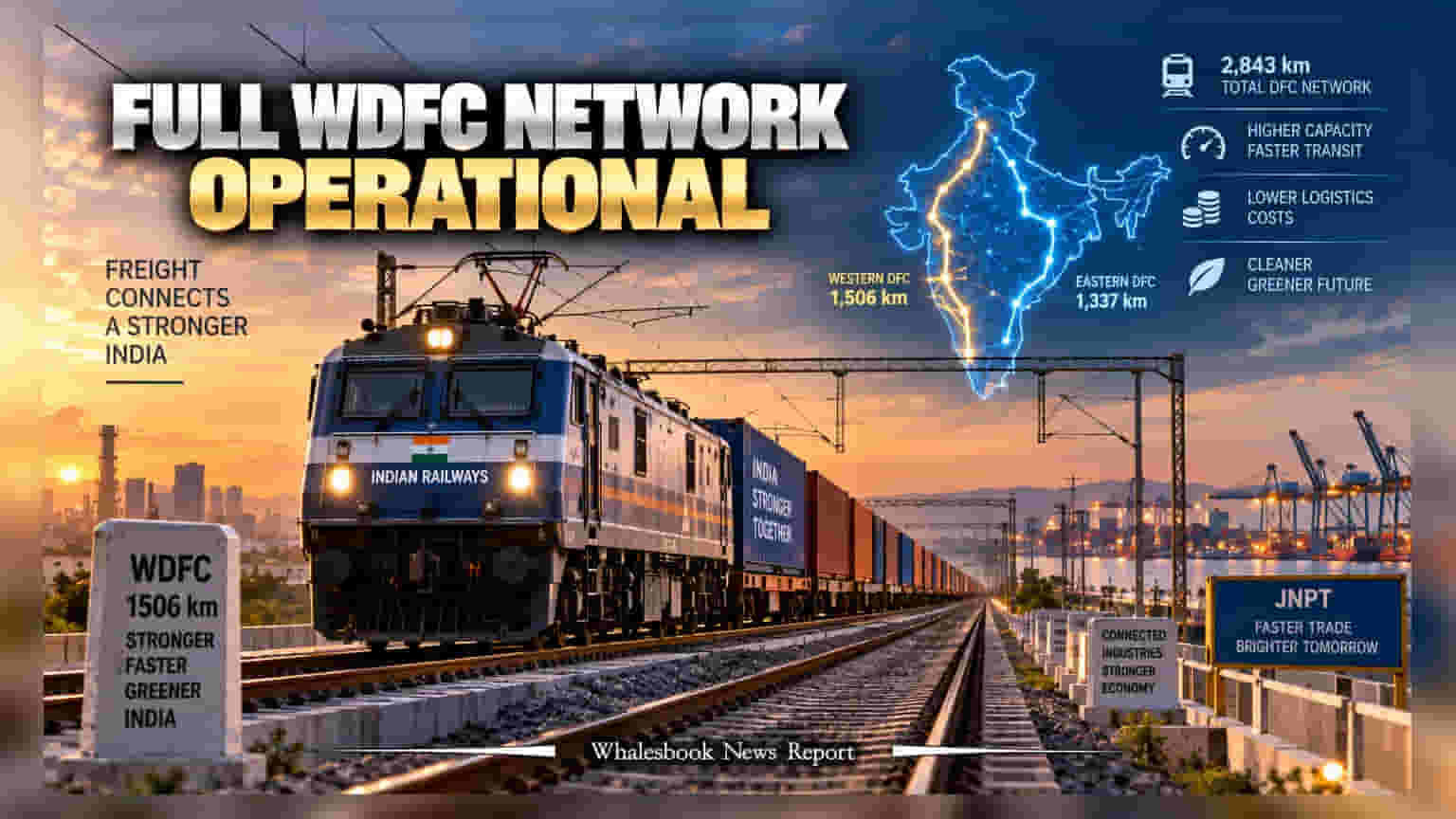
India’s 1,506-km Western Dedicated Freight Corridor is now fully operational with the launch of the final 326-km stretch. This ₹20,700 crore project connects the industrial heartland to the Jawaharlal Nehru Port, aiming to significantly reduce logistics costs and improve supply chain speed for export-import goods.
The Western Dedicated Freight Corridor (WDFC) has reached full operational status following the scheduled inauguration of its final three sections. Spanning 326 route kilometers, these segments—Sanand (N)-Makarpura, New Umbergaon-New Saphale, and New Saphale-JNPT—finalize the entire 1,506-km Western network. This completion is part of a broader government strategy to untangle cargo movement from passenger traffic, creating a high-capacity, electrified rail system dedicated entirely to freight.
Structural Shift in Logistics
The completion of the WDFC, combined with the 1,337-km Eastern Dedicated Freight Corridor (EDFC), establishes a comprehensive 2,843-km dedicated freight network across India. For years, Indian goods movement has struggled with heavy congestion on mixed-use rail lines, leading to slower transit times and higher costs. By segregating freight, the new corridors allow for heavier, longer, and faster freight trains. This infrastructure is designed to directly lower the cost of doing business by improving the reliability and speed of transport, particularly for goods headed to or from the Jawaharlal Nehru Port Authority (JNPT) and industrial centers in Gujarat and Maharashtra.
Impact on Logistics and Industry
While the Dedicated Freight Corridor Corporation of India Limited (DFCCIL) is a government-owned enterprise and not a publicly traded company, the broader economic impact is significant for the logistics and port sectors. Companies involved in multimodal logistics, container rail operations, and port services stand to benefit indirectly from the improved efficiency. Faster turnaround times for cargo at ports like JNPT can lead to better asset utilization for private logistics players, potentially supporting volume growth for companies that rely on rail freight to move containers across the country.
Operational Outlook and Risks
Transitioning to a fully operational, multi-operator, high-capacity network brings new challenges. For investors monitoring the logistics sector, the key areas to track will be the actual adoption rates by private operators and the ability to maintain the high-tech, electrified infrastructure. Success will depend on the smooth integration of these corridors with the existing road network and the ability of logistics firms to leverage this rail capacity to reduce their dependence on road transport.
Furthermore, the long-term benefit for the economy relies on steady demand from industries. As the corridor shifts from construction to full operations, maintaining efficient service levels to prevent technical bottlenecks will be critical. The government’s continued support, including track access charges and operational policy, will remain the primary monitorable for ensuring the network meets its efficiency goals.