

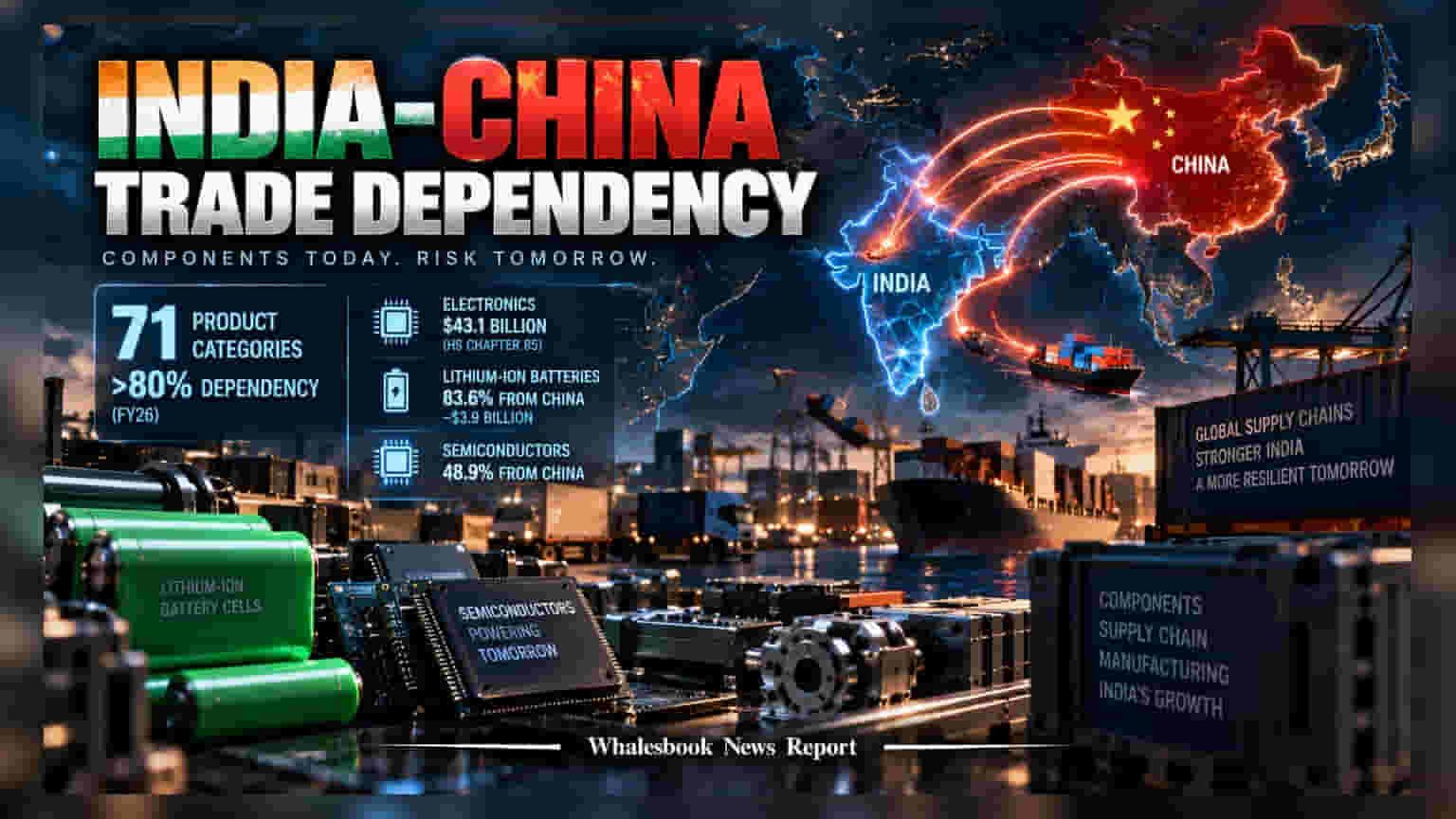
A new study reveals China supplies over 80% of India’s imports in 71 critical tariff lines, up from 46 in 2019. With the bilateral trade deficit reaching a record $112.1 billion in FY26, this dependency highlights supply chain risks for Indian manufacturing. Investors may track how import substitution plans affect domestic production costs and profit margins in the electronics and green-tech sectors.
A report from the Koan Advisory Group and the Institute of Chinese Studies highlights a significant shift in India’s industrial trade profile. As of fiscal year 2025-26, India shows a high level of reliance on China across 71 specific product categories, where Chinese imports account for more than 80% of total supply. This number has grown considerably from 46 categories in 2018-19, indicating that industrial integration has deepened rather than diversified over the last seven years.
The Impact on Electronics and Green Tech
The trade data shows that this dependency is most concentrated in the electronics and energy sectors, classified under HS Chapter 85. This category alone contributed $43.1 billion to the record $112.1 billion bilateral trade deficit recorded in FY26. The reliance is particularly visible in the electric vehicle and energy storage markets, where China supplied 83.6% of India’s lithium-ion batteries, amounting to roughly $3.9 billion.
Similarly, in the semiconductor segment, China remains a dominant supplier with a 48.9% market share. For Indian investors, these figures represent more than just trade statistics; they point to a structural vulnerability. Many Indian manufacturing companies, especially in consumer electronics and automotive parts, depend on these imported intermediate components to assemble finished goods. Any disruption in Chinese supply chains, whether due to geopolitical tension, export restrictions, or logistical delays, can directly impact the production timelines and profit margins of these domestic firms.
Strategic Policy and Investor Monitorables
To counter this trend, the Indian government has initiated a $51 billion import substitution plan targeting nearly 100 products. The goal is to move from simple assembly to component-level manufacturing within India. While this policy aims to reduce long-term reliance, it requires significant capital spending and time to build local expertise and capacity.
Investors may observe how quickly domestic manufacturers can shift to local sourcing or alternative markets. A key monitorable for the coming quarters will be the impact on operating margins for companies heavily reliant on Chinese components. While the government pushes for local production, the transition could result in short-term cost pressures if domestic alternatives are more expensive or if the scale of production is not yet efficient. Tracking the progress of these domestic manufacturing initiatives, alongside changes in trade policy, will be essential for understanding the future health of companies in the electronics and green energy supply chains.