 Whalesbook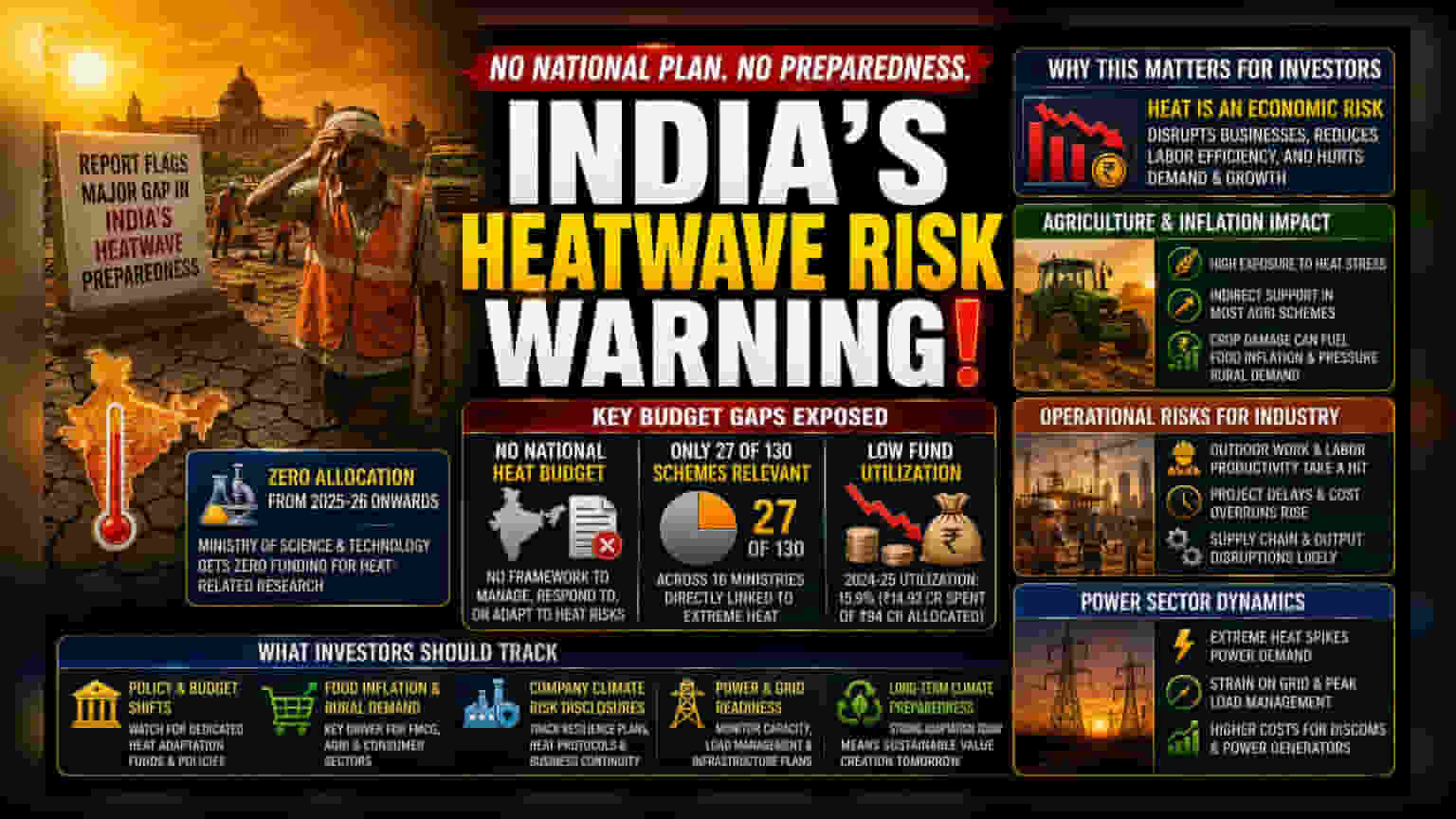


A recent study indicates that India's budget framework contains limited dedicated funding for heatwave preparedness. With only a small fraction of tracked schemes addressing heat risks, analysts highlight potential long-term impacts on agriculture, labor productivity, and public health infrastructure. Investors should monitor how these climate-related vulnerabilities could influence inflation, operational costs in manufacturing, and power sector demand, as heatwaves become more frequent.
What Happened
A collaborative report by the Centre for Budget and Governance Accountability, Greenpeace India, and the Budget Analysis and Research Centre Trust has highlighted a significant gap in India's fiscal planning regarding heatwave preparedness. The study, which analyzed Union Budget allocations from 2020-21 to 2026-27, found no national budget framework specifically designed to manage, respond to, or adapt to heat-related risks.
While the government manages many development programs, the report notes that only 27 out of 130 tracked schemes across 16 ministries are directly relevant to extreme heat. Furthermore, the findings point to low fund utilization. For instance, in the 2024-25 fiscal year, the Health Sector Disaster Preparedness and Response scheme saw a utilization rate of just 15.9%, with only Rs 14.92 crore spent against an allocated Rs 94 crore. Additionally, the Ministry of Science and Technology has seen zero allocation for heat-relevant schemes from 2025-26 onwards, which could limit research into climate adaptation.
Why This Matters For Investors
For the Indian stock market and broader economy, heatwaves are no longer just an environmental issue; they are an economic risk. Prolonged heatwaves can disrupt business operations, reduce labor efficiency, and alter consumer demand patterns. The lack of a centralized, well-funded adaptation strategy suggests that the burden of managing these climate risks may increasingly fall on the private sector or result in broader economic inefficiencies.
Impact on Agriculture and Inflation
The agricultural sector, which remains the backbone of the rural economy, faces high exposure to heat stress. The report notes that most agricultural schemes provide only indirect support. Investors often view agriculture-related challenges as a precursor to food inflation. Significant crop damage due to heatwaves can hurt yields for staple crops, potentially pressuring input costs for FMCG companies and reducing rural income, which affects discretionary spending in consumer sectors.
Operational Risks for Industry
Extreme heat affects the manufacturing and construction sectors significantly. Outdoor work, which relies heavily on labor, faces productivity declines during intense heatwaves. This can lead to project delays, cost overruns, and supply chain disruptions. Companies in infrastructure and manufacturing with high labor dependence may see increased operational costs as they are forced to invest in better working conditions or manage reduced output during peak summer months.
Power Sector Dynamics
While the report focuses on budget allocations, the broader climate trend points to rising power demand. Extreme heat drives up cooling requirements, leading to spikes in electricity consumption. Investors monitoring the power sector—including both generation and distribution companies—should be aware that unpredictable heat patterns can strain grid infrastructure and demand efficient load management. Companies that lack robust infrastructure may face higher costs during peak demand seasons.
What Investors Should Track
Going forward, market participants may want to observe several key indicators. First, changes in government policy toward climate adaptation, such as new, dedicated funds for heat resilience in future budgets, could signal a shift in risk management. Second, trends in food inflation and rural demand remain essential for assessing the health of consumer-focused companies. Finally, monitoring company disclosures regarding climate risk and the measures they are taking to ensure operational resilience during extreme weather can provide insight into their ability to handle long-term climate-related challenges.