 Whalesbook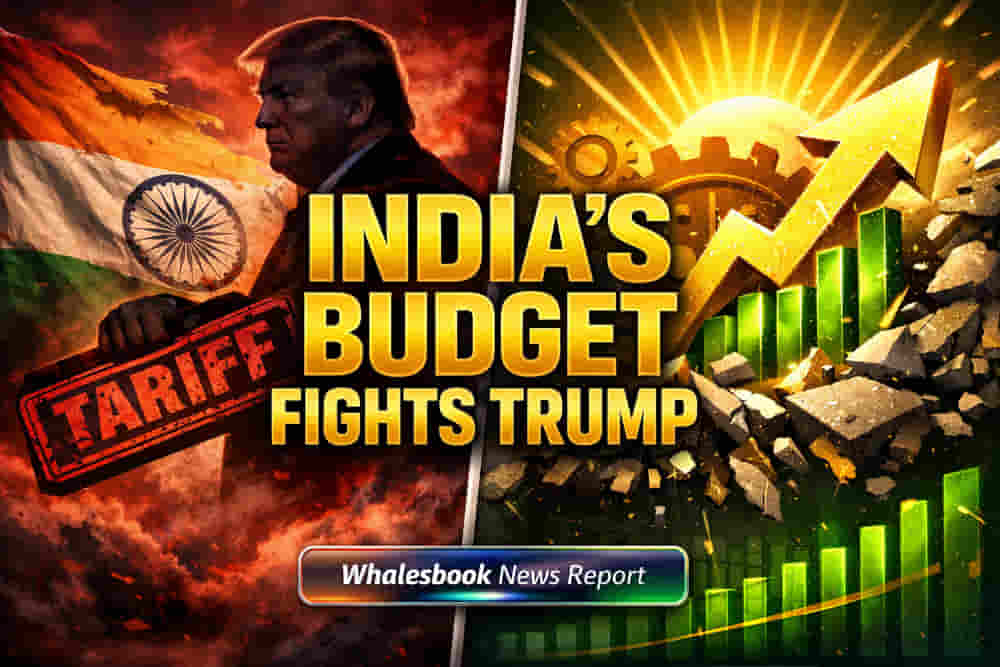
### Strategic Economic Response to Global Pressures
Against a backdrop of escalating global trade tensions and specific retaliatory tariffs imposed by the United States, the Union Budget 2026 outlines a dual-pronged strategy. Finance Minister Nirmala Sitharaman presented a fiscal plan designed to enhance economic resilience and sustain growth momentum. India is positioned as a notable bright spot in the global economy, with real GDP projected to grow by 7.4% in FY2025-26 and an anticipated 6.8-7.2% for FY2027. The nominal GDP growth for FY2026-27 is underpinned by an assumption of around 10.0% to 11%, reflecting a policy intent to leverage domestic demand and investment to navigate volatile international dynamics. This approach aims to cushion key export sectors while simultaneously fostering domestic industrial capacity.
### Cushioning Exports Amidst Tariff Headwinds
In direct response to steep US duties, which have significantly impacted labour-intensive sectors like textiles and seafood, the Budget 2026 introduces targeted relief measures. For the seafood industry, the limit for duty-free imports of specified inputs for processing exports has been increased from 1% to 3% of the previous year's FOB export turnover. This initiative is particularly relevant as India's seafood exports showed resilience, rising 15.53% to $6.5 billion in April-December 2025-26, despite a decline in shipments to the US, by diversifying to markets like Vietnam and Belgium. The leather and footwear sector, which saw a marginal 0.23% dip in shipments to $3.3 billion during the same period, will benefit from an extension of duty-free import benefits for inputs to cover shoe uppers, alongside an extension of the export obligation period from six months to one year. These measures aim to restore cost competitiveness and support export-oriented industries facing external trade pressures.
### Catalyzing Domestic Manufacturing and Future Industries
A significant focus of the Budget is on bolstering domestic manufacturing through customs duty exemptions. In the defence sector, raw materials imported for the maintenance, repair, or overhaul (MRO) of aircraft parts will be exempt from basic customs duty. The energy transition is a key priority, with exemptions extended to capital goods for manufacturing lithium-ion cells, now including those for battery energy storage systems. Additionally, duty exemptions are proposed for sodium antimonate used in solar glass production and capital goods for critical mineral processing. To further support industrial growth, duty exemptions on specified parts for microwave oven manufacturing were announced. Recognizing the strategic importance of critical minerals, the government plans to establish dedicated rare earth corridors in mineral-rich states, enhancing India's position in the global supply chain for these essential materials.
### Fiscal Prudence and Investment Drive
The Union Budget 2026 demonstrates a commitment to fiscal consolidation while maintaining an expansionary stance on capital expenditure. The government has proposed a 9% increase in capital expenditure to ₹12.2 lakh crore for the fiscal year beginning April 1, 2026. This significant investment is directed towards infrastructure, railways, small businesses, and health sectors. Concurrently, the fiscal deficit is targeted to narrow to 4.3% of GDP, down from an estimated 4.4% in the current year. Government debt is projected to decline marginally to 55.6% of GDP from 56.1%, reflecting a careful balancing act between growth stimulus and fiscal responsibility.