 Whalesbook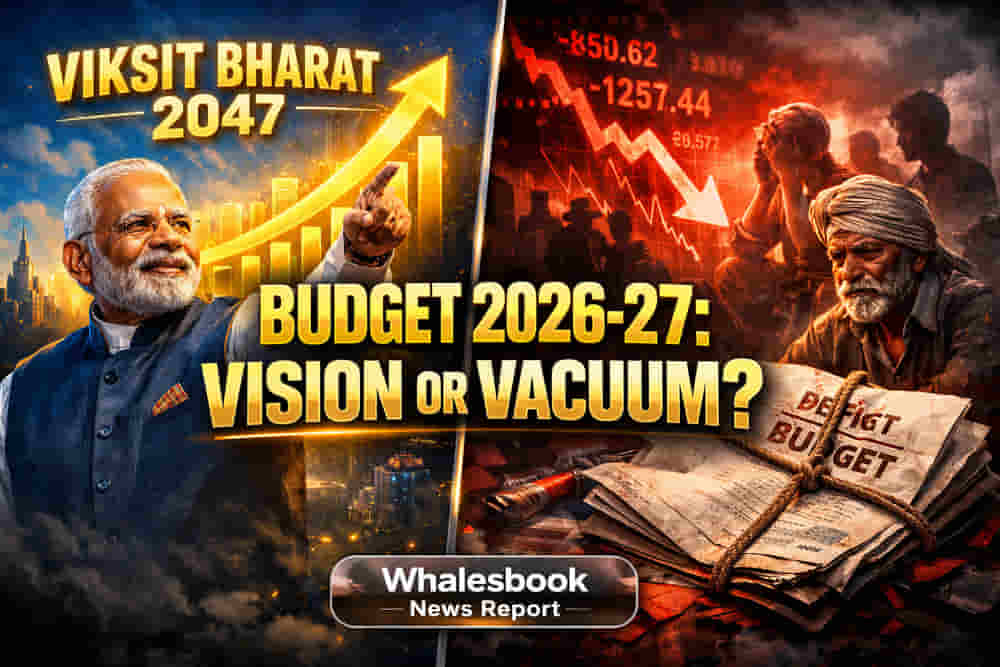
1. THE SEAMLESS LINK
The immediate market reaction to India's Union Budget 2026-27 was severe, with benchmark indices experiencing a significant downturn. This sell-off occurred despite the government's narrative framing the budget as a foundation for a developed India by 2047, emphasizing reforms and enhanced capital expenditure. The disconnect between official pronouncements and market sentiment, fueled by opposition critiques and specific tax proposals, painted a picture of immediate investor apprehension.
2. THE STRUCTURE (The 'Smart Investor' Analysis)
Market Whiplash Post-Budget Announcement
The Union Budget 2026-27 triggered a sharp negative reaction in Indian equity markets. The benchmark Sensex plunged by approximately 1,500 points, and the Nifty 50 index also recorded substantial losses, trading significantly lower on budget day. Analysts largely attributed this decline to the government's decision to hike the Securities Transaction Tax (STT) on derivatives trading, specifically raising STT on futures to 0.05% from 0.02% and on options to 0.15%. This move is perceived by traders as an attempt to curb speculation but is feared to reduce market liquidity and impact trading volumes.
Fiscal Pillars Versus Opposition Fault Lines
Finance Minister Nirmala Sitharaman presented a budget that aimed to balance growth with fiscal prudence. A key highlight was the increased capital expenditure (capex) target, set at ₹12.2 lakh crore for FY27, an increase from the ₹11.2 lakh crore earmarked for the current fiscal. The fiscal deficit for FY27 is projected to narrow to 4.3% of GDP, down from an estimated 4.4% in FY26. The government's narrative, championed by Prime Minister Narendra Modi, positioned the budget as a 'milestone' on India's reform journey towards a 'Viksit Bharat' by 2047.
However, opposition parties vehemently criticized the budget, labeling it as 'underwhelming,' 'opaque,' and disconnected from ground realities. Rahul Gandhi, Leader of the Opposition, stated the budget was "blind to India's real crises," highlighting ignored issues such as youth unemployment, declining manufacturing, farmer distress, and plummeting household savings. Mamata Banerjee, Chief Minister of West Bengal, dismissed the budget as a "Humpty Dumpty" and "directionless" document, accusing the Centre of political bias and neglecting her state. Mallikarjun Kharge, Congress president, asserted that the government "had run out of ideas" and the budget offered "not a single solution" to the nation's economic and social challenges.
Industry reactions were mixed. While some praised the focus on infrastructure and manufacturing, others expressed concerns. The Economic Survey 2025-26 projected India's real GDP growth at 6.8-7.2% for FY27, acknowledging global economic uncertainties. Historically, market reactions to the Indian budget have been volatile, with mixed outcomes on budget day over the past decade, often driven by the gap between expectations and actual policy signals rather than the speech itself. The current market P/E ratio for Nifty 50 stands around 22.12, suggesting a potentially high valuation that makes markets sensitive to adverse announcements.
3. THE FUTURE OUTLOOK
The government's stated intent is to continue its focus on capital expenditure and fiscal consolidation, aiming to foster sustainable growth. The budget's proposals, particularly in infrastructure, manufacturing, and technology sectors like data centers receiving tax holidays, are designed for long-term economic development. However, immediate investor sentiment, influenced by tax changes and opposition critiques, suggests continued volatility as the market digests the budget's implications against a backdrop of global economic headwinds.